
 Algeria
 Egypt
 Libya
 Morocco
 Sudan
 Tunisia
 Benin
 Cabo Verde
 Côte d'Ivoire
 Ghana
 Guinea
 Guinea-Bissau
 Liberia
 Mali
 Mauritania
 Niger
 Nigeria
 Senegal
 Sierra Leone
 The Gambia
 Togo
 Cameroon
 Central African Republic
 Chad
 DR Congo
 Equatorial Guinea
 Gabon
 Republic of the Congo
 São Tomé and Príncipe
 Burundi
 Comoros
 Djibouti
 Eritrea
 Ethiopia
 Kenya
 Madagascar
 Malawi
 Mauritius
 Mozambique
 Rwanda
 Seychelles
 Somalia
 South Sudan
 Tanzania
 Uganda
 Angola
 Botswana
 Eswatini
 Lesotho
 Namibia
 South Africa
 Zambia
 Zimbabwe
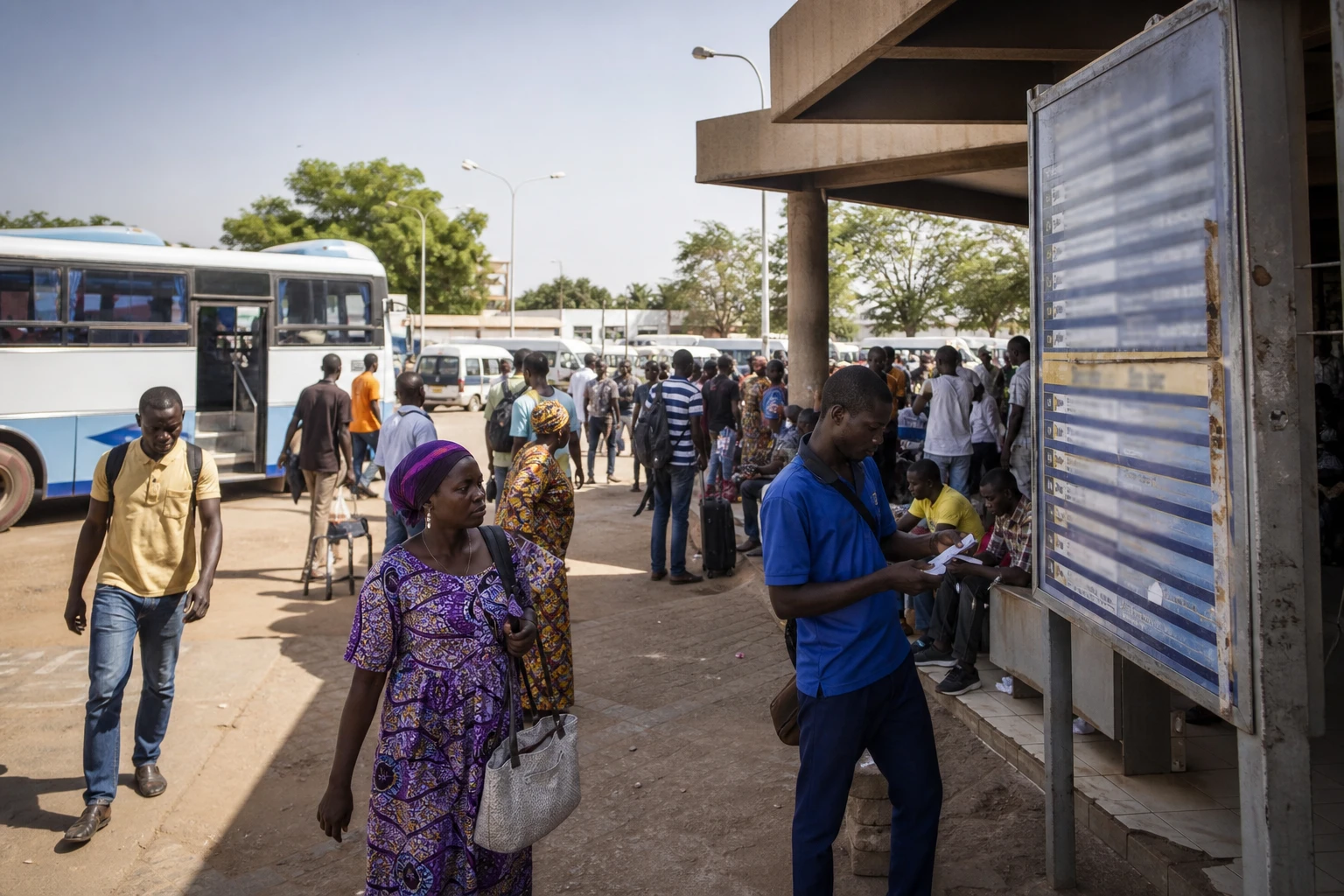
In Ouagadougou, the fourth anniversary of Ibrahim Traoré’s rule is about more than slogans of sovereignty or criticism from his opponents. It raises a more concrete question: how can a regime born of a promise to restore the state safeguard security, civil liberties and a credible political future ?
Four years after the coup, power has become centralised
Captain Ibrahim Traoré took power on 30 September 2022, after overthrowing Lieutenant-Colonel Paul-Henri Sandaogo Damiba. The break came in a Burkina Faso already weakened by attacks from armed groups linked to Al-Qaeda and the Islamic State organisation.
Since then, the head of the transition has gradually concentrated decision-making powers around the presidency and the military apparatus. The government presents this centralisation as a response to the security emergency. Its critics see it instead as the lasting establishment of a system in which political control takes precedence over public debate.
Burkinabè journalist Newton Ahmed Barry, a former president of the Independent National Electoral Commission who is now in exile, believes Ibrahim Traoré is moving away from Thomas Sankara’s legacy. His analysis, given in an interview broadcast in 2026, focuses on the concentration of power and the shrinking space for dissent.
Comparisons with Sankara remain sensitive in Burkina Faso. They evoke a historical figure associated with administrative discipline, popular mobilisation and a determination to bring about social change. They are not, however, enough to establish an equivalence between the two periods. The security, regional and international contexts are different.
Security remains the regime’s main test
The Burkinabè government puts the recovery of territory at the heart of its legitimacy. It relies on the National Armed Forces and the Volunteers for the Defence of the Homeland, civilian auxiliaries mobilised alongside the army. This strategy can strengthen the state’s presence in some areas, but it also exposes civilians and fighters to serious risks.
Armed groups retain significant operational capacity in several regions. Available information is difficult to verify because access to affected areas is limited and the authorities communicate selectively about operations. Human rights organisations also accuse state forces and their auxiliaries of abuses against civilians, while the authorities denounce violence by jihadist groups.
This dual reality complicates the official narrative. Some Burkinabè welcome the recovery of certain infrastructure, the equipping of the forces and local production initiatives. Others, particularly in exposed rural areas, consider protection inadequate. For displaced families, farmers and traders, sovereignty is measured first by the ability to travel, farm and sell without fear of attack.
The security record therefore cannot be assessed solely from Ouagadougou. The capital enjoys greater political and economic visibility than the provinces of the Sahel, East or North. The gap between national announcements and people’s daily experience remains one of the government’s main challenges.
Political renewal that reduces pluralism
The shrinking of civic space is the other major development of the past four years. In February 2026, the Transitional Legislative Assembly adopted the repeal of laws governing political parties, their public funding and the status of the opposition. The government presented the decision as a step towards national renewal.
In January 2026, the authorities had already dissolved political parties. The measure removed the traditional structures of electoral competition and strengthened the role of organisations supportive of the transition. The authorities say parties contributed to divisions in the country. For civil liberties advocates, their disappearance deprives citizens of an organised forum for debate and challenge to government decisions.
The press operates in an equally restrictive environment. Media outlets must work under the pressure of the security situation, administrative restrictions and increased scrutiny of content deemed harmful to the war effort. Human Rights Watch says the repression of dissent, the media and the opposition intensified in 2025.
This affects different groups in different ways. Figures close to the government have direct access to official channels. Independent organisations, critical journalists and the families of people forcibly mobilised face greater difficulties in making their concerns public. In cities, social media amplify expressions of support or opposition. In rural areas, access to independent information remains more limited.
Economic sovereignty and a regional break
Ibrahim Traoré has built part of his popularity on economic sovereignty. The government wants to increase the local processing of resources, strengthen domestic production and reduce dependence on foreign partners. The opening of the first gold refinery in September 2026 illustrates this approach. The stated aim is to process and certify a greater share of the gold in Burkina Faso.
This policy could increase the value retained locally, provided that contracts are transparent, workers are safe and production is traceable. It will not, on its own, remove constraints related to infrastructure, financing and instability in mining areas.
Diplomatically, Burkina Faso has moved away from France and strengthened its ties with Russia. It now works with Mali and Niger in the Alliance of Sahel States, which has become a confederation bringing together the three military regimes. In January 2025, these countries left the Economic Community of West African States, ECOWAS, an organisation tasked in particular with promoting economic integration and regional political cooperation.
This break gives the leaders of the Alliance of Sahel States greater room for manoeuvre. It nevertheless complicates the movement of people, trade and coordination with other West African countries. The consequences will be closely watched by informal operators, transporters and families who regularly cross borders.
The next challenge: turning popularity into institutions
Four years after the coup, Ibrahim Traoré retains a considerable ability to mobilise part of the population around sovereignty, the fight against terrorism and rejection of former tutelage. This support should not, however, be confused with a freely contested electoral mandate.
The central question now concerns institutions. Can Burkina Faso restore pluralistic political life, guarantee an open media environment and subject security forces to oversight mechanisms ? The answer will weigh as heavily on the regime’s domestic legitimacy as on its relations with ECOWAS and the African Union.
The government will also have to show that its announced economic projects deliver lasting benefits for households, rather than merely serving as political symbols. The gold refinery, infrastructure and agricultural programmes will be judged on their governance, the jobs they create and their impact beyond Ouagadougou.
Burkina Faso is thus entering a new phase. The military transition can no longer be presented as a brief interlude. It has become a political, security and regional system. Its strength will depend on its ability to protect the population while making real room for criticism, representation and public accountability.



