Algeria
 Egypt
 Libya
 Morocco
 Sudan
 Tunisia
 Benin
 Cabo Verde
 Côte d'Ivoire
 Ghana
 Guinea
 Guinea-Bissau
 Liberia
 Mali
 Mauritania
 Niger
 Nigeria
 Senegal
 Sierra Leone
 The Gambia
 Togo
 Cameroon
 Central African Republic
 Chad
 DR Congo
 Equatorial Guinea
 Gabon
 Republic of the Congo
 São Tomé and Príncipe
 Burundi
 Comoros
 Djibouti
 Eritrea
 Ethiopia
 Kenya
 Madagascar
 Malawi
 Mauritius
 Mozambique
 Rwanda
 Seychelles
 Somalia
 South Sudan
 Tanzania
 Uganda
 Angola
 Botswana
 Eswatini
 Lesotho
 Namibia
 South Africa
 Zambia
 Zimbabwe
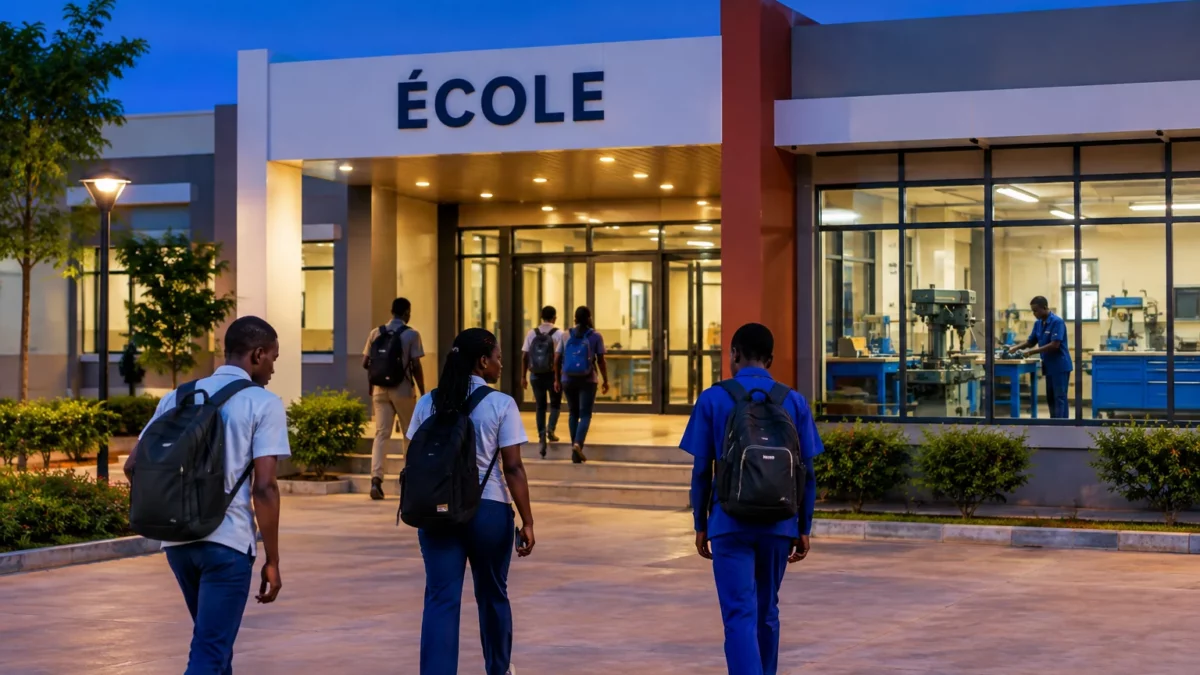
A factory can be equipped with modern machinery yet lack the ability to maintain it or improve its processes locally. In Burkina Faso, the opening of a technology academy in Pabré raises precisely this question: how can the skills being taught be matched to the real needs of industrial plants?
Developing technical skills in a country undergoing major change
Burkina Faso is seeking to process more raw materials within its borders, as the authorities emphasise national control of resources and expertise. This approach has a particular regional dimension: since 29 January 2025, the country has no longer been part of the Economic Community of West African States (ECOWAS), which it left alongside Mali and Niger. The organisation’s Commission has nevertheless provisionally maintained certain free-movement and trade arrangements to preserve people’s daily lives.
In this landscape, the Alliance of Sahel States (AES), which brings together these three countries, provides another framework for political co-operation. But the ability to industrialise also depends on very practical factors: training, access to equipment, a reliable supply of materials and commercial outlets. Opening a school alone will not resolve these challenges. It can, however, help strengthen the skills needed to address them.
The Faso Technology Academy (ATF), located in Pabré, near Ouagadougou, was inaugurated on 23 November 2026 by President Ibrahim Traoré. Its first cohort comprises 250 students, selected from among baccalaureate holders in science and technology streams. After two years of core studies, they are to specialise in eleven fields, including mining, metallurgy, energy, civil engineering, telecommunications, cybersecurity, nuclear technology and aeronautics.
The campus covers about 60 hectares and includes workshops, laboratories, an industrial forge, lecture halls and accommodation. The government had put the cost of the first phase at CFAF 37.37 billion, financed from the state budget. Burkinabè media have also reported this figure and the size of the first cohort.
Potential career paths, but no guarantees yet
Several recent investments illustrate the sectors in which technical skills could be put to use. In Bobo-Dioulasso, TEXFORCES-BF was inaugurated on 9 September 2026. The textile plant brings together several stages of production, from weaving to garment-making. The authorities have announced an annual capacity of up to 20 million metres of fabric and 4 to 6 million garments. These figures describe stated capacity, not necessarily production already achieved at that level.
Operating such a production chain requires a range of skills: machine operation, maintenance, quality control, dyeing management and process improvement. Some jobs may also be in logistics, management and production. The question is whether ATF students will be able to take up internships and work on projects at these facilities, particularly in Bobo-Dioulasso, far from the Pabré campus.
In the gold sector, RAFFINOR-BF was inaugurated in Ouagadougou on 28 September 2026. The refinery has announced an initial refining capacity of 164 tonnes of gold a year, with a smelter and an analysis laboratory. The activity could draw on skills in metallurgy, chemistry and process control. The company has also announced 100 direct jobs, without detailing the share of positions intended for engineers or specialised technicians.
These two examples give an idea of possible industrial applications, but are not enough to measure demand for graduates. Needs will depend on the actual pace of production, the availability of raw materials and companies’ recruitment choices. Announced capacity alone is not enough to conclude that a specific number of skilled jobs will be created.
Links between campus, companies and regions will be decisive
Ongoing partnerships will be essential to turn training into professional experience. Supervised internships, applied research projects and regular exchanges with industry could help students work on practical problems: breakdowns, productivity, energy consumption, product quality or waste treatment. These links could also support local businesses specialising in maintenance, analysis and parts supply.
The challenge also concerns how the benefits are distributed across the country. The campus is in Pabré, near the capital, while TEXFORCES-BF is based in Bobo-Dioulasso and other activities are developing elsewhere. Students will need to be able to travel between these centres. Companies, for their part, will need to define the skills they require and contribute to training if they want to recruit locally.
Across West Africa, the initiative reflects a broader trend: several countries are seeking to capture more value added in textiles and mineral resources. For Burkina Faso, the impact of the ATF will therefore be measured less by the number of courses it offers than by the equipment its graduates can actually operate, the innovations they develop and the career paths open to them. The next steps to watch are the establishment of partnerships with factories and students’ access to workshops and laboratories during their studies.