
 Algeria
 Egypt
 Libya
 Morocco
 Sudan
 Tunisia
 Benin
 Cabo Verde
 Côte d'Ivoire
 Ghana
 Guinea
 Guinea-Bissau
 Liberia
 Mali
 Mauritania
 Niger
 Nigeria
 Senegal
 Sierra Leone
 The Gambia
 Togo
 Cameroon
 Central African Republic
 Chad
 DR Congo
 Equatorial Guinea
 Gabon
 Republic of the Congo
 São Tomé and Príncipe
 Burundi
 Comoros
 Djibouti
 Eritrea
 Ethiopia
 Kenya
 Madagascar
 Malawi
 Mauritius
 Mozambique
 Rwanda
 Seychelles
 Somalia
 South Sudan
 Tanzania
 Uganda
 Angola
 Botswana
 Eswatini
 Lesotho
 Namibia
 South Africa
 Zambia
 Zimbabwe
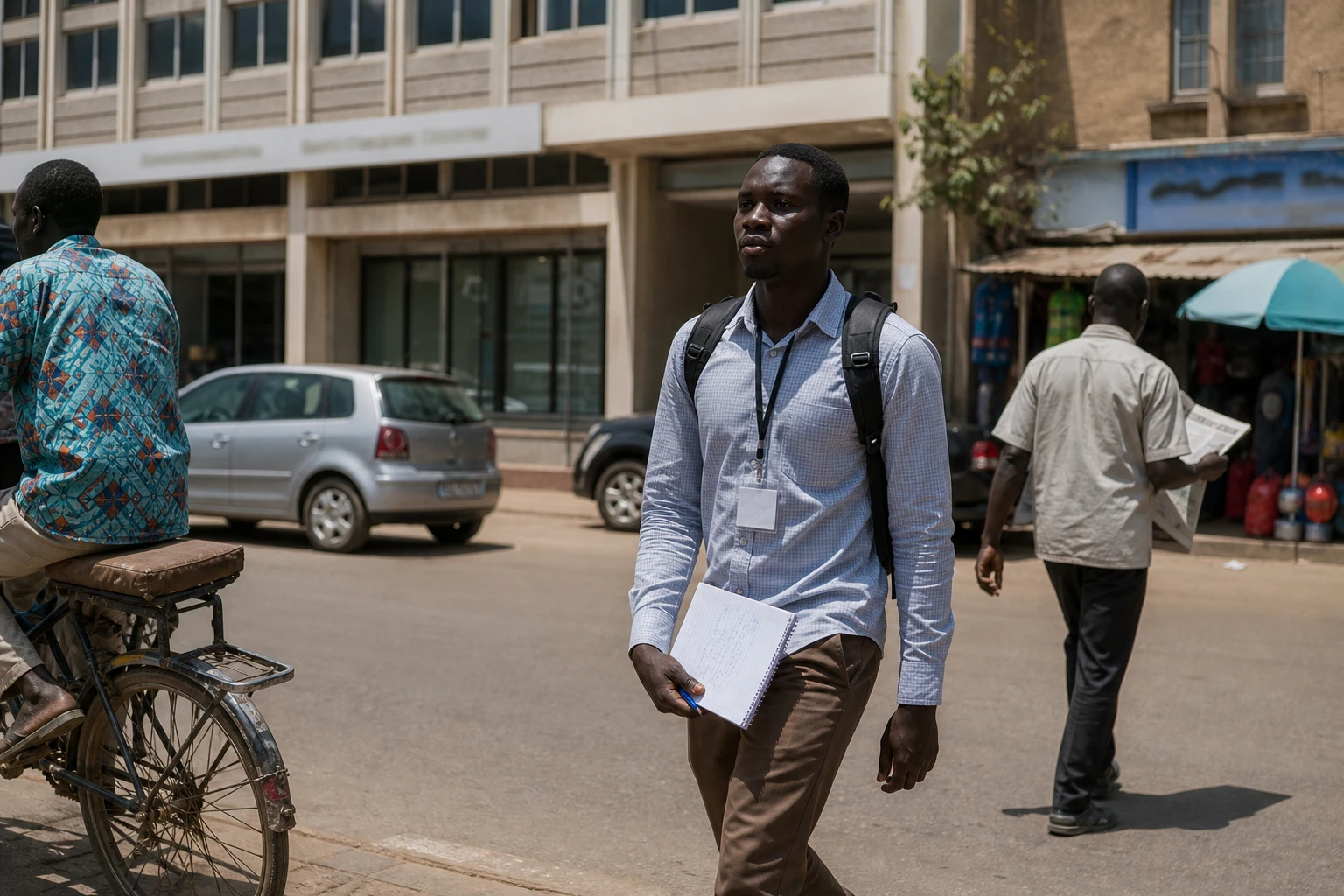
In Burkina Faso, the line between civic duty and discipline is blurring
In Ouagadougou, the question is no longer only about the front line. It also concerns public life, freedom of expression and the place given to journalists in a country that has been at war with armed groups for more than a decade. In this context, bringing media professionals into a military programme raises a simple question: when does patriotism become a constraint on editorial independence?
Burkina Faso remains under military transition rule following the September 2022 coup, in a profoundly reshaped West African region. Since 29 January 2025, the country has left ECOWAS, alongside Mali and Niger, further weakening the traditional frameworks for regional dialogue. At the same time, the Burkinabè authorities have stepped up their rhetoric of national mobilisation around security, sacrifice and sovereignty.
Forty-four journalists under supervision for six days
The episode that has sparked controversy lasted six days at a police academy near Ouagadougou. Forty-four journalists from public and private media took part in what the authorities describe as a “patriotic immersion”. According to footage broadcast by public television, participants wore military fatigues and held training weapons under the supervision of Communications Minister Pingdwende Gilbert Ouedraogo, who asked them whether they would be “patriotic and professional” journalists.
The government places the initiative within the context of the war against groups affiliated with al-Qaeda and the Islamic State, which have been active in the country for more than a decade. The official argument is familiar: in a situation of prolonged insecurity, institutions must close ranks and promote habits of civic discipline. The Burkinabè authorities have already defended similar mechanisms, such as the “patriotic immersion” imposed on pupils admitted to school examinations and later extended to other categories of citizens in recent government texts.
This time, the signal is more sensitive because it affects the press. Journalists are not participants in the war effort. Their role is to inform, verify and maintain distance from official narratives as well as accounts of the crisis. In practice, formally associating journalists with a military setting blurs that boundary and weakens a profession already under pressure.
A press under pressure for several months
The criticism has not emerged in a vacuum. Since 2023, and especially in 2024, several international organisations have described a marked narrowing of civic space in Burkina Faso. Human Rights Watch, Civicus, Amnesty International, the CPJ and RSF have documented media suspensions, the detention of journalists, summonses under the general mobilisation regime and, in some cases, disputed forced conscription, challenged by families and professional organisations.
The most troubling cases remain those of journalists who have disappeared or been taken by force, as reported by several human rights organisations during 2024 and 2025. Human Rights Watch has described journalists reappearing in military uniform in videos circulating online, while the civil rights organisation Civicus has spoken of the growing use of general mobilisation to silence critical voices. RSF, for its part, has continued to raise the alarm over the fate of Burkinabè journalists reported missing.
The authorities, for their part, defend a national security rationale. But that rationale comes at a democratic cost. When the state links patriotism with obedience, public criticism can be recast as a moral failing. For newsrooms in Ouagadougou and in the regions, the risk is twofold: self-censorship out of caution, followed by an impoverishment of public debate. Private media, often more economically vulnerable, are the most exposed; public media, meanwhile, find themselves more directly aligned with the government’s narrative.
A test of the regime’s proclaimed sovereignty
The Burkinabè government presents itself as the defender of reclaimed sovereignty. This message resonates with a significant section of public opinion, particularly in a country battered by armed attacks and population displacement. But sovereignty is not limited to holding territory. It also means being able to tolerate dissent, protect checks and balances, and ensure that information circulates without military pressure.
Regionally, the issue matters beyond Burkina Faso alone. Withdrawal from ECOWAS has deepened the country’s institutional isolation while strengthening political and security ties with Mali and Niger within the Alliance of Sahel States. In this new setting, the authorities emphasise their break with regional frameworks they consider too restrictive. But that rupture also deprives journalists and civil society of some of the regional support mechanisms that had previously made it easier to challenge abuses.
For the population, the stakes are tangible. In cities, information still circulates, but under increasing surveillance. In rural areas affected by insecurity, local radio stations and correspondents often play an essential role in warning, explaining and documenting. If these actors are seen as auxiliaries of the security apparatus, public trust may fracture. Yet in a context of diffuse conflict, that trust is often the last line of defence against rumour, propaganda and unverified information.
The significance of this episode therefore extends beyond the case of the 44 journalists. It says something about Burkina Faso’s political trajectory: a transition that continues to rely on patriotic mobilisation while reducing the space for dissent. The next point to watch is not only the response of professional organisations. It is also how the authorities will turn this immersion into a lasting precedent for the entire Burkinabè media sector — or whether they will not.



