
 Algeria
 Egypt
 Libya
 Morocco
 Sudan
 Tunisia
 Benin
 Cabo Verde
 Côte d'Ivoire
 Ghana
 Guinea
 Guinea-Bissau
 Liberia
 Mali
 Mauritania
 Niger
 Nigeria
 Senegal
 Sierra Leone
 The Gambia
 Togo
 Cameroon
 Central African Republic
 Chad
 DR Congo
 Equatorial Guinea
 Gabon
 Republic of the Congo
 São Tomé and Príncipe
 Burundi
 Comoros
 Djibouti
 Eritrea
 Ethiopia
 Kenya
 Madagascar
 Malawi
 Mauritius
 Mozambique
 Rwanda
 Seychelles
 Somalia
 South Sudan
 Tanzania
 Uganda
 Angola
 Botswana
 Eswatini
 Lesotho
 Namibia
 South Africa
 Zambia
 Zimbabwe
A rural facility, but a national signal
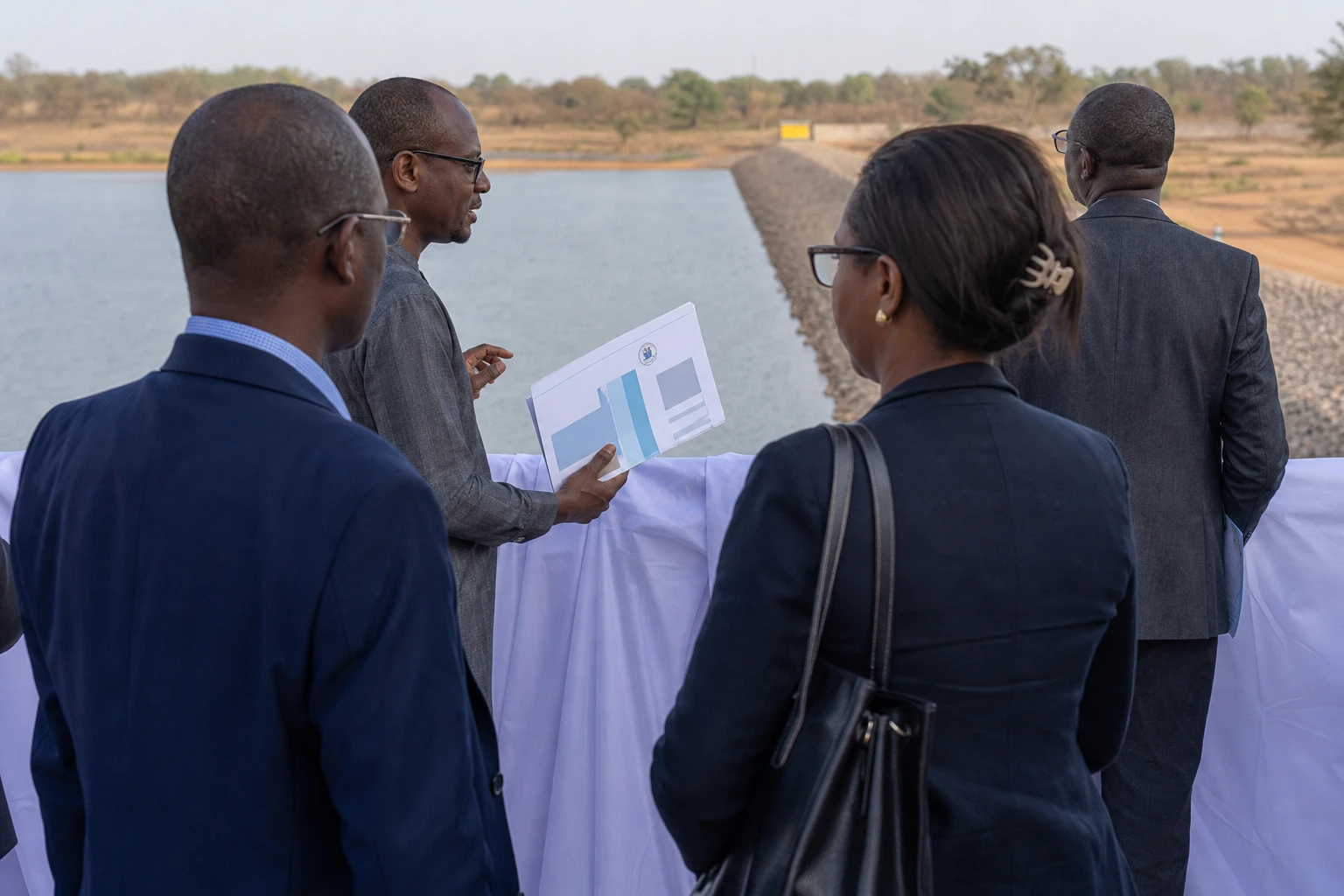
In Burkina Faso’s central-western region, water is never merely a technical issue. It determines an agricultural season, a family income, a journey between two villages, and sometimes even the stability of a territory. The refilling of Goulouré dam, in Kokologho, Boulkiemdé, reflects this practical reality: restoring to a rural area a tool for production, mobility and water security.
The project also says something about Burkina Faso’s current strategy. Since 2024, ONBAH, the National Office for Dams and Hydro-Agricultural Development, has taken over from the former AGETEER and presents itself as a lever for food sovereignty — that is, the ability to produce more locally through control of water. On its website, the Office sets out a programme for 2026 to 2030 that aims to build eleven new dams, rehabilitate 24 and reinforce or dredge more than 100 structures.
From the 1998 collapse to refilling in 2026
Goulouré dam was built in 1956 with an initial capacity of 80,000 m³, according to the Ministry of Agriculture, Water, Animal and Fisheries Resources. The structure collapsed in 1998 after a severe flood. For years, the local population therefore lived without this water-retention facility, with direct effects on crops, livestock and travel.
Reconstruction began in April 2025 and was announced as completed in June 2026 by the ministry. The dam was refilled on Saturday 1 August 2026, following a project described as having been carried out in nine months and funded entirely from the state budget for the 2025 financial year.
One point warrants caution. The public documents consulted do not give exactly the same final capacity. The ministry’s page cites 1,023,000 m³, while ONBAH’s project sheet gives 806,691 m³ for the reconstruction of Goulouré. The overall trend, however, is clear: the structure has been substantially enlarged compared with its original volume.
What a dam changes in an agricultural commune
In an area such as Kokologho, a rehabilitated dam does more than retain rainwater. It shapes the local economy. It can secure irrigated areas, support dry-season market gardening, improve water availability for animals and pave the way for small-scale fish farming. It is often at this very local level that part of rural Burkina Faso’s resilience is built.
The government is highlighting the prospect of more stable incomes for producers. The stakes are tangible: a functioning dam makes it possible to spread out harvests, reduce dependence on a single rainy season and limit vulnerability to climate fluctuations. In a Sahelian country exposed to irregular rainfall, this type of infrastructure is valuable as much for the water it stores as for the time it gives back to agriculture. This assessment is consistent with ONBAH’s stated strategy on water security and hydro-agricultural development.
The project also has another, often less visible, effect. The ministry said that a crossing structure had been built to prevent traffic disruptions during the rainy season. In practice, that means more reliable journeys to markets, schools, health centres and collection points. For rural households, this detail matters as much as the volume of water stored.
One part of a broader effort in Burkina Faso
Goulouré is not an isolated case. For several months, Burkina Faso’s authorities have been undertaking hydraulic projects and dredging structures in several provinces. The aim is to combine flood prevention, the preservation of useful water supplies and support for production. In Ouagadougou and across the regions, water is becoming a tool for development, not merely a public service.
This approach has regional significance. Burkina Faso is part of a West African area where population pressure, climate irregularity and dependence on rainfall make storage infrastructure essential. In this context, building and rehabilitating dams is about more than civil engineering. It affects food security, rural employment and states’ ability to cushion shocks. ECOWAS, although politically weakened since the announced departure of some Sahelian states, remains the historic framework for this West African interconnection.
For Burkina Faso, the Goulouré project ultimately makes one simple point: the battle to increase production is also fought in reservoirs, rural tracks and small irrigated plains. This is where the promise of food sovereignty advanced by the authorities is measured in very concrete terms. And it is here that future public spending decisions will be watched, both in Boulkiemdé and nationally.



