Algeria
 Egypt
 Libya
 Morocco
 Sudan
 Tunisia
 Benin
 Burkina Faso
 Cabo Verde
 Côte d'Ivoire
 Ghana
 Guinea
 Guinea-Bissau
 Liberia
 Mali
 Mauritania
 Niger
 Nigeria
 Senegal
 Sierra Leone
 The Gambia
 Togo
 Cameroon
 Central African Republic
 Chad
 DR Congo
 Equatorial Guinea
 Gabon
 Republic of the Congo
 São Tomé and Príncipe
 Burundi
 Comoros
 Djibouti
 Eritrea
 Ethiopia
 Kenya
 Madagascar
 Malawi
 Mauritius
 Mozambique
 Rwanda
 Seychelles
 Somalia
 South Sudan
 Tanzania
 Uganda
 Angola
 Botswana
 Eswatini
 Lesotho
 Namibia
 Zambia
 Zimbabwe
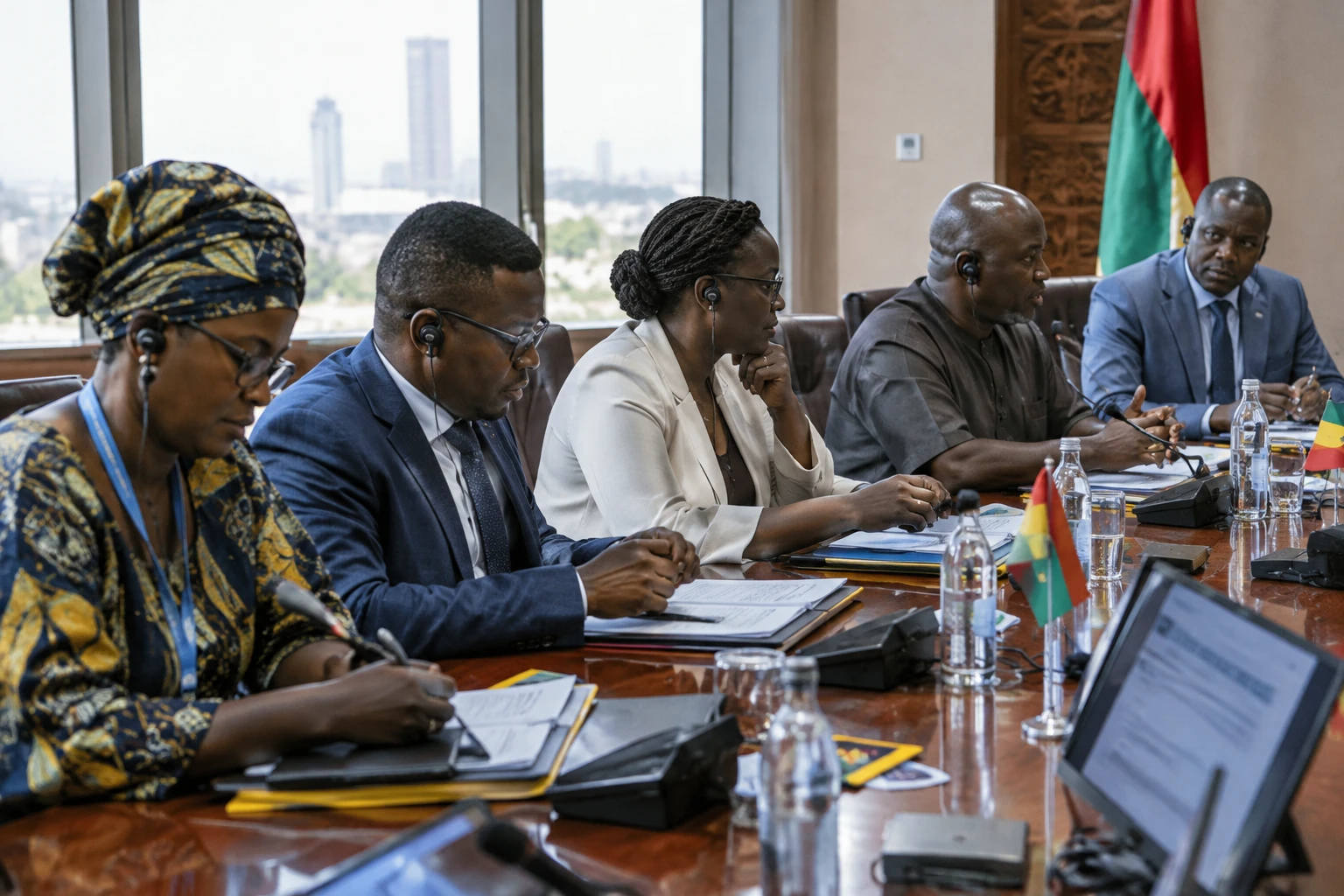
Mining gold is not enough to exert influence over its market. For producing countries, the question is also where the metal is refined, made into jewellery, bought as a reserve and sold to investors. Burkina Faso has just added a piece to this equation, but a refinery alone does not guarantee a local value chain.
A global market organised far from the mines
The continent is home to several major producers, from Ghana and Burkina Faso in West Africa to Tanzania and South Africa. Yet the main centres of consumption and investment are elsewhere. The World Gold Council estimates that in 2025 investment accounted for 43% of demand, jewellery 29%, central bank purchases 21% and technology uses 6%. These shares are rounded.
The figures illustrate the scale of this disconnect. Global investment demand reached 2,175.3 tonnes in 2025, driven in particular by bars, coins and exchange-traded funds, financial products backed by gold. China and India were among the largest markets for bars and coins. Gold funds also recorded strong growth. The World Gold Council’s data on investment in 2025 shed light on this concentration of demand.
Central banks are another strategic outlet. In 2025, they made net purchases of 863.3 tonnes, according to the same organisation. In Ghana, Zimbabwe and Egypt, authorities have increased their reserves in recent years. These decisions reflect distinct national strategies: diversifying reserves, reducing exposure to certain currencies or better linking mining output to the state’s financial needs. They do not, however, mean that local economies control all sales and processing channels.
Burkina Faso’s refinery: a step and a test
In Ouagadougou, the national refinery RAFFINOR-BF was inaugurated on 28 September 2026. The Burkinabe government presents the facility as a way to process gold mined in the country on site. The company says it has an initial capacity of 164 tonnes a year and a purity of 99.99%. These specifications have been announced by the operator and the authorities; they do not yet indicate the volumes actually refined or the share of national output that will be sent there.
The project is part of a regional trend: several governments want to capture more value before exports. In Ghana, GoldBod, the public body tasked with organising the gold trade, has also taken steps to formalise the jewellery trade and develop a “Ghana Gold Village”. Similar ambitions do not mean the models are identical: purchasing rules, operators and oversight arrangements vary from country to country.
In the countries of the West African Economic and Monetary Union (WAEMU), including Burkina Faso, Mali and Côte d’Ivoire, local refining capacity could facilitate the certification and marketing of gold. But the outcome will depend on practical factors: a regular supply, competitive processing costs, standards recognised by buyers, traceability and access to financial channels. Without these outlets, a plant may operate below capacity or process metal destined for export without generating many related activities.
Processing more, beyond refining
Refining gives a country greater control over one industrial stage, but it does not replace jewellery-making or the manufacture of electronic components. In 2025, technology uses accounted for around 323 tonnes of gold worldwide. This market depends largely on electronics manufacturing supply chains, concentrated in several Asian economies and the United States. The World Gold Council’s technology review highlights the stability of this annual demand, despite changes in the sector.
Jewellery offers another avenue, more directly linked to local skills and consumer markets. Developing workshops, training, brands and sales channels can create jobs that go beyond mining. In Ghana, initiatives around GoldBod are aimed in particular at better organising local manufacturing. Their reach will depend on whether craftspeople can access gold, finance, equipment and markets, as well as on rules that make their businesses viable.
The contrast between production and processing also calls for caution when making comparisons. Africa supplies a significant share of the world’s mined gold, but available demand statistics do not always provide a detailed picture of consumption, artisanal manufacturing or informal trade in each country. The absence of a country from a global chart therefore does not mean that there is no local demand; it may also point to incomplete data or categories that are difficult to measure.
Value also depends on rules and traceability
For governments, control over purchases and exports can improve revenue collection and knowledge of flows. For artisanal miners, traders and jewellers, these rules can open access to formal channels, but may also bring costs and procedures. The effects will not be uniform: large companies generally have different resources from small-scale mines and independent workshops.
Traceability is a central issue. It makes it possible to document the origin of the metal and meet buyers’ requirements, but requires credible checks throughout the supply chain. In mining areas and in capitals where government agencies and industrial facilities are concentrated, the benefits will also depend on how revenues are distributed, on training and on links with local suppliers.
RAFFINOR-BF therefore marks an industrial step, not a conclusion. Monitoring will need to cover its actual volumes, supplies, outlets and the share of value that remains in the country. Across West Africa, the question goes beyond refined metal: it concerns each state’s ability to link mining, public oversight, processing and regional demand, without confusing installed capacity with economic benefits already secured.