
 Algeria
 Egypt
 Libya
 Morocco
 Sudan
 Tunisia
 Benin
 Cabo Verde
 Côte d'Ivoire
 Ghana
 Guinea
 Guinea-Bissau
 Liberia
 Mali
 Mauritania
 Niger
 Nigeria
 Senegal
 Sierra Leone
 The Gambia
 Togo
 Cameroon
 Central African Republic
 Chad
 DR Congo
 Equatorial Guinea
 Gabon
 Republic of the Congo
 São Tomé and Príncipe
 Burundi
 Comoros
 Djibouti
 Eritrea
 Ethiopia
 Kenya
 Madagascar
 Malawi
 Mauritius
 Mozambique
 Rwanda
 Seychelles
 Somalia
 South Sudan
 Tanzania
 Uganda
 Angola
 Botswana
 Eswatini
 Lesotho
 Namibia
 South Africa
 Zambia
 Zimbabwe
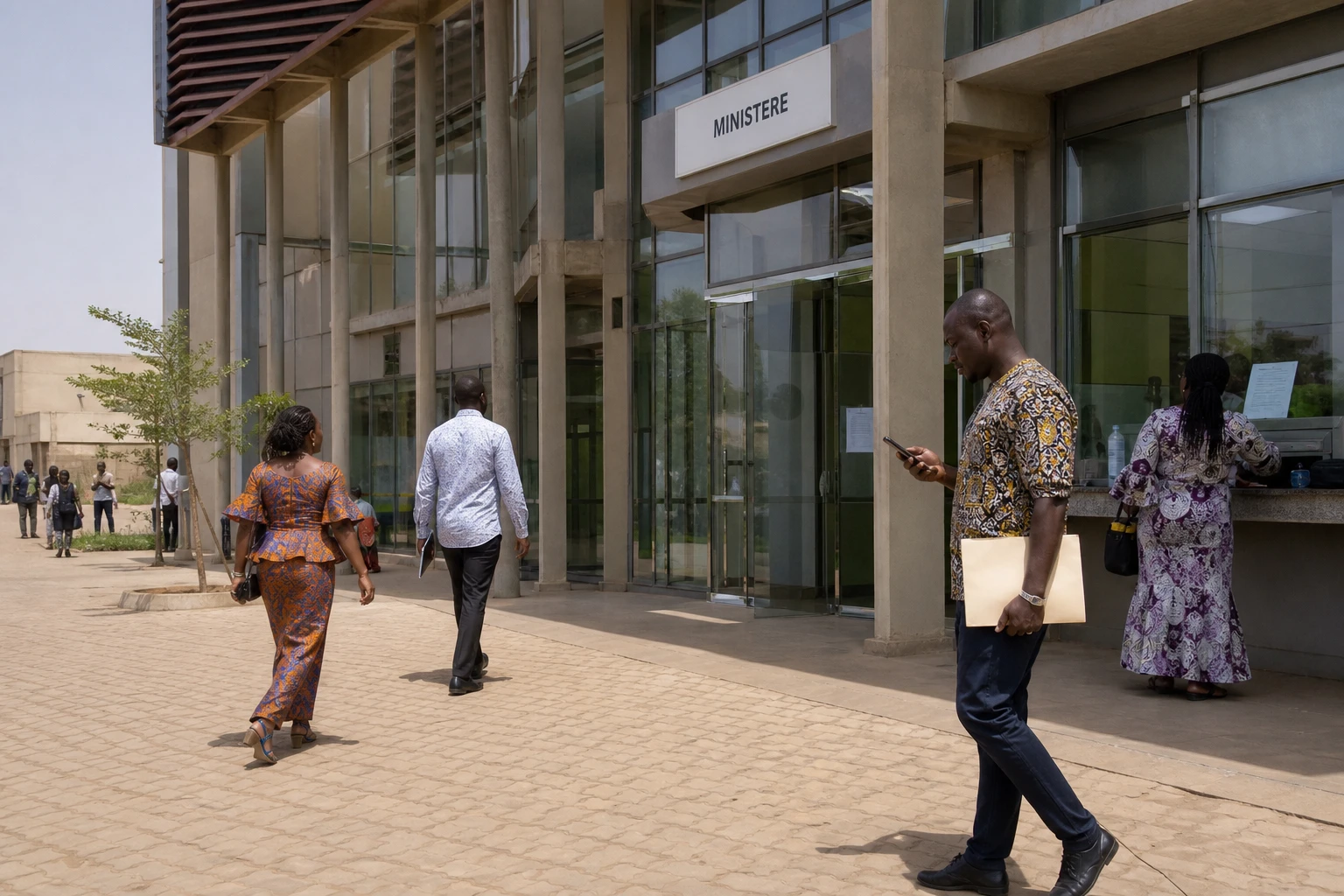
In Ouagadougou, public health is also going digital
In Burkina Faso, the modernisation of the state is no longer taking place only inside ministries. It is now reflected in the journeys of service users, who want to submit a file, track an application or obtain an authorisation without making repeated trips to a service counter. In a sector as sensitive as health, this shift is no minor matter. It directly affects the pace at which private facilities open, relations with partner associations and the administration’s ability to track its decisions.
This change is part of a broader reorganisation of public services in Burkina Faso. For several months, the authorities have been pursuing a number of digitisation projects, including a single portal for administrative procedures and a strategy to centralise the public administration’s digital services. The official Service Public BF website describes the portal as the administration’s single digital entry point.
What e-AGRÉMENT-MS changes for health professionals
The Ministry of Health and Public Hygiene launched the e-AGRÉMENT-MS platform on Friday 7 August to progressively digitise several administrative procedures. The system is intended to allow online submission of applications to open and operate private health facilities, applications for business licences, and requests for agreements with NGOs, associations and foundations. The launch was confirmed in a government statement published on 8 August.
In practice, the aim is straightforward: reduce queues, limit repeated trips to submit files and improve the tracking of documents. The government describes e-AGRÉMENT-MS as a one-stop shop for the ministry’s administrative procedures. Its stated goal is also to improve transparency and traceability. This is consistent with the approach already taken by the national Service Public BF portal, which aims to direct users to official platforms and reduce exposure to fraudulent websites.
The project does not come out of an institutional vacuum. In 2025, Burkina Faso already had dozens of digitised procedures on its national platform, and the authorities continued to expand online services in 2026. The Service Public BF portal now lists 95 digitised procedures and champions a centralised approach. This shows that health is joining a broader administrative trend, already visible in other sectors such as land administration, citizen petitions and identity procedures.
An administrative reform, but also a political signal
The launch of e-AGRÉMENT-MS also has political significance. The Minister for Digital Transition, Posts and Electronic Communications, Aminata Zerbo/Sabané, has for several months argued that digital transformation should improve the quality of public services and strengthen trust between the administration and citizens. This position aligns with the modernisation strategy pursued by Burkina Faso’s executive, which sees digitalisation as both an instrument of administrative sovereignty and a tool for simplification.
In the health sector, this approach is particularly important. The ministry is already working on digital health, with internal solutions, discussions on data interoperability and working documents that refer to strengthening the digital health ecosystem. In other words, e-AGRÉMENT-MS is not an isolated initiative. It is part of a broader shift aimed at linking procedures, data and public-sector management.
This reform has a dual effect, however. For large private-sector players, NGOs and foundations, it could streamline exchanges and make each step clearer. For smaller operators, particularly those based outside Ouagadougou, it raises another question: genuine access to digital services. Without a stable internet connection, support and the ability to navigate online procedures, the promised simplification may remain theoretical. In a country where the administration is seeking to bring its services closer to users, this territorial dimension matters as much as the speed at which files are processed.
The Minister for Digital Transition has described digital transformation as a major lever. The phrase is strong, but it points to a concrete reality: the more traceable a file is, the less room there is for arbitrariness. The more standardised a procedure is, the easier it is to measure delays. And the more users can access an official channel, the more the administration can reduce the risk of opaque intermediaries. That is precisely what the national public services portal promises.
SNDS 2026-2030: Burkina Faso’s health sector between digitalisation, funding and sovereignty
The launch of e-AGRÉMENT-MS comes a few months after the National Health Development Strategy 2026-2030 and its 2026-2028 action plan were approved in Ouagadougou. The Ministry of Health has put the cost of this strategic framework at 3,943.6 billion CFA francs. The plan is intended to strengthen the health system over the long term, as the authorities increasingly speak of health sovereignty.
This framework is important. Burkina Faso is not only seeking to manage its forms more effectively. It also wants to better organise its resources, agreements and investments. Digital health is therefore one part of a wider architecture: domestic financing, human resources, new infrastructure and more transparent governance. The 1000×5 plan, adopted in October 2025, follows the same approach, providing for the recruitment and training by 2030 of 5,000 doctors, pharmacists and dental surgeons a year, as well as other categories of staff.
This approach also resonates across Africa. In March 2026, Ouagadougou hosted health ministers from several countries invited to the first National Forum on Health Financing. Discussions focused on health diplomacy and solidarity among African states. Burkina Faso is thus seeking to place its reforms within a broader regional framework, where medical cooperation, the sharing of digital solutions and the resilience of health systems are common concerns.
The continental significance is clear: in many African countries, public health still faces fragmented administrations, lengthy delays and costly paper-based processes. Burkina Faso’s experience will therefore be watched beyond Ouagadougou. If digitisation genuinely cuts delays and improves file tracking, it could serve as a model for other health administrations in the sub-region, particularly in West Africa. If it runs up against barriers to digital access or interoperability, it will show that a portal alone is not enough to reform a system.
Ultimately, e-AGRÉMENT-MS is less about technological innovation than a change in method. Burkina Faso’s administration is seeking to make procedure a tool for building trust. And in the health sector, that trust matters as much to private operators as it does to patients, associations and the state itself.



