Algeria
 Egypt
 Libya
 Morocco
 Tunisia
 Benin
 Burkina Faso
 Cabo Verde
 Côte d'Ivoire
 Ghana
 Guinea
 Guinea-Bissau
 Liberia
 Mali
 Mauritania
 Niger
 Nigeria
 Senegal
 Sierra Leone
 The Gambia
 Togo
 Cameroon
 Central African Republic
 Chad
 DR Congo
 Equatorial Guinea
 Gabon
 Republic of the Congo
 São Tomé and Príncipe
 Burundi
 Comoros
 Djibouti
 Eritrea
 Ethiopia
 Kenya
 Madagascar
 Malawi
 Mauritius
 Mozambique
 Rwanda
 Seychelles
 Somalia
 South Sudan
 Tanzania
 Uganda
 Angola
 Botswana
 Eswatini
 Lesotho
 Namibia
 South Africa
 Zambia
 Zimbabwe
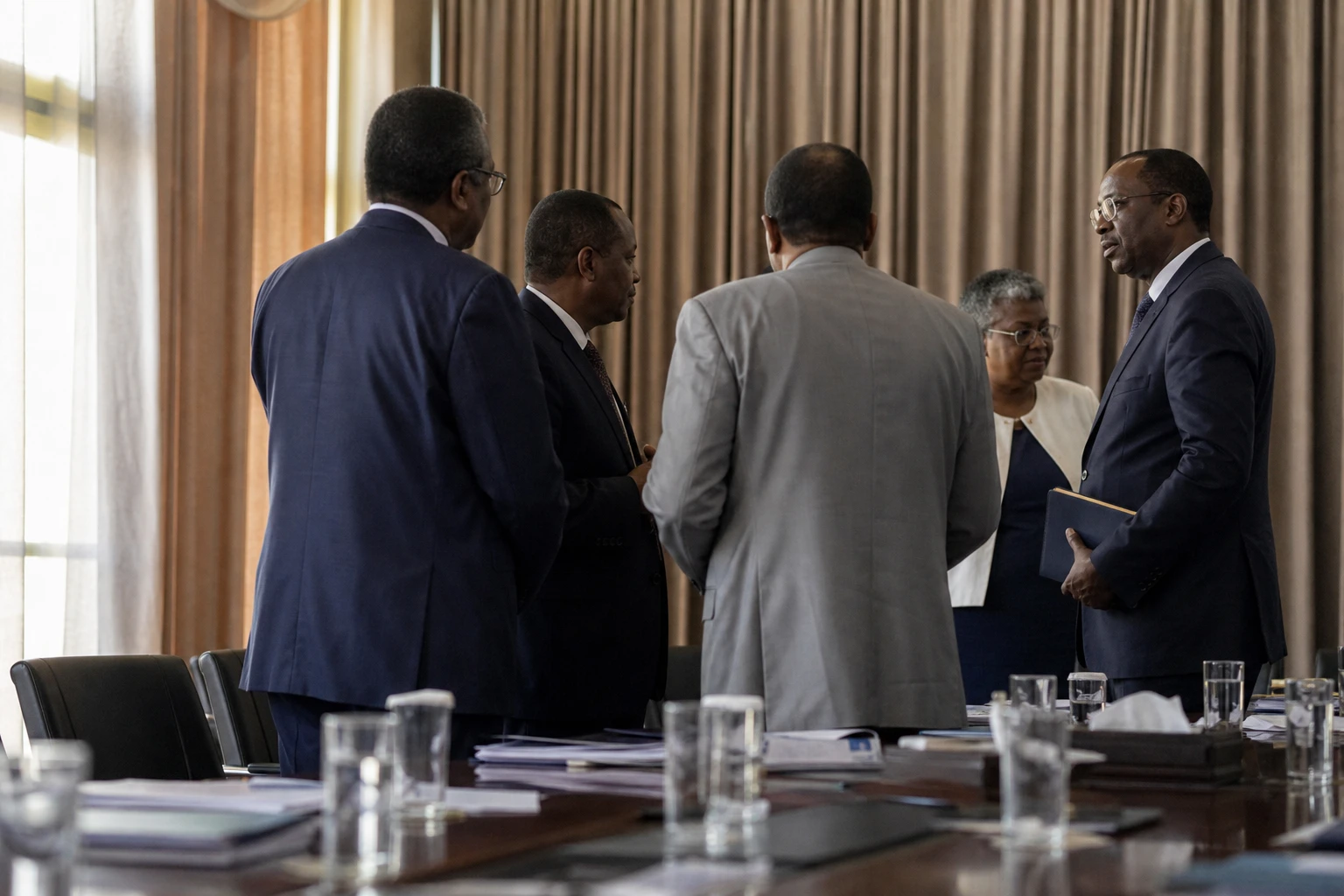
In Khartoum, the diplomatic battle has moved as far as New York. Abdel Fattah al-Burhan, head of the Sudanese army and president of the Transitional Sovereignty Council, was unable to attend the United Nations General Assembly after his US visa was blocked. Behind this protocol incident lies a broader confrontation over how to end the war.
A standoff in an already fragmented country
Since April 2023, the Sudanese Armed Forces have been fighting the Rapid Support Forces, a powerful paramilitary force led by Mohamed Hamdan Dagalo, known as Hemedti. The conflict has shattered Sudan’s political and territorial balance. The army controls Khartoum and several areas in the north and east, while paramilitary forces retain considerable influence in the west of the country.
The war has also shifted the centre of power. Port Sudan, on the Red Sea, hosts much of the administrative and diplomatic machinery associated with the military camp. Khartoum nevertheless remains the official capital and the foremost symbol of sovereignty claimed by both sides.
The conflict now extends beyond the national arena. The Intergovernmental Authority on Development, or IGAD, a regional organisation in East Africa, is seeking to maintain a space for mediation. The African Union, for its part, supports the principle of a civilian transition. But these initiatives are competing with efforts by Egypt, Saudi Arabia, the United Arab Emirates, the United States and other regional actors.
Is Washington linking the visa to a truce?
Abdel Fattah al-Burhan was due to represent Sudan at the 81st session of the UN General Assembly. According to the official programme, he was scheduled to speak on Thursday 24 September 2026. US authorities ultimately did not issue the visa required for his trip.
The refusal was initially presented cautiously. The US State Department said it did not comment on individual visa cases. Yet several diplomatic and government sources cited by Reuters on the link between the visa and a ceasefire proposal say Washington was seeking to make the Sudanese leader’s visit conditional on accepting a 90-day truce.
The proposal was reportedly put forward by Massad Boulos, the US adviser for Arab and African affairs. The precise terms of the initiative have not been made public in full. Khartoum is nevertheless said to have rejected making its leader’s trip conditional on an agreement negotiated under pressure.
On 22 September, Sudan’s ambassador to the United Nations, Al-Harith Idriss, asked Secretary-General António Guterres to intervene. According to Sudan Tribune, he argued that the failure to issue a visa could breach the United States’ obligations as the UN host country.
The Secretary-General expressed regret over the situation. The visa block prevented Abdel Fattah al-Burhan from addressing the leaders gathered in New York, at a time when Sudan was due to present its perspective on the conflict and the humanitarian crisis.
Diplomatic pressure with limited effects
For Washington, the visa is a tool of pressure. The United States is seeking a ceasefire, to facilitate humanitarian access and to prevent Sudan from fragmenting further. Its approach also serves as a reminder that neither side can expect a military victory without diplomatic costs.
But the strategy carries risks. By linking access to the General Assembly to a military concession, the United States gives Sudan’s authorities an opportunity to denounce an infringement of their sovereignty. The debate then shifts from the substance of the truce to the legitimacy of US pressure.
On 26 September, Abdel Fattah al-Burhan publicly rejected this pressure. Speaking in Khartoum, he said Sudan needed “neither a visa for any country, nor anyone’s permission”, according to Anadolu Agency. The statement was aimed as much at Washington as at Sudanese public opinion, as the army seeks to bolster its image as the defender of the state.
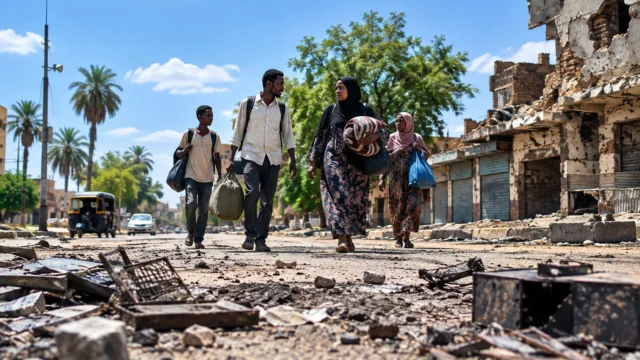
For the population, the stakes are different. A 90-day truce could facilitate aid deliveries and allow evacuations. It would not, however, resolve either the question of military command or the country’s political future. In major cities, people are living with damage to public services and supply disruptions. In rural areas, the consequences are felt more through displacement, food insecurity and difficulty accessing markets.
The informal sector, on which a large proportion of Sudanese households depend, is particularly exposed. Movement restrictions, currency depreciation and bank closures are making trade more difficult. A decision taken in New York can therefore have indirect consequences for families reliant on daily commerce or remittances from the diaspora.
African mediators remain central
The crisis above all highlights the limits of an approach dominated by foreign capitals. The United States can exert financial and diplomatic influence. On its own, however, it lacks the necessary links in territories controlled by the armed forces or groups allied with the paramilitaries.
African mediators remain indispensable. IGAD has direct knowledge of cross-border dynamics, particularly with South Sudan, Ethiopia and Chad. The African Union can provide a continental framework for discussing the political transition, the protection of civilians and the restoration of civilian authorities.
This involvement should not, however, be mistaken for an automatic solution. Regional organisations are weakened by rivalries between member states and divisions over external support for the two sides. The question, then, is whether they can speak with one voice while involving Sudanese civilians in the negotiations.
A diplomatic crisis that points to what comes next
The visa refusal has not stopped the war. It has nevertheless revealed the shifting balance of power between Washington and Sudan’s military camp. The United States wants a concrete commitment. Abdel Fattah al-Burhan refuses to give the impression that his authority depends on a US decision.
The next stage will need to be watched on the ground. If talks on the truce resume, the central questions will concern its guarantees, monitoring and effective humanitarian access. If they fail, the visa block risks deepening diplomatic confrontation without changing military calculations.
For Sudan, then, the stakes go beyond a leader’s presence at the UN. They concern the possibility of preserving a national framework amid armed fragmentation, restoring credible mediation and placing civilians back at the centre of a political process that the war has all but halted.