
 Algeria
 Egypt
 Libya
 Sudan
 Tunisia
 Benin
 Burkina Faso
 Cabo Verde
 Côte d'Ivoire
 Ghana
 Guinea
 Guinea-Bissau
 Liberia
 Mali
 Mauritania
 Niger
 Nigeria
 Senegal
 Sierra Leone
 The Gambia
 Togo
 Cameroon
 Central African Republic
 Chad
 DR Congo
 Equatorial Guinea
 Gabon
 Republic of the Congo
 São Tomé and Príncipe
 Burundi
 Comoros
 Djibouti
 Eritrea
 Ethiopia
 Kenya
 Madagascar
 Malawi
 Mauritius
 Mozambique
 Rwanda
 Seychelles
 Somalia
 South Sudan
 Tanzania
 Uganda
 Angola
 Botswana
 Eswatini
 Lesotho
 Namibia
 South Africa
 Zambia
 Zimbabwe
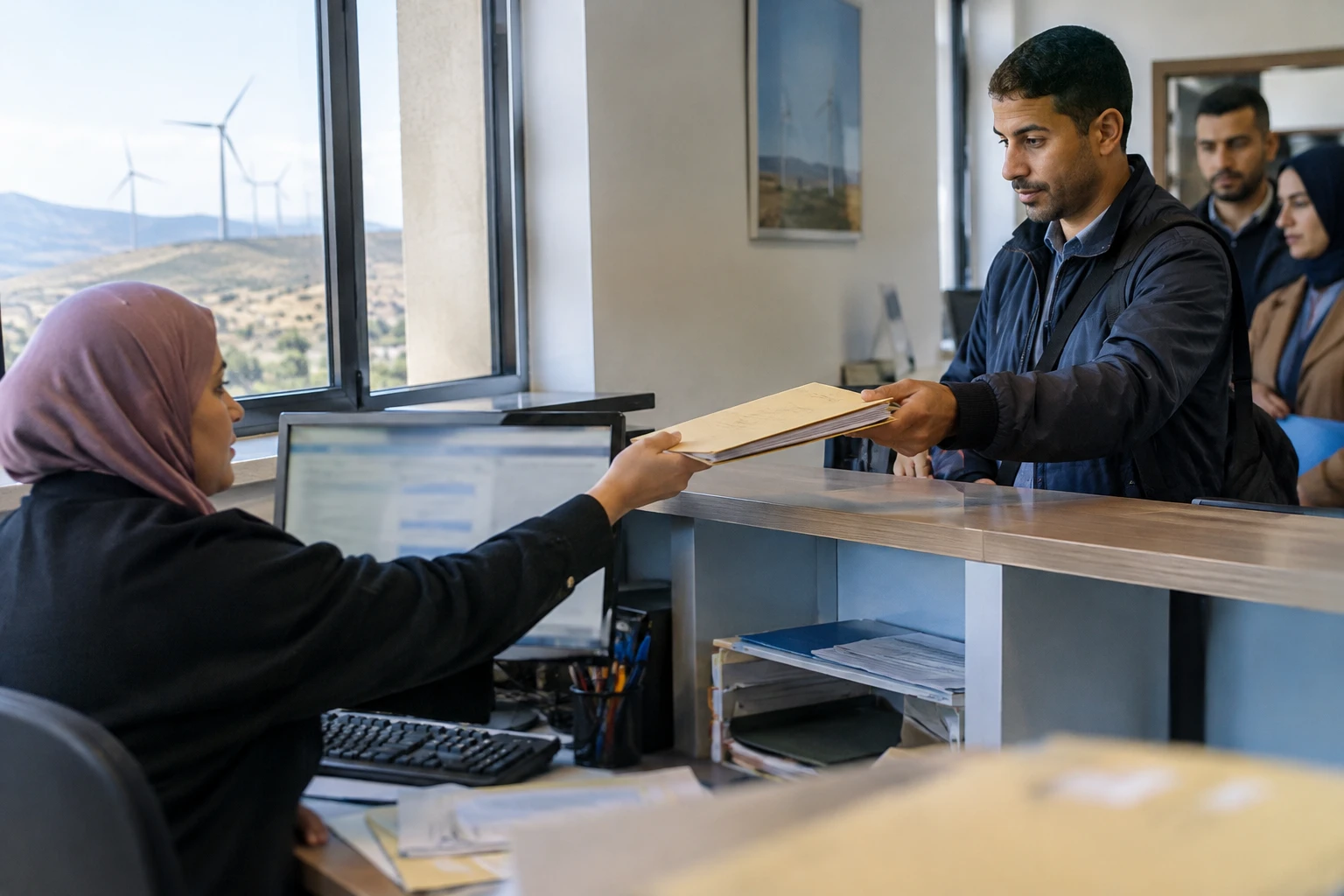
Financing for Boujmil marks a milestone for Morocco’s electricity sector: four domestic banks are backing a new wind farm, even as power generation remains heavily reliant on coal. The project will not, by itself, transform the energy mix. It does, however, show how a long-established major producer is seeking to broaden its activities.
A wind project financed by Moroccan banks
On 3 November 2026, TAQA Morocco announced the financial close of the first phase of the Boujmil wind farm in northern Morocco. This means that the financing needed for this phase has been secured, paving the way for work to continue.
The financed phase has a capacity of 96 megawatts (MW) and an investment of about 1.3 billion dirhams. Banque Centrale Populaire, Attijariwafa bank, Bank of Africa and Saham Bank are participating in the deal. For TAQA Morocco, this is its first financing described as green. The first electricity deliveries are expected in the second half of 2027, according to the announced timetable.
The wind farm could subsequently reach 144 MW. TAQA Morocco estimates that at this capacity its output would be equivalent to the consumption of 120,000 households. This comparison gives an indication of scale, but does not mean that the electricity will be reserved for those households. The project will be developed by a dedicated subsidiary, which will oversee its construction and then its operation.
The announcement of the financial close is referenced by the Moroccan Capital Markets Authority, the financial markets regulator, in its publications of 3 November. The financing details and timetable have also been reported by the Moroccan press. The AMMC publication on Boujmil’s financing and the Moroccan press report confirm the date, the participating banks and the capacity of the first phase.
Diversification from a thermal-power base
This shift is part of the trajectory of a group whose business remains closely associated with coal. TAQA Morocco operates the Jorf Lasfar thermal power complex, comprising six units with a combined capacity of 2,056 MW. The company says its facilities supply about a third of the electricity consumed in Morocco. Boujmil therefore broadens its portfolio without replacing the power station’s weight in the short term.
Diversification was already under way before the announcement. In its results published in March 2026, the group said construction of the project had started in the final quarter of 2025, with a total planned capacity of 144 MW. It also cited projects related to green hydrogen, electricity and water transmission, and desalination. The first phase financed now is 96 MW: expansion to 144 MW remains a future possibility, not capacity already covered by this financial close.
The contrast between ambitions to diversify and the reality of power generation remains significant. According to Morocco’s Ministry of Energy Transition, renewable energy accounted for 46.1% of installed electricity capacity in 2025. This capacity measures what facilities can produce under certain conditions. It is not the share actually generated over the year. To illustrate the gap, figures cited in the source material still put coal at about 60% of electricity generation in 2024. The two indicators should therefore not be confused.
The ministry’s official figures detail renewable capacity and note that the national strategy aims for renewables to account for more than 52% of installed capacity by 2030. The same ministry reports that electricity demand grew by an average of 4.3% a year between 2009 and 2025. Morocco’s official renewable energy indicators thus shed light on the twin challenge: adding lower-carbon generation while meeting rising demand.
What the financing changes — and what it does not
The involvement of four Moroccan banks is a sign of local lenders’ capacity to support large-scale energy infrastructure. It does not, on its own, show that green financing is now accessible to all producers. The published information did not specify the loan’s detailed terms, its duration or how the contributions are divided. The announced figure refers to investment in the phase, not necessarily the amount of bank debt.
For TAQA Morocco, the project opens up a potential new source of revenue and, over time, reduces its dependence on an activity dominated by thermal power. For the banks, it means supporting a productive asset over several years. For the grid and its users, the outcome will depend on the project entering service, the integration of wind power and the ability to balance variable generation. The announced timetable puts the first deliveries in the second half of 2027, subject to progress on construction.
The project does not yet provide a picture of all its local effects. The available information does not detail the number of jobs, the companies involved or the arrangements for connecting it to the grid. These details will matter in assessing effects beyond the investment itself — particularly for the workers and suppliers involved, as well as people living near the site.
A national and regional issue
Nationally, Boujmil forms part of Morocco’s goals to develop renewables and strengthen infrastructure. It must also be viewed in the context of the debate over security of supply: rising demand, grid constraints and dependence on fossil fuels will not disappear with a single wind farm. The transition depends on successive projects, their connection to the grid and their actual contribution to generation.
The regional dimension is also tangible. Morocco is a member of the Arab Maghreb Union, although regional integration remains limited. Its energy strategy also refers to strengthening electricity exchanges. Boujmil is not, in itself, an export project. But the expansion of renewable capacity and power grids could shape future discussions on interconnections in North Africa and with Europe.
The next milestone to watch is therefore operational: completion of the first phase and adherence to the announced commissioning date in the second half of 2027. It will also be important to see whether expansion to 144 MW goes ahead and how the wind farm fits into a system in which coal retains a major role. For now, Boujmil is a locally financed step towards diversification, not yet a shift in Morocco’s electricity model.



