Algeria
 Egypt
 Libya
 Morocco
 Sudan
 Tunisia
 Benin
 Burkina Faso
 Cabo Verde
 Ghana
 Guinea
 Guinea-Bissau
 Liberia
 Mali
 Mauritania
 Niger
 Nigeria
 Senegal
 Sierra Leone
 The Gambia
 Togo
 Cameroon
 Central African Republic
 Chad
 DR Congo
 Equatorial Guinea
 Gabon
 Republic of the Congo
 São Tomé and Príncipe
 Burundi
 Comoros
 Djibouti
 Eritrea
 Ethiopia
 Kenya
 Madagascar
 Malawi
 Mauritius
 Mozambique
 Rwanda
 Seychelles
 Somalia
 South Sudan
 Tanzania
 Uganda
 Angola
 Botswana
 Eswatini
 Lesotho
 Namibia
 South Africa
 Zambia
 Zimbabwe
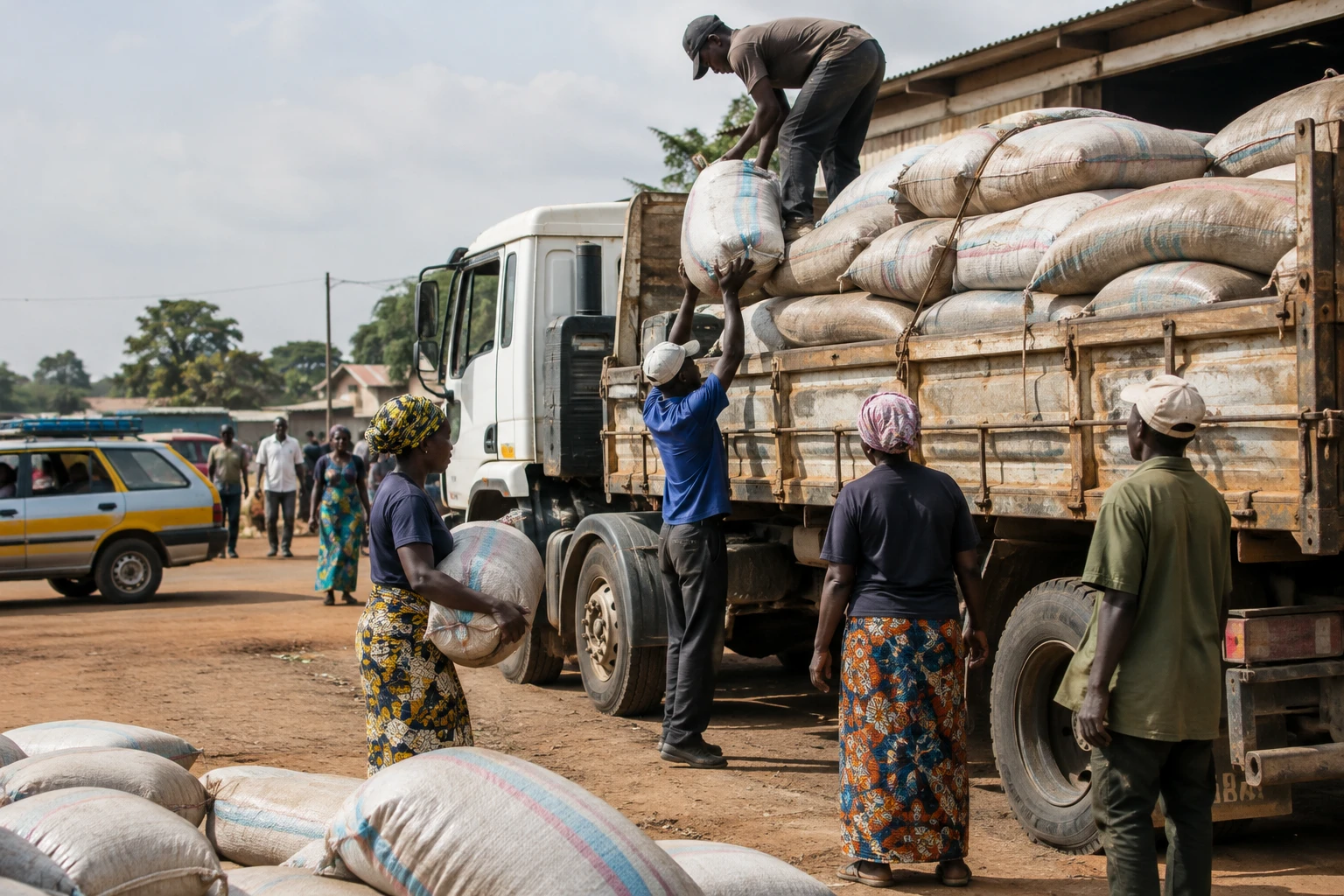
Processing shea kernels in Côte d’Ivoire can create more value locally. But another factory alone does not guarantee better incomes for the women who collect and sell the raw material. Everything will depend on the volumes actually processed, purchasing terms and outlets for finished products.
This challenge is playing out in and around Bouaké, in the centre of the country, but concerns a West African sector whose supply chains extend beyond national borders. Côte d’Ivoire is a member of ECOWAS, the Economic Community of West African States. Across the region, national processing policies must contend with cross-border trade flows and shared markets.
New industrial capacity in Bouaké
On Monday 12 October 2026, Ivorian Agriculture Minister Bruno Nabagné Koné inaugurated the BETA VEG OIL factory in Kongodékro, in the municipality of Bouaké. The facility is to process shea and soya. The ministry has announced an annual capacity of 70,000 tonnes of raw materials. This figure covers the entire operation, not shea alone.
The Ivorian Press Agency also reported the inauguration and the factory’s specialisation. However, the public information consulted does not specify what share of capacity will be devoted to shea, or the annual volumes the company actually plans to process. Theoretical production capacity must therefore be distinguished from the purchases and processing that will take place.
The ministry says about 450 direct jobs are expected. This remains an official announcement, not a record of jobs already created. The operation could also support transport, storage and marketing in the Gbêkê region. Its local impact will depend in particular on regular supplies and contracts concluded with women collectors and co-operatives.
The new facility joins an industrial base already in place. The Cotton, Cashew and Shea Council (CCAK), a public body responsible, among other things, for monitoring the sector, estimates that the country has 21 processing units. Their installed capacity for kernels is said to reach about 130,000 tonnes a year. Yet in 2025-2026, only 51,697 tonnes were recorded in the formal market and channelled to local processors.
Supplying factories without undermining women collectors
The gap between announced capacity and marketed volumes highlights the main challenge: supplying factories with raw materials sustainably. For the 2026-2027 season, which opened on 14 August, the CCAK is targeting 60,000 tonnes of marketed kernels. This is a target, not a result already achieved.
Since January 2025, the export of shea nuts and kernels has been suspended as a precautionary measure by the Ivorian authorities. The measure is intended to reserve more raw material for the country’s processors. For the current season, the CCAK has also said that purchases from women collectors and buyers would be reserved for local units until further notice. These rules may support industrial supply, but their implementation and effects on prices need to be monitored.
Women play a central role in collecting and marketing kernels, often in rural areas in the north. An increase in capacity will therefore not automatically improve their incomes. The prices actually paid, payment times, quality requirements and direct access to buyers matter as much as the opening of a factory. The ministry has called for more transparent and regular partnerships with women collectors. According to the ministry, BETA VEG OIL plans to source about 20% of its raw material needs directly from them.
The suspension of raw exports also calls for particular attention to market conditions. It may direct kernels to Ivorian factories, but it also reduces the opportunities for the actors concerned to sell abroad. The question is therefore whether industrial purchases will provide accessible outlets and satisfactory remuneration for women collectors, without creating bottlenecks in local supply chains.
Exported shea butter, but how much value is added?
The sector already has markets for its processed products. During the 2025-2026 season, 14,078 tonnes of Ivorian shea butter were exported to 13 countries in Asia, Europe and the Americas, according to data reported by the authorities and industry stakeholders. These sales show that local production can reach international markets. However, on their own they do not show how much income goes to women collectors or how much value is retained in the country.
The challenge is to move beyond the initial processing of kernels. Refining, consistent quality and the manufacture of finished products can help capture more value. But this requires investment, skills, appropriate standards and lasting commercial relationships. In Bouaké, the benefits will also depend on the share of production processed locally rather than simply collected or shipped.
The Ivorian sector is part of a regional trend: kernels and derived products circulate within a West African area where several countries are developing their own processing units. Ivorian export rules could affect trade flows in the region. Across ECOWAS, the balance between supplying domestic industries, cross-border trade and the incomes of producer communities will therefore remain decisive.
The next indicators to examine will be the volumes of shea actually processed by BETA VEG OIL, the number of jobs actually created and the purchasing terms offered to women collectors. The outcome of the 2026-2027 season will also show whether the 60,000-tonne target is met. The concrete impact of this new infrastructure will be measured by these results, rather than by the factory’s announced capacity.
Sources for verification: Ivorian Ministry of Agriculture, inauguration and announced capacity, Ivorian Press Agency, inauguration of BETA VEG OIL, government report on the 2025-2026 season, Directorate General of Customs, suspension of exports of shea kernels and nuts.