Algeria
 Egypt
 Libya
 Morocco
 Sudan
 Tunisia
 Burkina Faso
 Cabo Verde
 Côte d'Ivoire
 Ghana
 Guinea
 Guinea-Bissau
 Liberia
 Mali
 Mauritania
 Niger
 Nigeria
 Senegal
 Sierra Leone
 The Gambia
 Togo
 Cameroon
 Central African Republic
 Chad
 DR Congo
 Equatorial Guinea
 Gabon
 Republic of the Congo
 São Tomé and Príncipe
 Burundi
 Comoros
 Djibouti
 Eritrea
 Ethiopia
 Kenya
 Madagascar
 Malawi
 Mauritius
 Mozambique
 Rwanda
 Seychelles
 Somalia
 South Sudan
 Tanzania
 Uganda
 Angola
 Botswana
 Eswatini
 Lesotho
 Namibia
 South Africa
 Zambia
 Zimbabwe
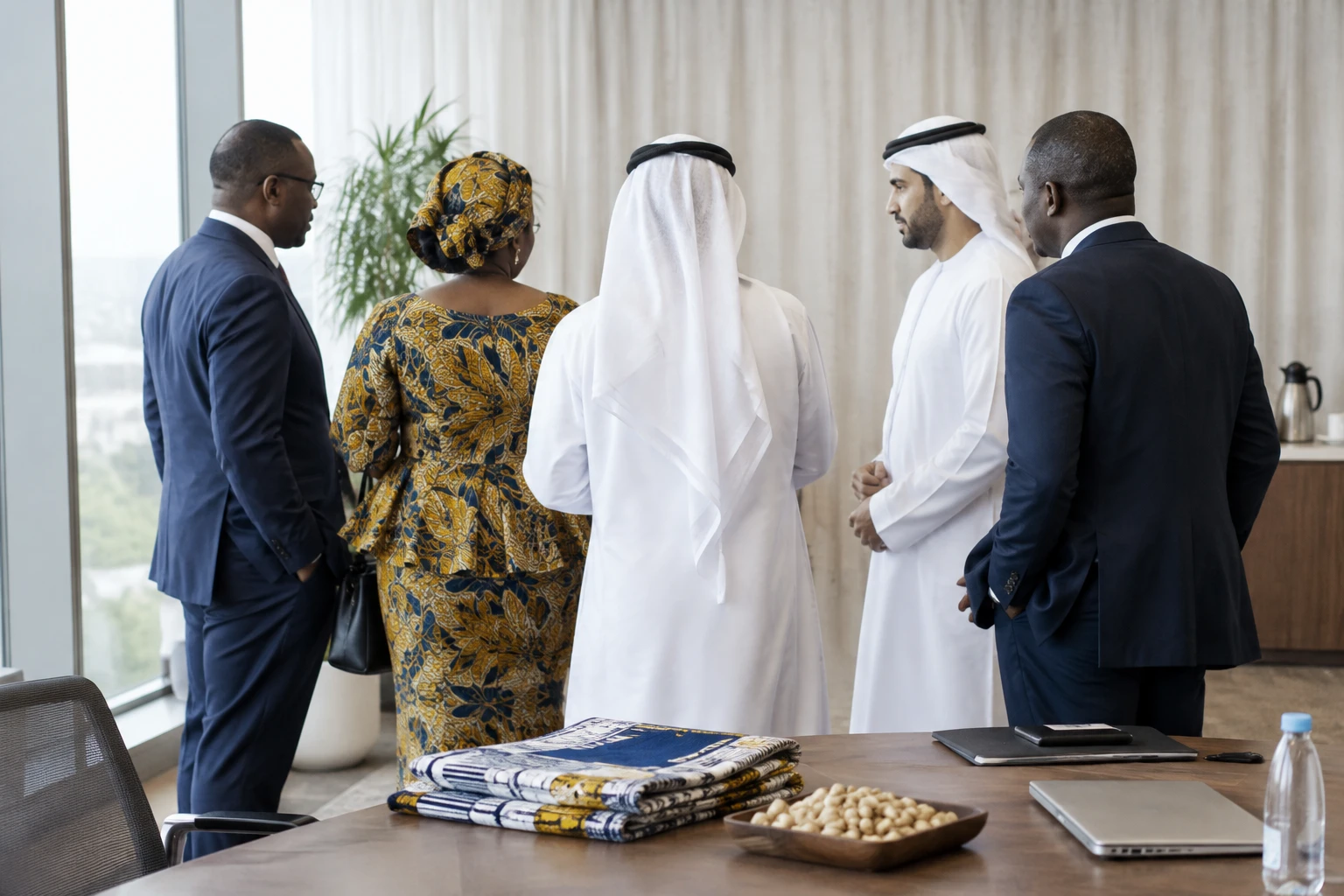
A trade deal is measured not by the signing ceremony, but by the orders it makes possible and the businesses able to benefit. For Benin, the partnership with the United Arab Emirates opens a new door to the Gulf. The challenge, however, is to turn the promised access into concrete opportunities for Beninese producers and investors.
Signed, but not yet in force
On 25 October 2026 in Abu Dhabi, Beninese President Romuald Wadagni and his Emirati counterpart, Sheikh Mohamed bin Zayed Al Nahyan, attended the exchange of a Comprehensive Economic Partnership Agreement, or CEPA. The text was signed by the two countries’ ministers responsible for foreign trade. Beninese media also reported that seven other cooperation instruments had been announced during the visit.
The agreement provides for reducing or eliminating customs duties on a wide range of goods, removing certain trade barriers and improving market access for service providers and investors. But it has not yet taken effect: it must first be ratified and enter into force. The practical arrangements for its implementation also remain to be specified.
According to the UAE’s Minister of State for Foreign Trade, Thani bin Ahmed Al Zeyoudi, nearly 97% of current trade between the two countries would be covered by liberalisation. He also said that, by 2033, UAE exports to Benin could rise by more than $1bn and Beninese exports to the UAE by more than $100m. These are official Emirati projections, not guaranteed outcomes.
Turning rising trade into local revenue
Figures released by the Emirati authorities give an indication of the recent acceleration. Non-oil bilateral trade is said to have reached $2.15bn in 2025, up 65% year on year. In the first half of 2026, it reportedly stood at $1.29bn, an increase of 37.4% compared with the same period in 2025. These figures have been reported by the Beninese press, but their source remains Emirati; they therefore do not amount to independent statistical verification.
Beninese products cited among exports to the UAE include cotton, soya, certain nuts and food products. The Gulf market could also offer opportunities for cashew nuts and shea-derived products. But businesses must be able to meet buyers’ requirements for quality, volume, transport and consistency.
Lower customs duties alone do not guarantee that producers will benefit. The gains will depend on the goods actually covered, rules of origin, logistics costs and the ability of Beninese businesses to export. Companies already focused on exports could seize opportunities quickly. Small businesses and informal-sector operators, meanwhile, risk being left out if access to finance, commercial information and infrastructure remains difficult.
The port and corridors are part of the equation
Benin’s position matters in this relationship. The port of Cotonou and road links to neighbouring countries give the country a role as a transit route for goods in West Africa. The UAE, for its part, is seeking to diversify its trade partnerships and strengthen its position in global trade and logistics. The partnership thus brings two strategies together, but does not guarantee that transit flows will translate into greater value added in Benin.
Regional competition will also matter. Beninese operators do not work in isolation: they operate in a space where trade and commercial standards are shaped by ECOWAS, the Economic Community of West African States. At continental level, the African Continental Free Trade Area aims to facilitate trade between African countries. The agreement with Abu Dhabi adds an external market to these frameworks without replacing them.
For the Beninese authorities, the challenge will be to link the agreement to agricultural value chains, infrastructure and productive investment discussed during the visit. The talks also covered renewable energy, food security and digital technology. Seven separate instruments were announced in areas including diplomatic cooperation, investment, information systems and labour. Those announcements, too, are no guarantee of implementation.
Implementation is the next step
Ratification, the entry-into-force timetable and publication of the lists of products receiving tariff concessions will make it possible to assess the CEPA’s real scope. It will then be necessary to track who exports, which investments are actually made and whether Beninese businesses gain access to the new markets. These indicators will say more than the overall value of trade alone.
For Benin, whose official capital is Porto-Novo while Cotonou accounts for much of the country’s economic and port activity, the agreement offers an opportunity to diversify its partners. Its regional impact will also depend on the role given to corridors and West African suppliers. The test will be tangible: increased Beninese sales, jobs and local processing, rather than a rise in flows that mainly benefits intermediaries.