
 Algeria
 Egypt
 Libya
 Morocco
 Sudan
 Tunisia
 Burkina Faso
 Cabo Verde
 Côte d'Ivoire
 Ghana
 Guinea
 Guinea-Bissau
 Liberia
 Mali
 Mauritania
 Niger
 Nigeria
 Senegal
 Sierra Leone
 The Gambia
 Togo
 Cameroon
 Central African Republic
 Chad
 DR Congo
 Equatorial Guinea
 Gabon
 Republic of the Congo
 São Tomé and Príncipe
 Burundi
 Comoros
 Djibouti
 Eritrea
 Ethiopia
 Kenya
 Madagascar
 Malawi
 Mauritius
 Mozambique
 Rwanda
 Seychelles
 Somalia
 South Sudan
 Tanzania
 Uganda
 Angola
 Botswana
 Eswatini
 Lesotho
 Namibia
 South Africa
 Zambia
 Zimbabwe
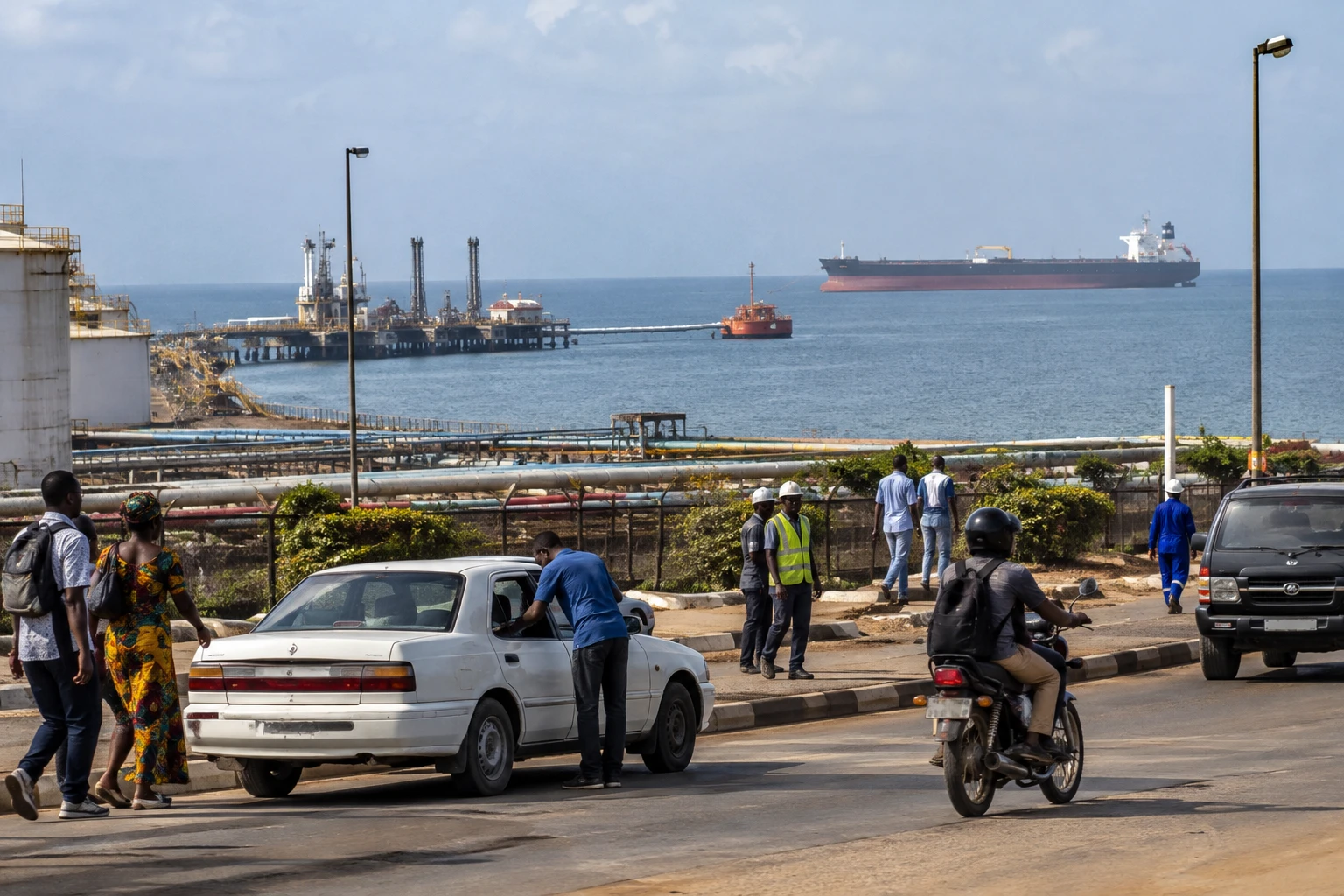
The return of oil at Sèmè opens a new export route for Benin. But a cargo sold abroad does not automatically mean cheaper fuel at the pump, or immediate clarity on public revenues.
An old field back in production
Off Benin’s south-eastern coast, the Sèmè oil field is back in operation after nearly three decades of inactivity. Discovered in 1969, it produced crude between 1982 and 1998. Production ceased amid low prices and technical difficulties, notably the increasing presence of water in the wells.
The restart is being led by Akrake Petroleum Benin, the offshore block’s operator. The company is indirectly owned by Singaporean group Rex International. The production-sharing contract gives Akrake a 76% stake; the Beninese state holds 15% and Octogone E&P 9%. These shares alone do not, however, determine public revenues: royalties, recoverable costs and oil-sharing rules must also be taken into account.
The company says it completed the drilling of a production well in February 2026 and achieved first production the following month. Offshore facilities enable it to produce and store crude before loading. The Sèmè-Kpodji terminal is already used to export Nigerien oil, transported from inland via a pipeline.
One cargo, several figures to distinguish
An initial cargo of about 330,000 barrels was loaded aboard the tanker Kriti Jade in early November, bound for the Netherlands. The Beninese daily La Nation reported that the vessel arrived off Cotonou on 31 October and was expected to head to the Dutch market. Maritime tracking data cited by S&P Global subsequently indicated that nearly 360,000 barrels had been loaded, with arrival in Rotterdam expected on 18 November. The discrepancy may reflect loading and tracking estimates; the published figures are therefore not identical.
The distinction between the value of the cargo and the state’s revenue also matters. La Nation estimates that at a hypothetical price of $110 a barrel, 330,000 barrels would represent a gross value of $36.3m. This is not the confirmed sale amount, let alone the sum paid into the Treasury. The actual price, the quality of the crude, transport charges and recoverable costs all affect the outcome.
Estimates of Sèmè’s potential require the same caution. A November 2026 article published by La Nation refers to reserves of about 6 million barrels, while a Beninese media outlet cites an independent report from March 2025 estimating proven and probable reserves at 10.9 million barrels. The operator, meanwhile, refers to broader resources, which are not equivalent to commercially recoverable reserves. These categories should not be confused.
Benefits for Benin yet to be demonstrated
The exported oil will not be refined in Benin. The country does not currently have an operational refinery, according to reports on the project. The cargo is therefore heading to the international market; it does not directly supply Beninese petrol stations.
For public finances, the challenge is to turn still modest production into verifiable and sustainable revenue. La Nation notes that the amount accruing to the state will depend in particular on the costs declared by the operator and the terms of the production-sharing contract. Transparency on these parameters will make it possible to assess what the restart actually delivers, beyond the theoretical value of the exported crude.
Announced volumes must also be considered over time. The initial target cited by the operator was 15,000 barrels a day. Yet information published in early November puts initial production at about 3,000 barrels a day, with a gradual increase planned. At this rate, the first shipment represents several months of production, rather than proof that the targeted plateau has already been reached.
Sèmè, between regional co-operation and logistical dependence
The restart comes amid a changing West African energy landscape. The port of Sèmè-Kpodji has become a strategic facility for Niger, a landlocked country that exports its crude through the pipeline linking the Agadem fields to the Beninese coast. In 2024, tensions between Niamey and Porto-Novo disrupted operations along this route. The restart of Benin’s field therefore adds a second oil flow to a terminal already tied to relations between the two neighbours.
Benin is a member of ECOWAS, the Economic Community of West African States. The movement of oil and the operation of cross-border infrastructure involve more than commercial considerations: they also depend on political relations, agreements and the security of facilities. For Porto-Novo, Benin’s official capital, the challenge is to make the most of its coastline without confusing regional transit with domestic production.
The next step will be to verify the regularity of shipments, the actual growth in production and the share of revenue effectively received by the state. At Sèmè, the restart marks a return to the oil market; its economic significance will be judged instead by its duration, the public accounts and the tangible benefits for the country.



