Algeria
 Egypt
 Libya
 Morocco
 Sudan
 Tunisia
 Burkina Faso
 Cabo Verde
 Côte d'Ivoire
 Ghana
 Guinea
 Guinea-Bissau
 Liberia
 Mali
 Mauritania
 Niger
 Nigeria
 Senegal
 Sierra Leone
 The Gambia
 Togo
 Cameroon
 Central African Republic
 Chad
 DR Congo
 Equatorial Guinea
 Gabon
 Republic of the Congo
 São Tomé and Príncipe
 Burundi
 Comoros
 Djibouti
 Eritrea
 Ethiopia
 Kenya
 Madagascar
 Malawi
 Mauritius
 Mozambique
 Rwanda
 Seychelles
 Somalia
 South Sudan
 Tanzania
 Uganda
 Angola
 Botswana
 Eswatini
 Lesotho
 Namibia
 South Africa
 Zambia
 Zimbabwe
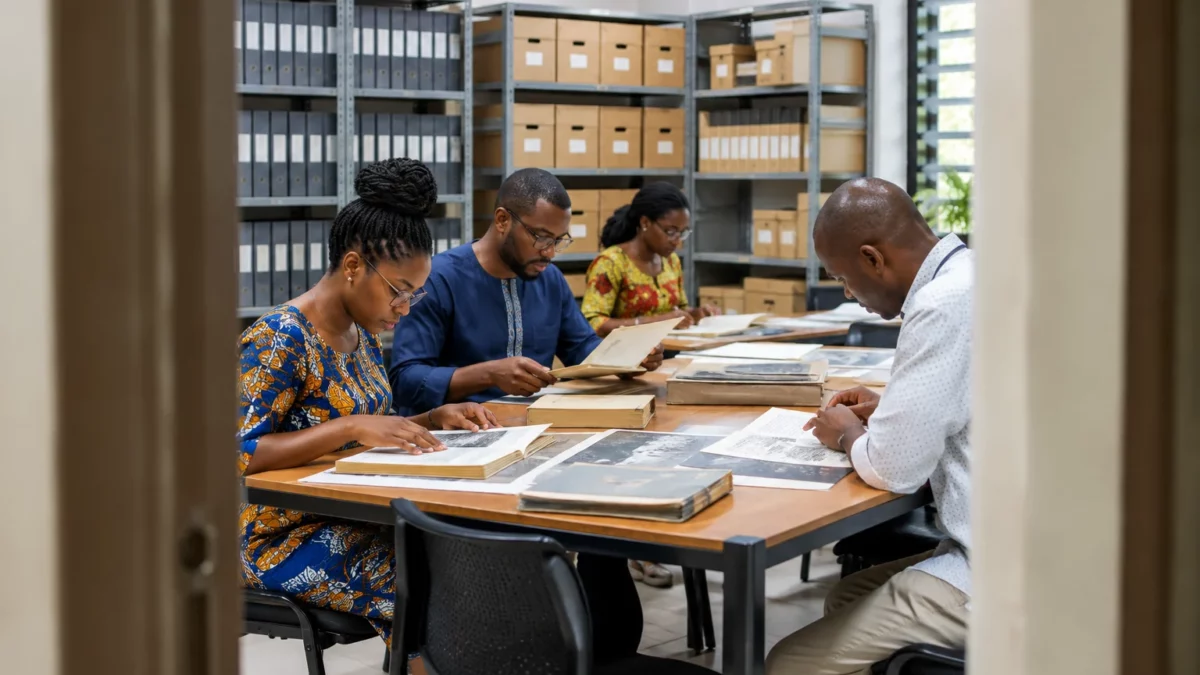
The return of even a few works can change the place of a history in museums, sites of memory and the transmission of knowledge to younger generations. For Benin, the new request submitted to France also raises a practical question: who documents the objects’ origins, and under what rules can their return be decided?
French collections at the heart of a Beninese case
In August 2025, Benin submitted a request to France concerning 35 cultural objects held at the Quai Branly–Jacques Chirac Museum in Paris. The Beninese authorities then began preparing the scientific case. Benin’s Ministry of Culture announced the formation of a national committee tasked with consolidating research and preparing a joint commission with France. The case does not yet amount to a decision on restitution: each item must be examined and its history documented. Benin’s Ministry of Culture outlines the preparatory work.
The objects include a sculpture associated with the god Gou, ancient weapons and a divination tablet linked to Fâ. The issue is not limited to establishing their presence in French collections. Experts must also examine the conditions under which they were acquired and determine whether the objects meet the criteria set out in the new French law. Some weapons, for example, could be considered military objects or ceremonial and parade pieces. This distinction will carry weight in the examination of the case.
The god Gou gives the request considerable symbolic significance. The metal sculpture is associated with a deity in the Vodun pantheon and with the memory of the kingdom of Danhomè. Historical sources cited in information published about the request link its departure to the French conquest of Abomey in 1892. The available documentation must nevertheless be examined item by item: the general history of an expedition is not enough to establish the precise journey of each object.
A new law, but a case-by-case examination
French Law No. 2026-351, promulgated on 9 May 2026, creates a framework for restituting certain cultural objects acquired illicitly without requiring a separate law for each item. Subject to conditions, it provides an exception to the principle that public collections are inalienable, which normally prevents the state from disposing of works it owns. The legislation provides for joint scientific work with the requesting state, followed by an examination of the case by a specialist national commission. Restitutions are therefore not automatic. The French law on the restitution of cultural objects.
This change addresses a difficulty long highlighted by requesting countries: before the framework law, removing an object from national collections often required specific legislation for each case. The process could therefore move at the pace of diplomatic negotiations and parliamentary debates. The new system provides a common framework while retaining verification stages. For Benin, it turns a political request into an expert review process, without prejudging the outcome.
The closest precedent remains the return of 26 works from the royal treasures of Abomey in 2021. France then adopted a specific law to enable their transfer. The restitution, received by the Beninese authorities in Cotonou, prompted a national debate on the conservation, display and transmission of this heritage. It also established a method of co-operation between government departments and museums. The official legislation governing the transfer of the 26 works.
Beninese heritage has also been returned from another European country: Finland handed Benin a 27th royal treasure from Abomey in May 2025. This case is a reminder that restitution requests do not concern a single holding country. They require inventory research, exchanges between institutions and arrangements to care for objects after their return.
Beyond transfer, the question of access
For the Beninese authorities, restitution concerns memory and people’s right to access elements of their history. It can also strengthen museums, research and cultural industries. But the transfer of ownership does not, on its own, resolve questions of conservation, security, restoration or public display. These choices involve the state, heritage specialists, communities connected to the works and cultural institutions.
The effects are not evenly distributed. Decisions are made by government departments and museums, but the objects may hold particular importance for communities and areas far from Porto-Novo, Benin’s political capital. Documentation work and display choices determine whether this heritage remains concentrated in a few institutions or circulates more widely across the country. They also influence the place given to local knowledge and Beninese interpretations.
France has already returned objects to other African countries under legislation specific to each case. In 2026, Côte d’Ivoire received the talking drum Djidji Ayôkwé, confiscated in 1916, following a separate legislative process. This precedent shows that the timetable still depends on historical verification and institutional decisions. The new French framework law could make procedures more consistent, but requests remain tied to their evidence and history. France’s Ministry of Culture recounts the transfer of the Djidji Ayôkwé.
A regional issue of memory and co-operation
The initiative resonates across West Africa, where several states are pursuing research or requests for the return of cultural objects. ECOWAS, the organisation bringing together the countries of the region, has itself published a guide to restitution procedures. This regional framework can help share experience, particularly on collection inventories, conservation and co-operation between museums. It does not, however, replace national decisions or negotiations with holding countries. The ECOWAS guide to restitution procedures.
The next decisive step will be a joint examination of the 35 objects and the publication of substantiated findings on their provenance. The criteria applied, the commission’s timetable and the arrangements for any potential transfer will need to be followed. For Benin, then, the case will be decided as much in archives and museum stores as by institutions’ ability to make these objects accessible, studied and passed on.