Algeria
 Egypt
 Libya
 Morocco
 Sudan
 Tunisia
 Burkina Faso
 Cabo Verde
 Côte d'Ivoire
 Ghana
 Guinea
 Guinea-Bissau
 Liberia
 Mali
 Mauritania
 Niger
 Nigeria
 Senegal
 Sierra Leone
 The Gambia
 Togo
 Cameroon
 Central African Republic
 Chad
 DR Congo
 Equatorial Guinea
 Gabon
 Republic of the Congo
 São Tomé and Príncipe
 Burundi
 Comoros
 Djibouti
 Eritrea
 Ethiopia
 Kenya
 Madagascar
 Malawi
 Mauritius
 Mozambique
 Rwanda
 Seychelles
 Somalia
 South Sudan
 Tanzania
 Uganda
 Angola
 Botswana
 Eswatini
 Lesotho
 Namibia
 South Africa
 Zambia
 Zimbabwe
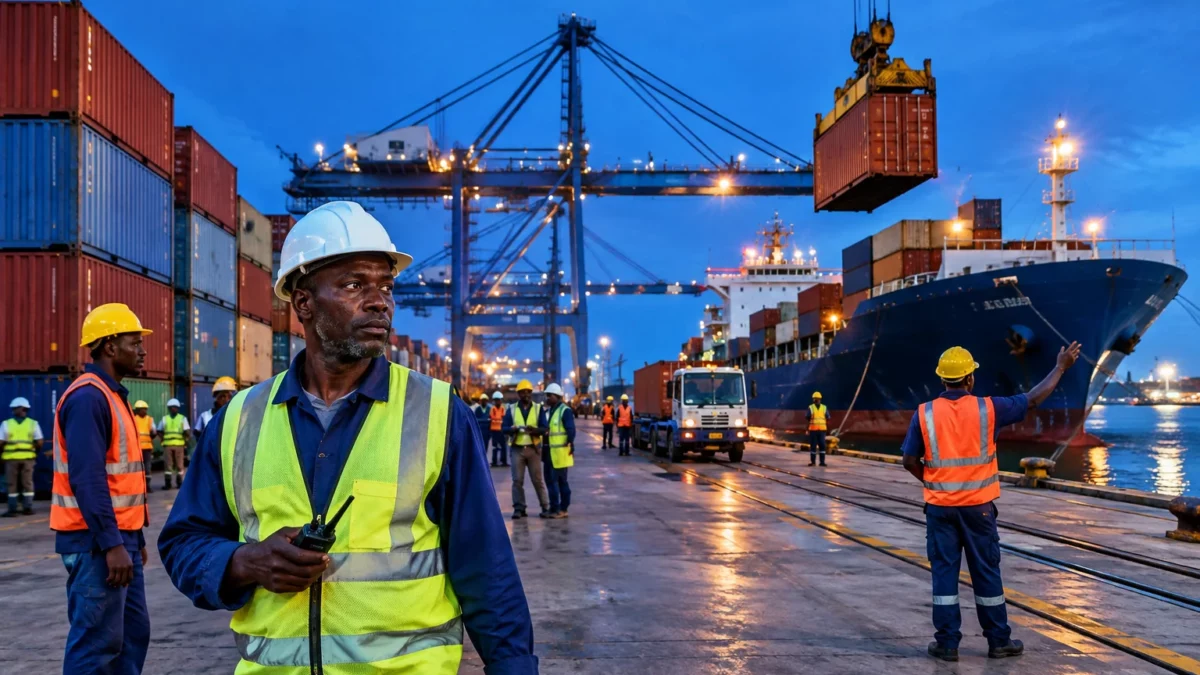
For Beninese importers and transport operators serving the West African hinterland, a deeper berth is valuable only if it cuts waiting times and makes it easier for goods to pass through. In Cotonou, the opening of new facilities increases available capacity. On its own, however, it does not guarantee lower costs or shorter delays.
A national port at the heart of regional trade
Located on the Gulf of Guinea, the Port of Cotonou is a gateway for Benin and a transit route to neighbouring landlocked countries. Its activity therefore depends as much on domestic trade as on the smooth operation of the land corridors that extend from the quays into the region.
This gives the project a significance that extends beyond the city of Cotonou. Goods unloaded can supply Beninese businesses and consumers, but can also continue on to hinterland markets. In a region where several ports compete for cargo, the capacity to accommodate ships and clear their loads matters. So do the quality of roads, customs formalities, tariffs and co-ordination between operators.
The programme is part of the port’s master plan for modernisation, launched over several years and structured around twelve projects. The overall budget announced in the available information is close to CFAF 500 billion. The African Development Bank, for its part, describes a set of projects worth CFAF 302.8 billion to be financed on the port’s balance sheet. These amounts may not cover the same scope and should therefore not be presented as directly comparable estimates.
454 additional metres put into operation
Two sections have just been handed over: a 154-metre quay in the south, with a depth of 15 metres, and 300 metres in the north, at a depth of 16 metres. The Port of Cotonou has put them into operation. These facilities add to the 400 metres of quays delivered at the beginning of 2026. The cumulative length thus reaches 854 metres, including 700 metres at a depth of 16 metres and 154 metres at 15 metres.
Construction data published by Eiffage report more than 1.5 million cubic metres of material dredged, 61,000 cubic metres of concrete poured, 24,000 square metres of paving laid and 3,250 tonnes of reinforcement used. The group of companies also includes Spie batignolles Fondations and Beninese company Adéoti. The port says the works are part of the expansion of the basin and renovation of the north and south quays.
The handover of these sections marks an operational milestone, not the completion of the entire programme. Work is to continue on the next phases of the northern quay extension. Other announced components include a bulk terminal, expansion of the basin, a holding car park at Zongo and a maritime affairs centre. Their timetable and commissioning will determine the port’s actual ability to handle more traffic.
The available information presents 25 million tonnes of goods and more than one million TEUs as long-term targets. A TEU, or twenty-foot equivalent unit, is the measure used to compare container capacity. These ambitions must be distinguished from results already achieved: projected capacity does not mean that current traffic has reached this level, or that the equipment will immediately operate at full capacity.
Performance also depends on what happens on land
Greater depth can allow ships with a deeper draught — that is, a deeper submerged section — to be accommodated. This broadens the range of ways in which the quays can be used. But the benefit will depend on shipping lines’ needs, cargo-handling equipment, the availability of storage space and how quickly containers and other goods leave the port.
Traffic illustrates the growth that the programme is intended to support, but the figures should be treated with caution. The port’s environmental report gives a total of 9,670,776 tonnes for 2024, close to the rounded figure of 9.6 million in the information behind this report. The figure of 14.7 million tonnes for 2025 and the forecast of 16 million for 2026 have not been confirmed here by a second independent publication. They should therefore remain attributed and must not be confused with verified data.
The benefits will not be evenly distributed. Import-export businesses, freight forwarders and transport operators may benefit from a smoother service if the quays ease congestion. Consumers could indirectly gain from more predictable delays, but the final price also depends on transport and distribution costs. Conversely, an increase in volumes without improvements to road access or procedures risks shifting queues from the quays to the port gates and urban roads.
A competitiveness test for Benin’s corridor
For Benin, modernising the port is part of a strategy to strengthen infrastructure and develop trade. Success will be measured less by the length of quay delivered than by results tracked over time: ship waiting times, the length of time goods spend in port, the cost of passage, actual traffic handled and the share of flows carried to domestic and regional markets.
Across West Africa, Cotonou operates in a region where ECOWAS, the Economic Community of West African States, seeks to facilitate trade among its members. But integration also depends on the agreements applied at borders and the continuity of corridors. For landlocked countries, additional port capacity will be valuable only if land transit remains predictable.
The next steps to watch are therefore the continuation of work in the north, the actual opening of the other planned facilities and the publication of comparable traffic data from year to year. These will show whether the new quays durably strengthen the port’s regional role — and whether the improvement also brings tangible gains for Beninese operators and users.
Context sources incorporated: construction data published by Eiffage, Beninese press coverage of the quays handed over, information from the Port of Cotonou on the first phase, African Development Bank project note and the port’s 2023-2024 environmental report.