Algeria
 Egypt
 Libya
 Morocco
 Sudan
 Tunisia
 Benin
 Burkina Faso
 Côte d'Ivoire
 Ghana
 Guinea
 Guinea-Bissau
 Liberia
 Mali
 Mauritania
 Niger
 Nigeria
 Senegal
 Sierra Leone
 The Gambia
 Togo
 Cameroon
 Central African Republic
 Chad
 DR Congo
 Equatorial Guinea
 Gabon
 Republic of the Congo
 São Tomé and Príncipe
 Burundi
 Comoros
 Djibouti
 Eritrea
 Ethiopia
 Kenya
 Madagascar
 Malawi
 Mauritius
 Mozambique
 Rwanda
 Seychelles
 Somalia
 South Sudan
 Tanzania
 Uganda
 Angola
 Botswana
 Eswatini
 Lesotho
 Namibia
 South Africa
 Zambia
 Zimbabwe
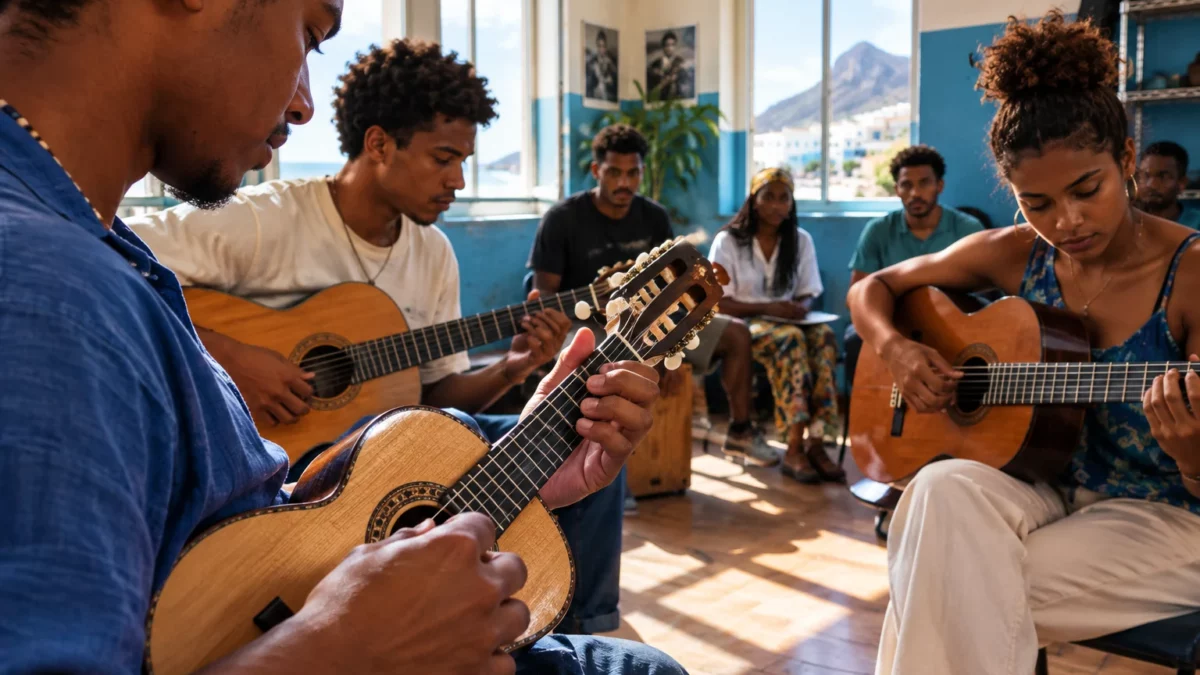
An instrument often heard in accompaniment can also take centre stage. In Cabo Verde, musician Bau has made the cavaquinho one of the hallmarks of his playing. His career links family learning, the international stage and the passing on of a living heritage.
Strings passed down in São Vicente
Rufino Almeida, known as Bau, was born in 1962 on the island of São Vicente. His father made instruments. As a child, he played the cavaquinho outside the family home with his brothers. He began playing the guitar at 14. In an interview, the musician emphasises the importance of regular practice: natural talent is no substitute for scales or practice.
This connection with instrument-making and playing gives his career a distinctive dimension. Bau adapts the cavaquinho to his needs and develops a model associated with his name. The small string instrument, often tasked with keeping rhythm in ensembles, becomes a solo voice in his hands. The virtual museum of Cape Verdean music traces this evolution and his work as a maker, performer and arranger.
São Vicente, whose main city is Mindelo, has an important place in the archipelago’s musical life. But this history cannot be reduced to a single island or celebrated artist. Cape Verdean repertoires have been shaped by movement between the islands and across the Atlantic. They have also evolved thanks to musicians who compose, arrange and accompany other voices.
A central role alongside Cesária Évora
His meeting with Cesária Évora brought Bau to an international audience. In 1991, he joined the Mindel Band, formed to accompany the singer during the recording of the album Mar Azul. He then led her musical group for several years. A biography submitted to UNESCO places this period between 1995 and 1999.
Bau also recalls a tour in France around the release of Petit Pays. He says he formed a group at the time to accompany the singer. These details shed light on his role: he does not simply play a few instrumental parts. He helps shape the collective sound accompanying a performer who became a leading figure in Cape Verdean music.
This collaboration is part of a broader history. Morna, a Cape Verdean musical genre led in particular by voice and strings, with often melancholic lyrics, has reached a worldwide audience while remaining rooted in local practices. In 2019, UNESCO inscribed it on its Representative List of the Intangible Cultural Heritage of Humanity. This international recognition underlines the importance of passing it on, but does not replace the everyday role of the artists, families and communities who keep it alive.
Composing without freezing tradition
After touring, Bau continued his career as a composer and performer. His first solo album, Top d’Coroa, was released in 1994, according to the biographical entry presented to UNESCO. He went on to develop a repertoire bringing together several string instruments and a range of influences. His work shows that a musical tradition can change without losing its roots.
Morna is not an immovable object passed intact from one generation to the next. Arrangements, instruments and stage experience all drive its evolution. Bau’s role alongside Cesária Évora, followed by his own work, illustrates this interplay between accompaniment and creation. The musician says he wants to take time to compose again and pass on to young people the sound and techniques he has learned.
This transmission also matters for artists who work far from the major international stages. Learning an instrument, mastering a repertoire and finding opportunities to perform all take time and resources. Careers such as Bau’s are a reminder that a music’s global profile rests on a local network of musicians, instrument-makers and places to practise.
Cape Verdean influence across West Africa
Cabo Verde is a West African archipelago and a member of ECOWAS, the Economic Community of West African States. Its island geography and Atlantic connections give it a distinctive musical history, while also linking it to regional exchanges. The movement of artists and repertoires connects the archipelago’s music scenes with those of the diaspora and audiences well beyond the continent.
For Cape Verdeans, morna is both an artistic practice and a space for memory and creation. UNESCO recognition may enhance its visibility, but the challenge also lies in passing on skills and supporting new generations. Bau’s career highlights a less visible part of this continuity: behind a familiar song are arrangements, hours of learning and instruments crafted to produce their own sound.
What happens next will depend in particular on the place given to this transmission in the country’s musical practices and cultural initiatives. For now, Bau’s journey is a reminder that a music’s reach is not built solely on its great voices. It also depends on the musicians who accompany it, reinvent it and pass it on.