Algeria
 Egypt
 Libya
 Morocco
 Sudan
 Tunisia
 Benin
 Burkina Faso
 Cabo Verde
 Côte d'Ivoire
 Ghana
 Guinea-Bissau
 Liberia
 Mali
 Mauritania
 Niger
 Nigeria
 Senegal
 Sierra Leone
 The Gambia
 Togo
 Cameroon
 Central African Republic
 Chad
 DR Congo
 Equatorial Guinea
 Gabon
 Republic of the Congo
 São Tomé and Príncipe
 Burundi
 Comoros
 Djibouti
 Eritrea
 Ethiopia
 Kenya
 Madagascar
 Malawi
 Mauritius
 Mozambique
 Rwanda
 Seychelles
 Somalia
 South Sudan
 Tanzania
 Uganda
 Angola
 Botswana
 Eswatini
 Lesotho
 Namibia
 South Africa
 Zambia
 Zimbabwe
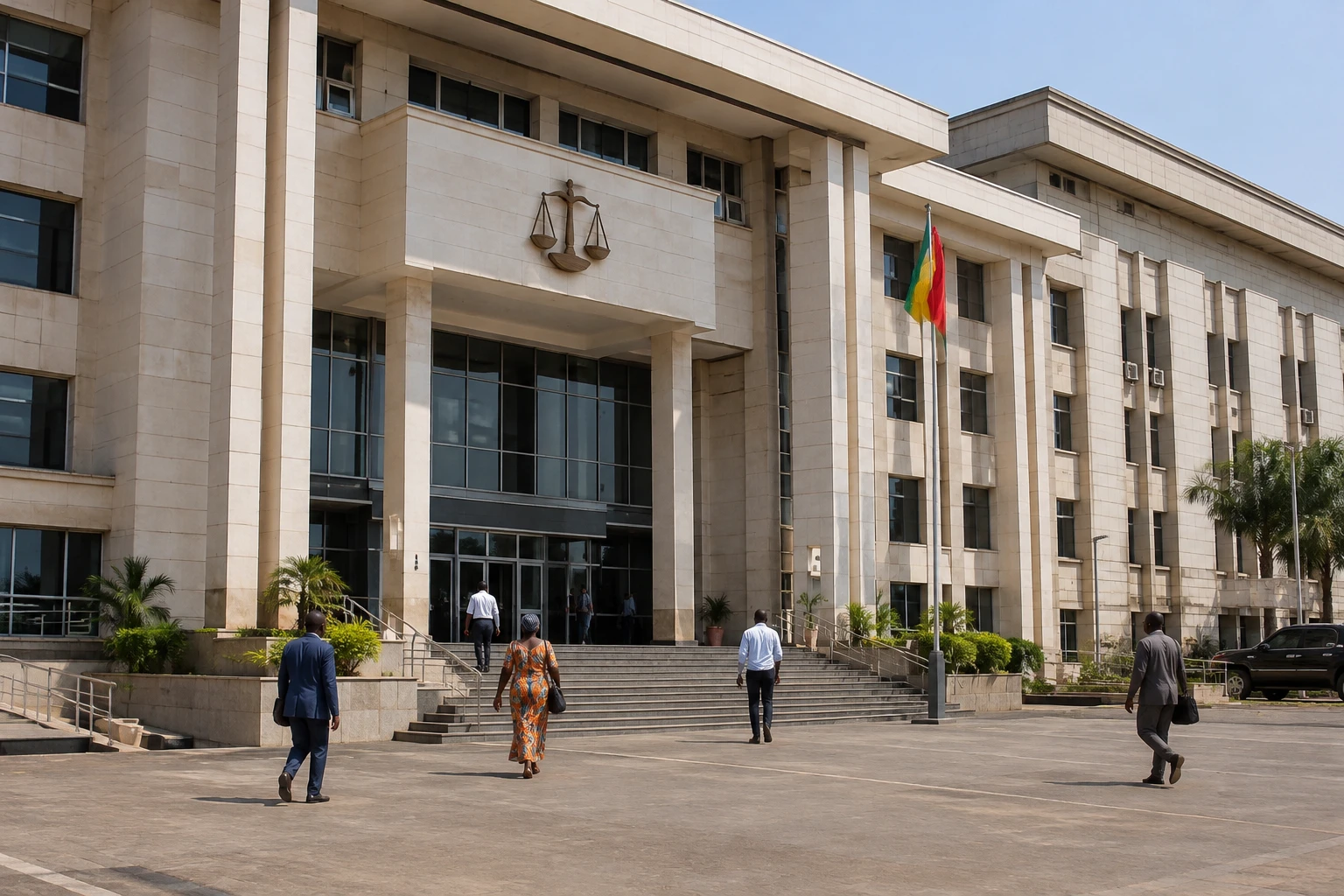
When a former guardian of the Constitution is convicted of financial offences, the consequences extend beyond the fate of a single official. In Guinea, the case also tests the justice system’s ability to handle state-related cases without undermining the credibility of the anti-corruption drive.
On Wednesday 21 October 2026, the Court for the Repression of Economic and Financial Offences (CRIEF), a specialist court for economic and financial cases, sentenced Mohamed Lamine Bangoura to seven years in prison. The ruling comes in a country where prosecutions targeting former officials intersect with an ongoing debate about judicial independence and the country’s political future.
A verdict accompanied by financial penalties
The CRIEF found the former president of the Constitutional Court guilty of corruption, embezzlement of public funds, illicit enrichment and money laundering. It fined him two billion Guinean francs and barred him from standing for public office for five years. The court also ordered the confiscation of assets in Guinea and Senegal, according to several Guinean reports of the ruling.
Two co-defendants tried in absentia, Amadou Diallo and Sidiki Sylla, were each sentenced to ten years in prison and fined five billion Guinean francs. The three men must also jointly pay 41 billion Guinean francs to the state. Guinean media report that the CRIEF found that proceedings against another defendant, Rouguiatou Barry, had lapsed following her death. These details were reported notably by Judicalex Guinée and TopAfrica.
Bangoura had been in detention since December 2022 and contested the accusations, according to information provided during the proceedings. The ruling does not preclude the possibility of an appeal. It will also be important to distinguish the sums ordered by the court from the amounts actually recovered: an announced confiscation does not mean that the assets have already been transferred to the state.
A court at the heart of the transition
The CRIEF was established after the military takeover of September 2021, which ousted President Alpha Condé. Since then, it has investigated several cases involving officials from the previous administration. The case against Bangoura forms part of this sequence, but a conviction alone is not enough to establish collective wrongdoing by the former government or settle the debate over the impartiality of institutions.
The defendant’s former role makes the case particularly sensitive. As head of the Constitutional Court, he led an institution responsible, among other things, for constitutional review and electoral disputes. Any criminal ruling against a former holder of this office therefore revives a central question: can institutions hold their leaders to account while guaranteeing the rights of the defence and a fair trial?
The CRIEF says its mandate is to combat economic offences. At the same time, opposition figures accuse the authorities of instrumentalising the justice system and restricting freedoms. These criticisms should be presented as political allegations, not as facts judicially established in this case. They nevertheless serve as a reminder that confidence in a court also depends on transparent hearings, reasoned judgments and effective avenues of appeal.
Asset recovery, another test for the state
The asset-related penalties raise a very practical issue. The authorities will have to identify the assets concerned, establish their connection to the offences found and implement the ruling in each country where assets are located. For assets in Senegal, Guinea’s neighbour, enforcement will also depend on judicial co-operation procedures between the two states. The joint sum of 41 billion Guinean francs will need to be distinguished from the individual fines to avoid confusion over the amounts owed.
For the public, the issue is accountability: anti-corruption proceedings produce tangible results only if proven embezzlement is punished and recovered resources benefit the public finances. But rigour is not measured solely by the length of prison sentences. It also requires evidence that can be tested in adversarial proceedings, reasoned judgments and respect for judicial safeguards.
Caution is all the more necessary because media reports do not agree on every detail of the case. Articles published after the verdict concur on the seven-year prison sentence, the two-billion-Guinean-franc fine and the confiscation of assets, but some details concerning the charges and co-defendants vary. Detailed information on these points should therefore be attributed to the media outlets reporting it, pending publication of the full text of the ruling.
An issue extending beyond Conakry
Guinea is a member of the Economic Community of West African States (ECOWAS), a regional organisation that is also monitoring the country’s political transition. In 2025, ECOWAS said it was accompanying the process of returning to constitutional order. It notably observed the constitutional referendum of 21 September 2025. The Bangoura ruling is not part of this electoral process, but it relates to the same underlying issue: the strength of institutions and confidence in public rules.
For regional partners, as for Guinean citizens, two questions remain to be followed: will avenues of appeal be pursued, and can confiscation orders be enforced in a verifiable manner? The answers will affect the credibility of financial justice in Guinea. They will also matter in a wider West African debate, in which political transitions are judged as much on their promises of good governance as on their lasting respect for rights and procedures.