
 Algeria
 Egypt
 Libya
 Morocco
 Sudan
 Tunisia
 Benin
 Burkina Faso
 Cabo Verde
 Ghana
 Guinea
 Guinea-Bissau
 Liberia
 Mali
 Mauritania
 Niger
 Nigeria
 Senegal
 Sierra Leone
 The Gambia
 Togo
 Cameroon
 Central African Republic
 Chad
 DR Congo
 Equatorial Guinea
 Gabon
 Republic of the Congo
 São Tomé and Príncipe
 Burundi
 Comoros
 Djibouti
 Eritrea
 Ethiopia
 Kenya
 Madagascar
 Malawi
 Mauritius
 Mozambique
 Rwanda
 Seychelles
 Somalia
 South Sudan
 Tanzania
 Uganda
 Angola
 Botswana
 Eswatini
 Lesotho
 Namibia
 South Africa
 Zambia
 Zimbabwe
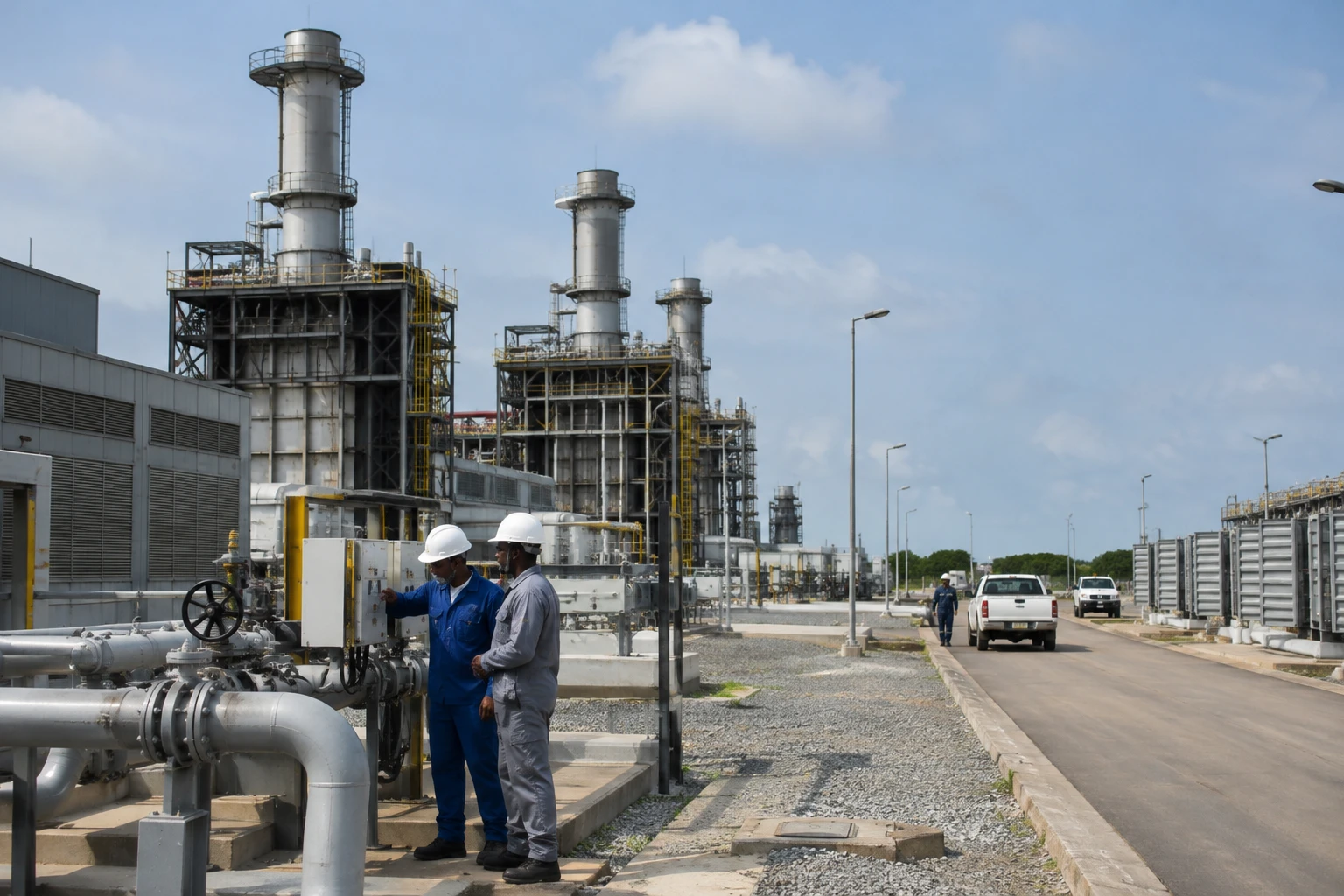
Producing more electricity is not enough to guarantee that every household has access to it. In Côte d’Ivoire, the commissioning of a new power plant has revived a crucial question: how can the country meet national demand while expanding connections and diversifying its energy sources?
On 6 November 2026, in Taboth, in the department of Jacqueville, Prime Minister Robert Beugré Mambé inaugurated the Atinkou thermal power plant. Its installed capacity of 390 megawatts brings the national electricity fleet’s capacity to 3,337 MW, according to the Ivorian ministry responsible for energy and the Ivorian Press Agency. The Ivorian energy ministry provides details on the commissioning of Atinkou; the Ivorian Press Agency confirms the announced capacity.
An electricity fleet still largely powered by thermal plants
Atinkou runs on natural gas using combined-cycle technology. This uses a gas turbine followed by a steam turbine to produce more electricity from the fuel consumed. The facility was developed by Atinkou, a company linked to the pan-African Eranove group, with the participation of the National Social Security Fund. The African Development Bank says it contributed €81 million to the project’s financing.
This new capacity is part of a system in which gas and other thermal power plants already play a major role. Figures provided in the source material attribute 67.7% of the 3,272 MW of installed capacity in 2025 to these facilities. But these figures predate Atinkou’s commissioning and therefore do not describe the current breakdown of the fleet, now reported at 3,337 MW. It would be premature to infer the new share of thermal power without recent detailed data.
Securing fuel supplies is also a challenge. Using gas extracted in the country can support local production, but power plants need sufficient and regular volumes. Côte d’Ivoire’s energy compact identifies securing gas supplies as a sectoral challenge. Additional generation capacity alone does not guarantee that units will operate at full capacity throughout the year.
Biomass and solar: diversification without losing sight of the grid
The November sequence also highlights another option. The day before Atinkou’s inauguration, on 5 November, the authorities commissioned BIOVEA, a 46 MW power plant in Ayébo, in the department of Aboisso. It uses agricultural residues, particularly from the oil palm sector. The Ivorian Press Agency and the Directorate-General for Energy both report its commissioning and capacity. The AIP explains the role of agricultural residues in electricity production.
Solar power complements this strategy, with projects announced or under way in different regions. However, building power plants does not automatically resolve transmission and distribution problems. Electricity must be able to reach secondary cities, rural communities and households that are not yet connected. The distance between a new generating unit and daily needs is also measured in lines, substations, connections and the grid’s capacity to absorb the output.
Public targets make this dual requirement clear. The 2026-2030 National Development Plan sets a target of 4,905 MW of installed capacity by 2030, with renewables accounting for 45%. It also provides for the expansion of transmission and distribution networks. The energy indicators in the 2026-2030 NDP show that the growth of renewables and infrastructure must go hand in hand.
A regional supplier, provided local needs are met
Côte d’Ivoire already exports electricity to several neighbouring countries, notably Mali, Burkina Faso and Ghana. It is integrated into the West African Power Pool, which coordinates exchanges between the region’s grids. An interconnector between Ghana and Côte d’Ivoire is also expected to strengthen these exchanges. The Ivorian economy portal describes exports and interconnections.
For the authorities, this position as a regional supplier offers an economic outlet and a lever for co-operation. But the balance is delicate: exports cannot be sustainably separated from the availability of electricity for households and businesses in the country. Figures cited in the source material report 798 GWh exported in 2025, out of total production of 14,720 GWh. This annual balance, which must be attributed to the figures available for 2025, does not on its own measure the situation after the plants commissioned in November 2026.
The benefits and constraints are not distributed evenly. Industries and major urban centres need a stable supply to produce and invest. In rural areas, the immediate challenge is often to secure an actual connection, followed by the quality and cost of service. Likewise, a power plant can support activity around its construction and operation without, on its own, guaranteeing easier access to electricity for surrounding villages.
Atinkou’s commissioning therefore marks a step towards increasing Côte d’Ivoire’s capacity, but it is not the culmination of the country’s energy policy. The next indicator to watch will be the grid’s ability to integrate this output, while solar and biomass projects will need to contribute to the 45% renewables target. Across West Africa, the same equation applies: strengthen regional exchanges while first securing domestic supply.



