Algeria
 Egypt
 Libya
 Morocco
 Sudan
 Tunisia
 Benin
 Burkina Faso
 Cabo Verde
 Côte d'Ivoire
 Ghana
 Guinea
 Liberia
 Mali
 Mauritania
 Niger
 Nigeria
 Senegal
 Sierra Leone
 The Gambia
 Togo
 Cameroon
 Central African Republic
 Chad
 DR Congo
 Equatorial Guinea
 Gabon
 Republic of the Congo
 São Tomé and Príncipe
 Burundi
 Comoros
 Djibouti
 Eritrea
 Ethiopia
 Kenya
 Madagascar
 Malawi
 Mauritius
 Mozambique
 Rwanda
 Seychelles
 Somalia
 South Sudan
 Tanzania
 Uganda
 Angola
 Botswana
 Eswatini
 Lesotho
 Namibia
 South Africa
 Zambia
 Zimbabwe
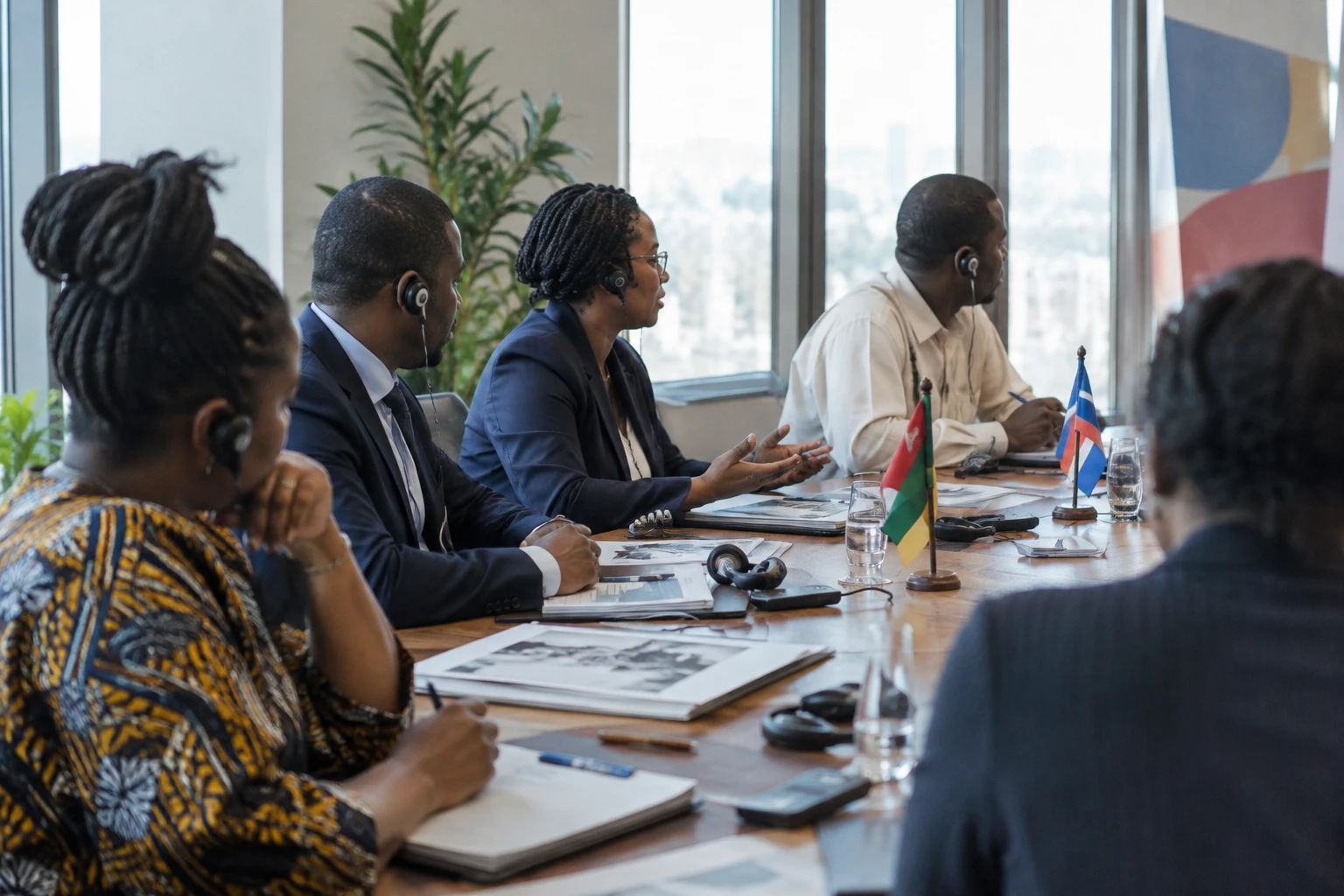
In Paris, an artistic exhibition brings a central question in the history of African independence movements into the present: what does it mean to liberate a country if its people cannot also decide their cultural, social and economic future? The exhibition dedicated to Amílcar Cabral addresses this through artworks, archives and music, rather than solely through the heroic account of a leader who is no longer alive.
A history linking Guinea-Bissau, Cape Verde and Guinea
Amílcar Cabral was born in 1924 in Portuguese Guinea, the territory that became Guinea-Bissau, to a family of Cape Verdean origin. Trained as an agronomist, he helped found the African Party for the Independence of Guinea and Cape Verde, the PAIGC, in 1956. The movement aimed to end Portuguese rule over two distinct territories linked by their colonial history.
Armed struggle began in Portuguese Guinea in 1963. Cabral also undertook political and diplomatic work: he sought to organise the movement, persuade the population and secure recognition of their right to independence. The PAIGC established a presence in Conakry, the capital of neighbouring Guinea, which served as a rear base. In 1972, the UN recognised the movement as representing the people of Guinea-Bissau and Cape Verde in debates related to decolonisation.
Cabral was assassinated in Conakry on 20 January 1973. The circumstances and responsibility for his assassination have prompted competing interpretations; it would be unwise to reduce its history to a single version. His death did not bring the struggle to an end. The PAIGC proclaimed Guinea-Bissau’s independence on 24 September 1973, and Portugal recognised it in September 1974. Cape Verde and Guinea-Bissau subsequently consolidated their political separation, notably after the 1980 coup in Guinea-Bissau.
This chronology is a reminder that Cabral’s legacy is not confined to a single state. It also belongs to the history of Cape Verde and to the solidarities forged in West Africa during the anti-colonial struggles. For an overview of the key events, the United Nations’ chronology of Guinea-Bissau confirms the dates of the assassination, the proclamation of independence and its recognition by Portugal.
Contemporary works, not illustrations of the past
Presented at the Maison des mondes africains in Paris, the exhibition “Amílcar Cabral: For a Radical Humanism” runs from 16 October to 13 December 2026. It brings together nine artists associated with Guinea-Bissau, Cape Verde, Senegal, Portugal and other parts of the African Lusophone world. Photography, video, textiles, drawing and installation bring questions of identity, memory, belonging and resistance into dialogue.
The choice to foster dialogue matters. The works are not presented as mere archival images or as definitive commentaries on Cabral. They set his thinking against today’s realities and artistic forms. The exhibition also includes films by Sarah Maldoror, a pioneering filmmaker whose work accompanied the liberation struggles. A soundtrack created by rapper and music researcher Rocé brings together songs, sound archives and music linked to the independence movements and their circulation.
The programme extends beyond the exhibition walls: talks, screenings, listening sessions and family events continue through December. The Maison des mondes africains’ detailed presentation of the event sets out the dates, artists and formats on offer. The Lusophone cultural outlet Bantumen has also covered the opening and the prominence given to contemporary works.
Culture at the heart of the political project
For Cabral, culture was not an extra reserved for artists or institutions. It was a dimension of the colonial balance of power and of a people’s ability to think for itself. Liberation, therefore, was not to stop at the transfer of political power: it also entailed transforming societies and building ways of life chosen locally.
This idea helps explain the exhibition’s approach. Setting contemporary works alongside traces of the struggles does not mean that today’s questions are identical to those of the 1960s and 1970s. Rather, it makes it possible to ask what becomes of sovereignty, transmission and memory when states are independent but colonial legacies and cultural dependencies continue to shape public narratives.
The project also concerns diasporas. In Paris, a city of exchange between Europe, Africa and Cape Verdean and Guinea-Bissauan communities, an exhibition of this kind brings visibility to histories often told from the perspective of former colonial powers. The music programme, meanwhile, highlights how the sounds of the struggles travelled between countries, political movements and generations. This heritage is not fixed: it is passed on, transformed and open to reinterpretation.
A shared legacy, distinct national trajectories
Cabral’s pan-African reach should not obscure the differences between the countries concerned. Guinea-Bissau, Cape Verde and Guinea-Conakry have their own political trajectories. The PAIGC initially advanced a shared project of emancipation, before political developments separated the paths of Guinea-Bissau and Cape Verde. Recalling these distinctions avoids turning a specific history into a general symbol detached from its places and actors.
The exhibition ultimately invites visitors to see Cabral as a political thinker, organiser and intellectual, without reducing his life to that of an icon. His assassination did not prevent Guinea-Bissau’s independence, but it deprived the movement of a central figure at a time when the post-colonial future was taking shape. The Paris exhibition puts this tension up for discussion: how can a memory of struggle be preserved while allowing artists and today’s generations to question it? Until 13 December 2026, artworks, archives and events offer some answers without closing the debate.