Algeria
 Egypt
 Libya
 Morocco
 Sudan
 Tunisia
 Benin
 Burkina Faso
 Cabo Verde
 Côte d'Ivoire
 Ghana
 Guinea
 Guinea-Bissau
 Liberia
 Mali
 Mauritania
 Niger
 Nigeria
 Senegal
 Sierra Leone
 The Gambia
 Togo
 Cameroon
 Central African Republic
 Chad
 DR Congo
 Equatorial Guinea
 Gabon
 Republic of the Congo
 São Tomé and Príncipe
 Burundi
 Comoros
 Djibouti
 Eritrea
 Ethiopia
 Kenya
 Madagascar
 Malawi
 Mauritius
 Mozambique
 Rwanda
 Seychelles
 Somalia
 South Sudan
 Tanzania
 Uganda
 Botswana
 Eswatini
 Lesotho
 Namibia
 South Africa
 Zambia
 Zimbabwe
A focus on oil, but also on timing
In Luanda, Angola’s oil industry is more than a line on a balance sheet. It still determines a decisive share of budgetary headroom, skilled jobs and the country’s ability to finance its diversification. Against this backdrop, TotalEnergies’ announced commitment carries significance beyond the boundaries of a single company: it forms part of Angola’s effort to extend the life of its offshore sector while retaining its place among the heavyweights of Southern Africa. Angola is a member of SADC, the regional economic organisation of Southern Africa, and of the African Union. Its capital is Luanda.
The signal is clear: continue investing in crude oil even as the Angolan authorities have for several years been talking about diversification, refineries, gas and local content. The issue is not new. It is becoming more pressing as production declines at some mature fields and the country seeks to turn a historic advantage into a more stable source of revenue. This is also reflected in the sector’s official strategy, which aims to sustain hydrocarbon activity over the long term, with an adjusted fiscal and regulatory framework to retain capital.
What the French group plans, and why it matters
On 9 September in Luanda, TotalEnergies’ chief executive said the group and its partners planned to invest about $10bn in Angola by 2031 to support oil production and accelerate offshore exploration. This commitment is based first and foremost on assets already under way. TotalEnergies produces about 450,000 barrels a day in the country, according to its own figures. The group therefore remains a central player in Angola’s upstream sector, alongside Sonangol, the national oil company, and the other operators active in the Angolan Gulf of Guinea.
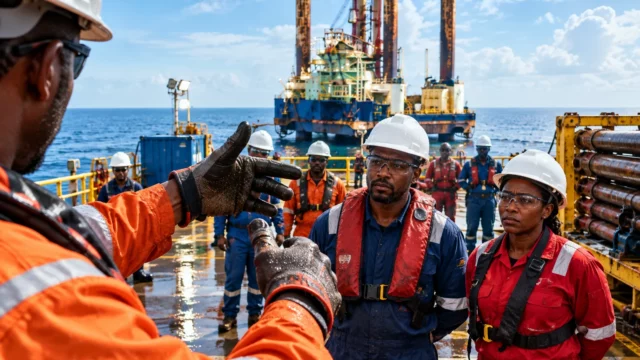
The centrepiece of this new phase is Kaminho, a deepwater project valued at about $6bn. Located about 100 kilometres off the coast, in Block 20/11 of the Kwanza Basin, it is set to develop the Cameia and Golfinho fields at a depth of 1,700 metres. TotalEnergies holds a 40 per cent stake in the project, alongside Petronas, also at 40 per cent, and Sonangol, at 20 per cent. The final investment decision was taken in 2024, and start-up is expected in 2028. The project involves converting a large oil tanker into a floating production, storage and offloading unit, or FPSO — a vessel that processes oil at sea before it is transferred.
This industrial choice is significant. Kaminho is set to become the first major deepwater development in the Kwanza Basin. It will therefore open up an area that is less mature than the Lower Congo Basin, where much of the offshore infrastructure is already concentrated. For Angola, this means two things: securing new volumes while also avoiding an oil economy confined to the exploitation of historic fields. TotalEnergies also describes Kaminho as its seventh FPSO operated in Angola, a sign of a long-standing presence, but above all of its determination to remain relevant in a market where the most profitable projects are often the most technically complex.
Luanda wants a production floor, not a one-off surge
The Angolan government’s bet is clear: to make the one-million-barrels-a-day mark a benchmark rather than an occasional peak. Recent figures nevertheless show how fragile the current base is. In December 2025, average oil production in Angola reached 1,027,844 barrels a day, according to the ANPG, the National Agency for Petroleum, Gas and Biofuels. This level confirms that the country remains sub-Saharan Africa’s second-largest crude producer, behind Nigeria. The African Development Bank and the US Department of Commerce have reached similar conclusions.
To achieve this, the authorities have made a series of adjustments. The ANPG says it has supported the incremental production project, signed the final investment decision for Kaminho with TotalEnergies and Petronas, and concluded agreements with ExxonMobil to strengthen exploration in other blocks. The Ministry of Mineral Resources, Petroleum and Gas, for its part, has changed the fiscal and regulatory framework to encourage the revival of mature fields, new drilling and the reactivation of wells. In practice, the challenge is straightforward: extract more barrels from infrastructure that has already been paid for, rather than relying solely on new discoveries that require heavy investment.
This approach has different effects. For the state, it supports revenues, which remain sensitive to crude prices. For companies, it reduces risk by relying on known assets and established offshore developments. For local workers and service companies, it creates an opportunity to expand local content, provided contracts and procurement do not remain concentrated among a handful of large international contractors. For households, however, the equation is more complex: oil rents support the budget, but do not resolve either the cost of importing refined fuels or the challenge of productive diversification.
An Angolan perspective on the issue, beyond the barrel
Regionally, the announcement comes as Southern African states that produce oil seek to protect their revenues while preparing for the post-oil era. Angola, which left OPEC in late 2023, has clearly chosen to regain greater flexibility over its volumes, partnerships and investment timetable. This decision does not mean a retreat from crude oil. Rather, it reflects Luanda’s desire to manage its resources more freely at a time when the majors remain essential to financing deepwater projects and high-risk exploration campaigns. The Angolan ministry also presents hydrocarbon development as a lever for energy security, economic sovereignty and a gradual transition.
The issue’s continental significance ultimately lies in a balance that many African countries are watching closely: how to continue investing in oil without giving up on local processing. Angola is seeking to respond through several parallel initiatives: more offshore production, more gas, more domestic refining and greater local content. The strategy is not without risk. It requires long timelines, disciplined public finances and operators able to deliver on their promises. But it also offers a different perspective on Africa’s energy debate: that of a country seeking to continue using oil as a tool of economic power without reducing itself to a fixed dependency.