Algeria
 Egypt
 Libya
 Morocco
 Sudan
 Tunisia
 Benin
 Burkina Faso
 Cabo Verde
 Côte d'Ivoire
 Ghana
 Guinea
 Guinea-Bissau
 Liberia
 Mali
 Mauritania
 Niger
 Senegal
 Sierra Leone
 The Gambia
 Togo
 Cameroon
 Central African Republic
 Chad
 DR Congo
 Equatorial Guinea
 Gabon
 Republic of the Congo
 São Tomé and Príncipe
 Burundi
 Comoros
 Djibouti
 Eritrea
 Ethiopia
 Kenya
 Madagascar
 Malawi
 Mauritius
 Mozambique
 Rwanda
 Seychelles
 Somalia
 South Sudan
 Tanzania
 Uganda
 Angola
 Botswana
 Eswatini
 Lesotho
 Namibia
 South Africa
 Zambia
 Zimbabwe
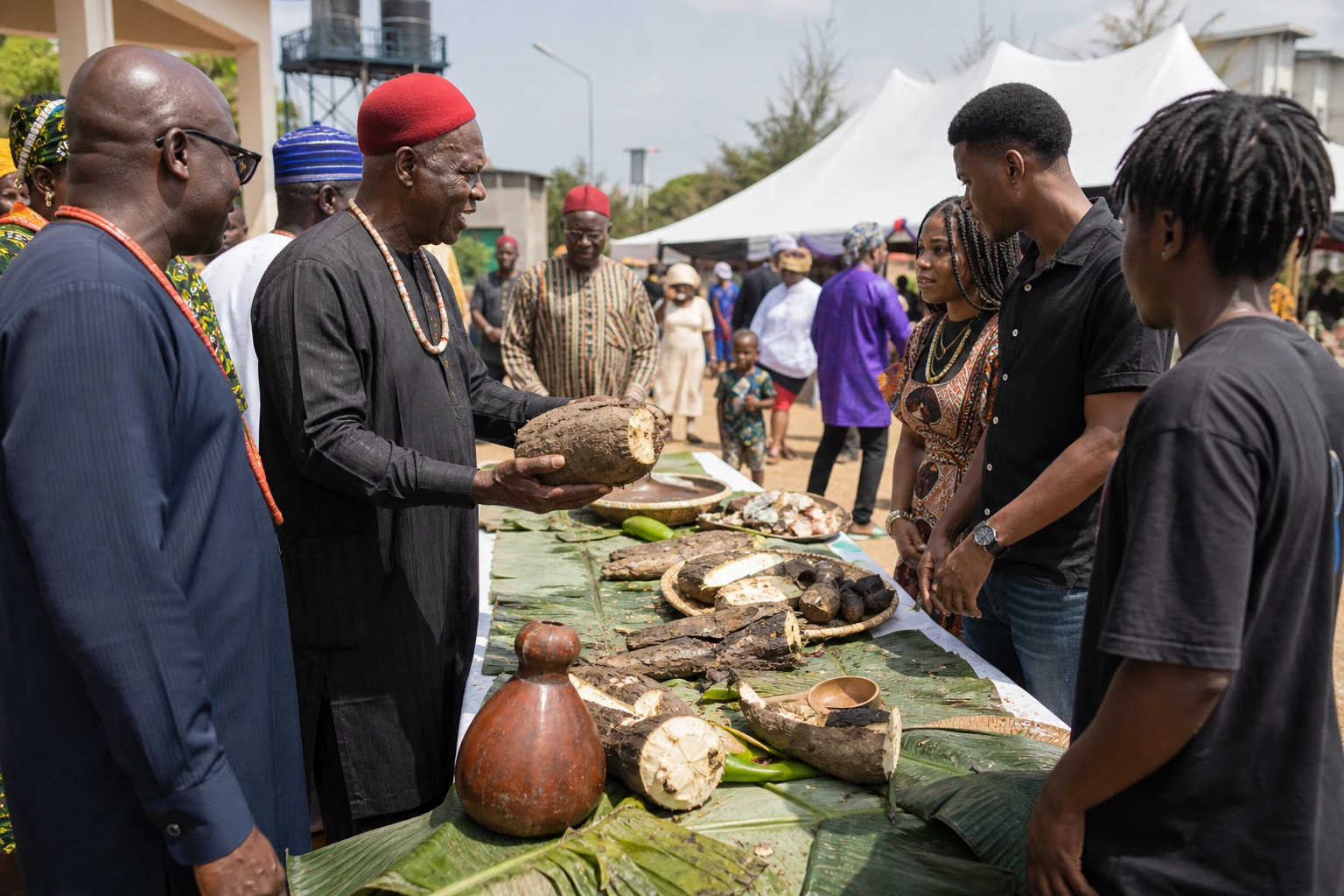
In Abuja, Igbo culture is not merely surviving far from south-eastern Nigeria. It is organising, passing itself on and finding a place in the life of the capital. The New Yam Festival, known as Iri ji or Iwa ji in different communities, offers a concrete example.
A south-eastern tradition takes root in the capital
The ceremony celebrated in Abuja brought members of the Igbo community together around the harvest, prayer and cultural transmission. In the federal capital, home to Nigerians from every region of the country, the event has a particular significance. It helps maintain a link with villages of origin while building a cultural expression adapted to urban life.
The festival has its roots in the south-eastern states, particularly Anambra, Imo, Enugu, Abia and Ebonyi. In these areas, yam plays an important role in agriculture, food and social organisation. The festival traditionally marks the start of eating the new harvest, after the first agricultural work of the year.
The timing varies according to the community and agricultural conditions. Celebrations often take place between the end of the rainy season and the start of the harvest, generally around August and September. In Abuja, however, associations adapt the date and format to the demands of city life.
This adaptation does not erase the festival’s territorial roots. Rather, it reflects an enduring Nigerian reality: communities settled in big cities continue to sustain their languages, ceremonies and networks of solidarity beyond their regions of origin.
The first tuber, a gesture rich in meaning
At the heart of the ceremony is the presentation of the new yam. Elders or traditional leaders generally open the ritual with prayers, libations and the sharing of kola nuts. These gestures express gratitude for the harvest and offer wishes for peace, health and prosperity.
In many Igbo communities, yam is therefore not regarded as a mere food. It represents agricultural work, family responsibility and a community’s ability to secure its future. In traditional society, yam production could also contribute to a man’s prestige and social standing.
The New Yam Festival thus gives an agricultural harvest a collective dimension. It recalls the role of farmers, as well as that of the families who organise food production, processing and distribution. In Abuja, this link with rural life remains present, even when participants work in government, trade, services or the creative industries.
After the rituals, participants gather around yam-based dishes. The meal then becomes a moment of sharing between generations. Children discover their parents’ practices. Adults reinterpret some customs. Elders pass on the words, gestures and stories that give the festival its meaning.
A cultural education for younger generations
In Abuja’s neighbourhoods, many young Igbos grow up in a multilingual, highly urbanised environment. English dominates at school, at work and in administrative exchanges. Nigerian Pidgin also plays an important part in everyday life. Igbo can consequently be less present in daily interactions.
The festival creates a space where the language, traditional clothing, music and dances regain public visibility. Masquerades, drums, flutes and songs are not merely elements of a show. They also serve to recall the history of communities and the diversity of Igbo cultural expression.
Transmission, however, no longer relies solely on family ceremonies. Residents’ associations, community unions and youth groups are playing an increasingly important role. They organise gatherings, document practices and use social media to reach a wider audience, including Nigerians living abroad.
This evolution is transforming the festival. Alongside rituals reserved for traditional leaders, events organised in cities often feature performances, exhibitions, fashion competitions, cooking demonstrations and activities for children. Heritage thus becomes a meeting place for memory and contemporary creativity.
Abuja, a crossroads of Nigerian cultures
The federal capital does not only host Igbo events. It also welcomes festivals organised by Yoruba, Hausa, Kanuri, Tiv, Nupe, Yakurr and many other communities. This diversity reflects Abuja’s political and administrative role, bringing together people from across Nigeria.
In this context, a community festival can strengthen a group’s identity without excluding others. Recent editions of cultural festivals in Abuja have attracted both Igbo and non-Igbo participants. This openness turns the ceremony into a space for mutual discovery, without removing its original significance for the families concerned.
The phenomenon also extends to other Nigerian cities and the diaspora. Igbo communities organise New Yam Festivals in Europe, North America and several African countries. The forms change from place to place, but the themes remain similar: gratitude, cohesion, transmission and the affirmation of a shared history.
This circulation also highlights culture’s economic potential. Tailors, restaurateurs, musicians, craftspeople, photographers and event organisers find opportunities to work at these gatherings. Heritage is therefore not confined to memory. It also contributes to the urban economy and Nigeria’s creative industries.
A significance that goes beyond celebration
The New Yam Festival is also a reminder that Nigerian identity is built on several levels. A sense of belonging to a community, a region and a nation can coexist. In Abuja, the Igbo celebration is part of this federal reality, in which local traditions help define a shared national space.
Its future, however, will depend on organisers’ ability to involve young people, preserve the meaning of the rituals and prevent the festival from becoming a mere spectacle. The question arises in many urban communities: how can the presentation of heritage be modernised without losing its social and spiritual depth ?
In Abuja, the answer already lies in organisation led by younger generations. By taking responsibility for the festival, they are not turning their backs on the city where they live. They are establishing an active, visible Igbo memory there, one capable of evolving.