Algeria
 Libya
 Morocco
 Sudan
 Tunisia
 Benin
 Burkina Faso
 Cabo Verde
 Côte d'Ivoire
 Ghana
 Guinea
 Guinea-Bissau
 Liberia
 Mali
 Mauritania
 Niger
 Nigeria
 Senegal
 Sierra Leone
 The Gambia
 Togo
 Cameroon
 Central African Republic
 Chad
 DR Congo
 Equatorial Guinea
 Gabon
 Republic of the Congo
 São Tomé and Príncipe
 Burundi
 Comoros
 Djibouti
 Eritrea
 Ethiopia
 Kenya
 Madagascar
 Malawi
 Mauritius
 Mozambique
 Rwanda
 Seychelles
 Somalia
 South Sudan
 Tanzania
 Uganda
 Angola
 Botswana
 Eswatini
 Lesotho
 Namibia
 South Africa
 Zambia
 Zimbabwe
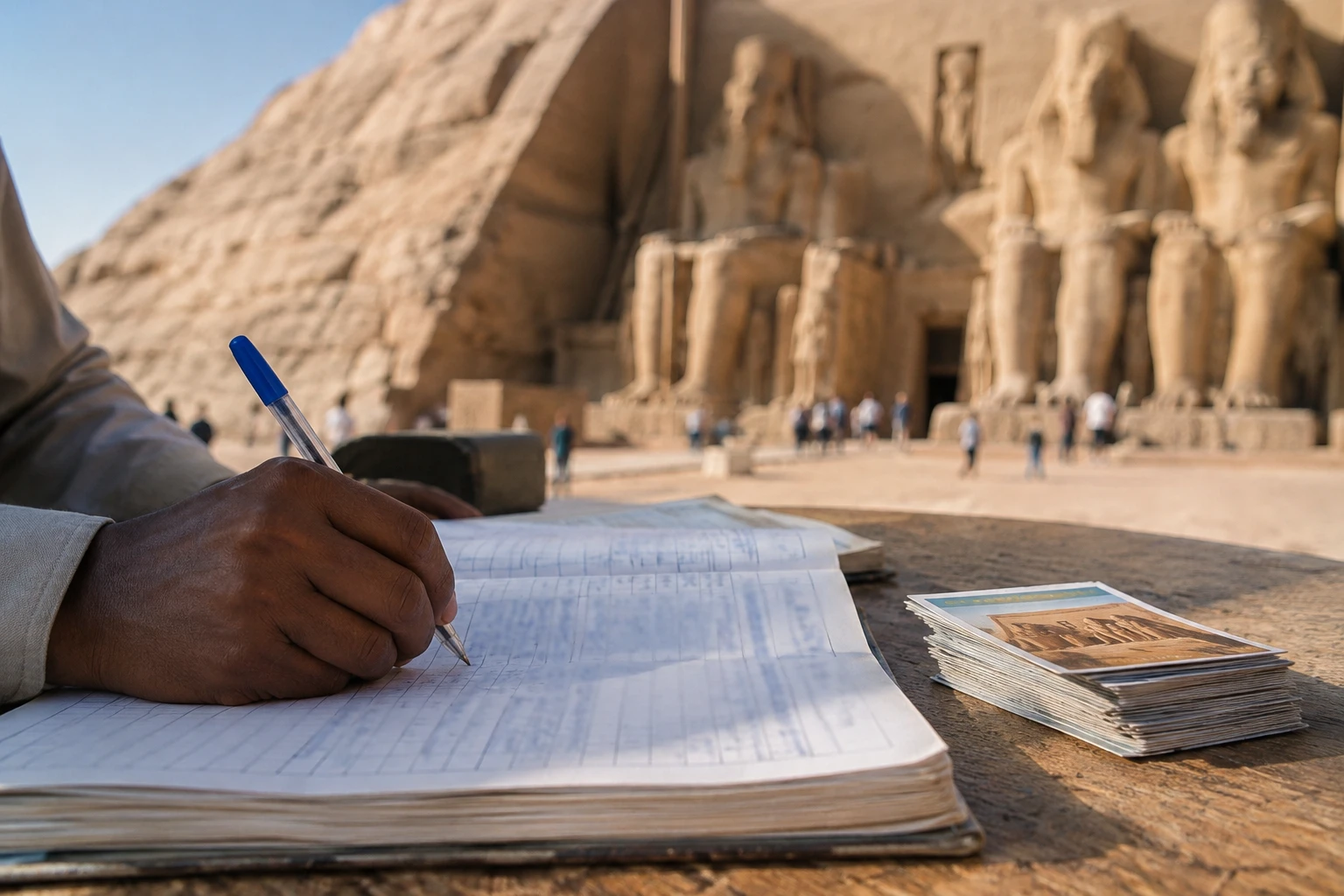
At Abu Simbel, architecture does more than endure through the centuries: twice a year, it guides the light into a pharaoh’s sanctuary. The occasion draws visitors to Upper Egypt and is also a reminder that an ancient monument can depend on technical and political decisions made in the present day.
A rendezvous between the sun and the sanctuary
At dawn on Thursday 22 October 2026, the sun’s rays entered the great temple of Ramses II at Abu Simbel, in southern Egypt. They reached the statues in the inner sanctuary, according to Agence France-Presse and Egypt’s Ministry of Tourism and Antiquities. The phenomenon usually occurs on 22 February and 22 October.
Hundreds of people gathered at the site to watch the alignment. Some visitors spent the night nearby to arrive before sunrise. Egypt’s ministry describes a ray passing through the temple and illuminating the statues of Ramses II, Amun-Ra and Ra-Horakhty. Ptah, associated in particular with the underworld, remains in shadow.
The dates are often described as the anniversary of Ramses II’s birth and his accession to the throne. This interpretation is popular, but it has not been established with certainty by any known ancient documents. It should therefore be distinguished from the observable fact: at these times of year, the temple’s orientation allows the rising sun to reach the sanctuary.
This annual rendezvous rests on the monument’s geometry and the sun’s yearly path. The light does not illuminate only the pharaoh’s face: several statues in the sanctuary are lit, while that of Ptah remains in darkness. This detail reveals the arrangement of the site without reducing its significance to a tourist spectacle.
A Nubian monument moved to survive
Ramses II had the great temple built in the 13th century BCE in ancient Nubia. The site is now in Aswan Governorate, near Lake Nasser and the border with Sudan. Its location is a reminder that Nubian history extends beyond today’s borders, even though Abu Simbel is firmly within Egypt.
The temple visitors see, however, no longer stands in its original location. The construction of the Aswan High Dam created Lake Nasser and threatened to submerge archaeological sites in the Nile Valley. At the request of the Egyptian and Sudanese governments, UNESCO launched an international rescue campaign in 1960. Work to relocate the temples of Abu Simbel began in 1964 and was completed in 1968.
Teams cut the temples into blocks and then reassembled them on higher ground, close to their original location. The operation brought together Egypt, Sudan, UNESCO and partners from several countries. It saved monuments, but also transformed a Nubian landscape and displaced communities affected by the rising waters. Heritage preservation is thus part of a broader history, linked to decisions about development along the Nile.
The monuments of Nubia, from Abu Simbel to Philae, have been on UNESCO’s World Heritage List since 1979. The organisation describes the campaign as a major precedent for international cooperation to preserve sites threatened by a large infrastructure project. At Abu Simbel, engineers also preserved the temple’s solar orientation, allowing the alignment to continue at its new location.
Heritage, territory and the local economy
For Egypt, Abu Simbel is both a place of memory and a tourist destination. Visitors contribute to the work of guides, accommodation providers, transport operators and businesses in the Aswan region. The benefits are not automatically distributed equally: large operators and established businesses may capture a different share of revenue from that received by small local enterprises.
The celebrations draw attention to a site far from Cairo and the main urban centres. They can boost the visibility of tourism in the south of the country, but also raise questions about management: visitor flows, preservation of ancient spaces and the role of Nubian communities in presenting their heritage. The story of the monument is richer when it includes this local history, not only that of the pharaoh or modern engineering.
At the regional level, Abu Simbel lies in a Nile basin shared by several countries. The construction of the High Dam and the creation of Lake Nasser had consequences in Egypt and Sudan, while development along the river remains an issue between riparian states. Here, the episode is a concrete reminder that decisions about water, energy and heritage can intersect far beyond a single site.
What the alignment tells us today
The event on 22 October connects three scales: the skill of the builders of ancient Egypt, the modern history of the temples’ rescue and today’s visitor economy. It also shows that preserving a monument means more than conserving its stones. It requires documenting changes to the site, passing on local narratives and taking contemporary uses into account.
The next alignment is expected on 22 February 2027. As with each occurrence, the light will provide a visible demonstration of the sanctuary’s orientation. But Abu Simbel’s history is not confined to a few minutes of sunshine: it also unfolds in Nubian memory, cooperation between Egypt and Sudan, and decisions about the Nile.
Sources consulted: Associated Press report on the 22 October 2026 alignment, Egyptian Ministry of Tourism and Antiquities, UNESCO World Heritage Centre on the monuments of Nubia, history of the Nubia rescue campaign and historical context on the temple’s relocation and the alignment dates.