Algeria
 Egypt
 Libya
 Morocco
 Sudan
 Tunisia
 Benin
 Burkina Faso
 Cabo Verde
 Ghana
 Guinea
 Guinea-Bissau
 Liberia
 Mali
 Mauritania
 Niger
 Nigeria
 Senegal
 Sierra Leone
 The Gambia
 Togo
 Cameroon
 Central African Republic
 Chad
 DR Congo
 Equatorial Guinea
 Gabon
 Republic of the Congo
 São Tomé and Príncipe
 Burundi
 Comoros
 Djibouti
 Eritrea
 Ethiopia
 Kenya
 Madagascar
 Malawi
 Mauritius
 Mozambique
 Rwanda
 Seychelles
 Somalia
 South Sudan
 Tanzania
 Uganda
 Angola
 Botswana
 Eswatini
 Lesotho
 Namibia
 South Africa
 Zambia
 Zimbabwe
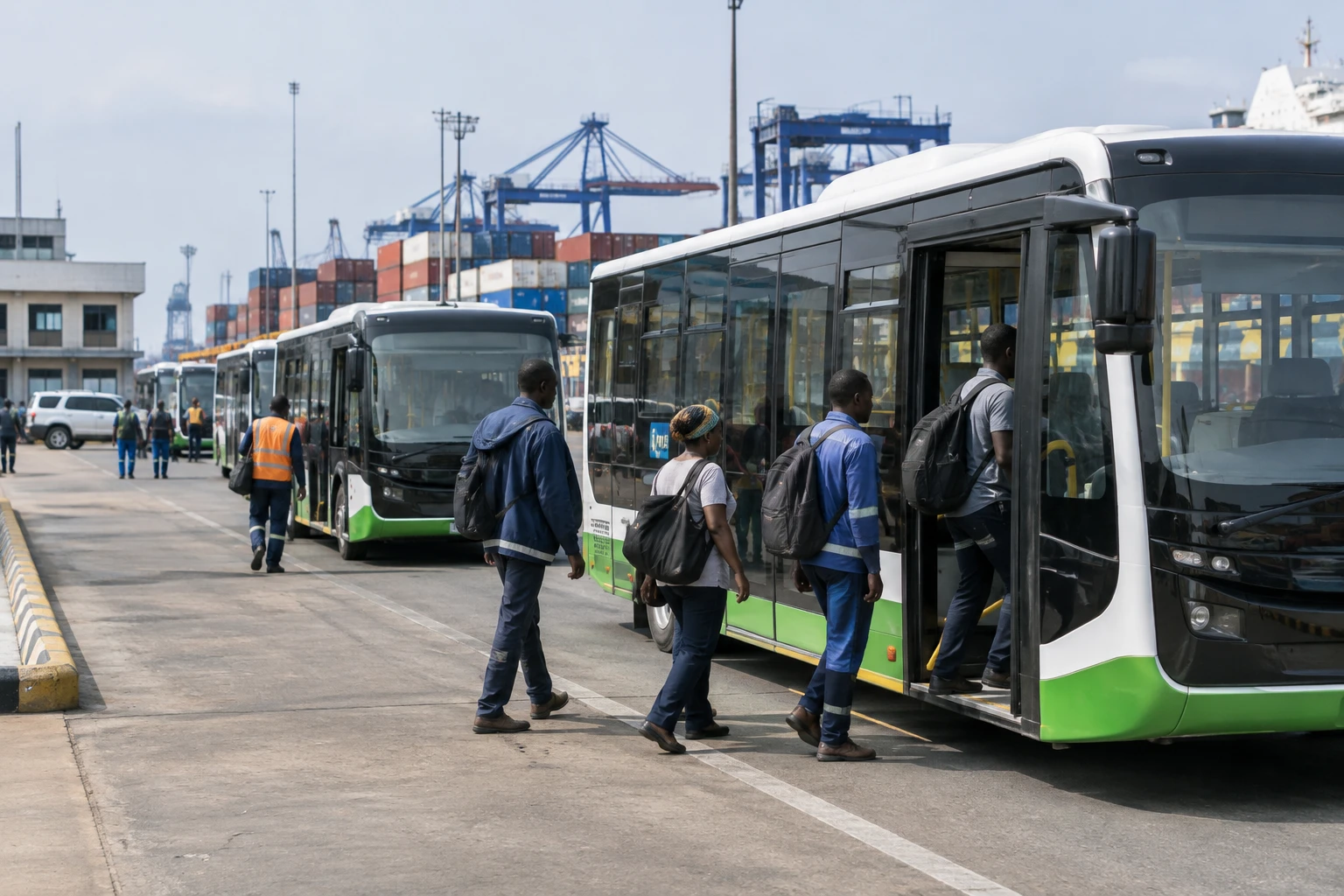
At a port terminal, the energy transition is also measured in the daily journeys made by staff. Three electric buses are now set to transport Côte d’Ivoire Terminal (CIT) employees between the quays and buildings at its Abidjan site. The initiative is modest in the context of port operations, but it raises a practical question: how can the footprint of a platform handling ever greater volumes of goods be reduced?
A growing port under operational pressure
The Port of Abidjan is a major gateway for the Ivorian economy and West African trade. Its second container terminal, operated by Côte d’Ivoire Terminal, began operations in December 2022. It is part of a strategy to increase capacity and strengthen the port’s logistics role.
Traffic growth underscores the scale of the challenge. The Port of Abidjan says it handled 1,646,304 TEUs in 2024, compared with 1,238,195 in 2023. The TEU, or twenty-foot equivalent unit, is the standard measure of container volumes. The Ministry of Transport also reports this increase, estimated at nearly 33%. Figures from the port and the ministry are consistent on this trend. The Port of Abidjan’s annual report on 2024 traffic and the assessment published by Côte d’Ivoire’s Ministry of Transport document the increase.
This activity connects Côte d’Ivoire with its landlocked neighbours, notably through West African road corridors. It supports trade and employment, but also increases demand for energy and equipment, as well as travel within port facilities. Environmental concerns therefore relate as much to the organisation of work as to operational performance.
Electric shuttles at the terminal
CIT says it took delivery of three electric buses on 20 October. Each can carry 15 passengers. The company gives their range as between 160 and 210 kilometres and says the vehicles are air-conditioned. They are intended to transport staff between the quays and the terminal’s various buildings.
These specifications come from information provided by the company and are not detailed in any independent publication consulted. The same applies to the delivery date and number of vehicles: they are therefore reported as CIT announcements, with no public data available to verify their actual use or the distances travelled.
For employees, the stated benefit is to provide internal transport in dedicated vehicles, with capacity suited to moving teams. For the operator, the shuttles could replace some journeys made by combustion-engine vehicles. The environmental benefit, however, will depend on how often they are used, the source of the electricity and battery maintenance.
CIT says the acquisition follows the earlier addition of two electric saloons to its fleet. Its chief executive, Mohamed Diao, describes the project as a response to mobility needs, quality of working life and the company’s environmental objectives. This statement sets out the project’s ambition; it is not, in itself, an assessment of its results.
Electric mobility beyond the vehicles
The shift to electric vehicles does not automatically eliminate emissions linked to mobility. It partly shifts them to electricity generation and battery manufacturing. Assessing the overall impact will require information on charging conditions, the share of journeys actually transferred to the buses and how batteries are handled at the end of their life.
These issues extend beyond the terminal. Côte d’Ivoire’s Ministry of Transport has published work on developing a regulatory framework for electric vehicles, covering their import, operation and end of life. In February 2026, the ministry also announced a technical committee on integrating electric mobility and renewable energy. These initiatives point to institutional work under way, but do not allow us to conclude that a comprehensive framework has been adopted. The regulatory work on electric mobility and the project linking electric mobility and renewable energy offer insight into this development.
At regional level, the issue also concerns alignment between equipment, electricity availability and logistics chains that cross the borders of ECOWAS, the Economic Community of West African States. Major port operators’ choices can help shape practices, but CIT’s three buses are not enough to measure a transformation across the sector as a whole.
Commitments to be measured over time
CIT highlights its “Green Terminal” certification, awarded by Bureau Veritas. The certifier confirms that the terminal received the label following an audit. This recognition attests to an initiative assessed against a given set of criteria; it does not replace the publication of quantified results on emissions, energy consumption or waste management. Bureau Veritas’ account of the Green Terminal certification explains how it was awarded.
The next step will be to establish whether the shuttles are part of a broader plan: changes to cargo-handling equipment, the use of lower-carbon energy, publication of consumption data and monitoring of effects on working conditions. These elements will help distinguish a one-off investment from a lasting transformation of operations.
In Abidjan, where container traffic rose sharply in 2024, balancing logistics capacity with impact management is a national and regional concern. The buses announced by CIT are a targeted signal. Their significance will now depend on their actual use and the transparency of the results.