Algeria
 Egypt
 Libya
 Morocco
 Sudan
 Tunisia
 Benin
 Burkina Faso
 Cabo Verde
 Ghana
 Guinea
 Guinea-Bissau
 Liberia
 Mali
 Mauritania
 Niger
 Nigeria
 Senegal
 Sierra Leone
 The Gambia
 Togo
 Cameroon
 Central African Republic
 Chad
 DR Congo
 Equatorial Guinea
 Gabon
 Republic of the Congo
 São Tomé and Príncipe
 Burundi
 Comoros
 Djibouti
 Eritrea
 Ethiopia
 Kenya
 Madagascar
 Malawi
 Mauritius
 Mozambique
 Rwanda
 Seychelles
 Somalia
 South Sudan
 Tanzania
 Uganda
 Angola
 Botswana
 Eswatini
 Lesotho
 Namibia
 South Africa
 Zambia
 Zimbabwe
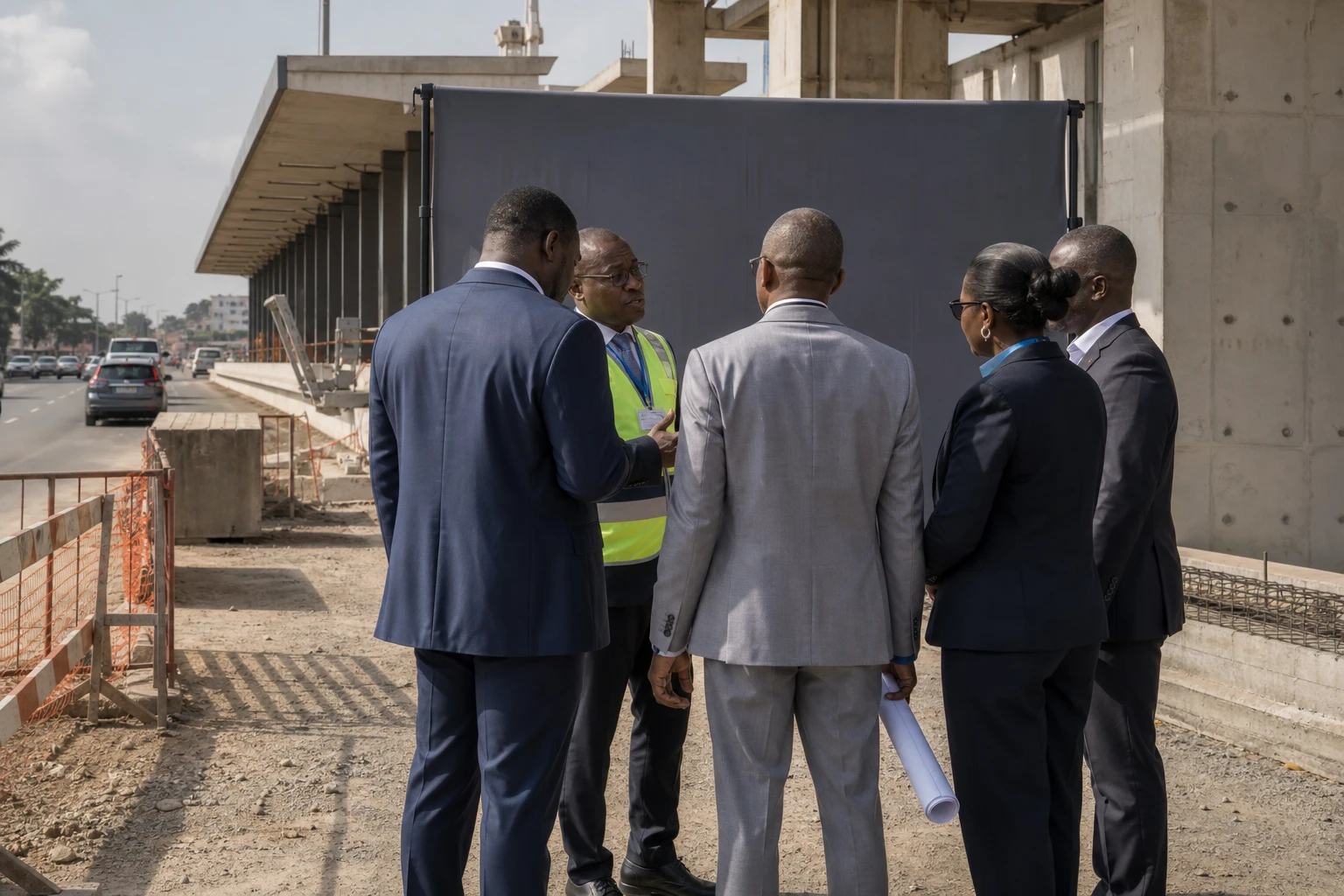
Crossing the Abidjan metropolitan area from west to east can still take several hours. The planned rapid transit corridor between Yopougon and Bingerville is intended to reduce this daily journey while reorganising part of the bus network around a dedicated route.
A 20-kilometre project at the heart of Greater Abidjan
The project is a Bus Rapid Transit, or BRT, line. The system relies on buses travelling mainly in a dedicated lane, separated from ordinary traffic. The aim is to make journeys faster and more regular.
The corridor will link Yopougon in the west with Bingerville in the east, over a distance of about 20 kilometres. It will include 21 stations and two bus depots. The line is set to cross several busy areas of the Abidjan metropolitan area.
Ivorian authorities officially launched construction on 10 July 2024 in Bingerville. The project represents an announced investment of 242 billion CFA francs. Once completed, the journey between the two municipalities could take about 45 minutes, compared with nearly three hours under current traffic conditions.
The line is designed to operate with fully electric articulated buses. The plan also provides for feeder routes to the main stations. These services are intended to make travel easier for residents who live far from the corridor, without forcing them to use several forms of informal transport.
Construction is well under way, but the schedule remains under pressure
Construction is visible along several roads in Abidjan. In Yopougon, stations are taking shape and several structures are reported to be nearly complete. These facilities are intended to cross certain junctions and ease traffic around the route.
A structure in the Indénié area nevertheless remains an important factor in the schedule. About one kilometre long, it still requires preparatory work and the installation of piles. Project teams say they aim to make up some of the delays linked to the finalisation of studies and technical plans.
Overall completion is estimated at between 25% and 30%, according to project officials cited during a site visit. This estimate should be treated with caution, as progress varies from one section to another. Roadworks, stations, bridges, electrical equipment and operating systems are not necessarily advancing at the same pace.
The line is now expected to enter service around 2029. The initial schedule envisaged operations beginning in late 2028 or early 2029. The timetable will depend in particular on the completion of structures, installation of the electrical system and trials with the future vehicles.
Traffic and compensation at the centre of the challenges
Building along an already congested route means keeping traffic moving during construction. Teams must therefore clear certain sites, secure work zones and limit disruption for motorists, pedestrians and public transport users.
This constraint is particularly acute in a metropolitan area where journeys rely on a combination of SOTRA buses, taxis, gbakas and municipal vehicles. SOTRA is the public company responsible for part of Abidjan’s public transport. Gbakas, meanwhile, provide numerous services between municipalities and outlying neighbourhoods.
The project is intended to restructure these services. Some conventional routes are to be reorganised to feed into the BRT. Informal transport is also expected to retain a role in serving the last mile, meaning the journey between a station and home or the workplace.
Land acquisition is another sensitive issue. Nearly 500 people are said to be affected by the land needed to build the Yopougon terminus. Project officials say compensation payments are due to begin soon. This stage will be crucial to easing local tensions and preventing further blockages.
Effective compensation concerns not only formal property owners. It must also take account of commercial activities, workshops, small services and income linked to occupying the affected sites. In low-income neighbourhoods, an interruption of just a few weeks can undermine a business that depends entirely on passing customers.
A project that goes beyond the bus line
The BRT is part of the Abidjan Urban Mobility Project, supported by Côte d’Ivoire, the World Bank and the French Development Agency. The programme is not limited to dedicated lanes. It also includes support for SOTRA, the modernisation of informal transport and training for professionals in the sector.
The challenge, then, is to build a coherent system. A rapid transit line will not deliver its full benefits if transfers remain lengthy, pavements are impassable or stations are poorly connected to neighbouring areas. Access to stops, pedestrian safety and fare arrangements will be just as important as bus speeds.
The choice of electric vehicles adds an energy dimension to the project. It is intended to reduce local emissions and noise along the corridor. However, that promise will depend on the availability of electricity, the grid’s capacity to supply the depots, and the maintenance of batteries and charging equipment.
The project is intended to serve nearly one million people living near the corridor, according to technical partners. Target ridership is estimated at about 330,000 passengers a day. These figures reflect the importance of the route for employees, students, traders and households travelling between Abidjan’s western, central and eastern municipalities.
A test for urban mobility in West Africa
For Côte d’Ivoire, the BRT will complement other major transport projects in Greater Abidjan, notably the metro under construction and the existing bus networks. Its success will depend on how these systems connect, rather than on each operating separately.
The issue is also of interest to ECOWAS, the Economic Community of West African States. Several capitals and major cities in the region are seeking to respond to rapid urban growth without replicating a model based solely on private cars.
The next steps in Abidjan will be closely watched: progress on structures, settlement of compensation claims, installation of electrical equipment, selection of the operator and the timetable for trials. The challenge is no longer simply to build infrastructure. It is now to ensure that it is accessible, reliable and integrated into the daily routines of Ivorians.