Algeria
 Egypt
 Libya
 Morocco
 Sudan
 Tunisia
 Benin
 Burkina Faso
 Cabo Verde
 Côte d'Ivoire
 Ghana
 Guinea
 Guinea-Bissau
 Liberia
 Mali
 Mauritania
 Niger
 Nigeria
 Sierra Leone
 The Gambia
 Togo
 Cameroon
 Central African Republic
 Chad
 DR Congo
 Equatorial Guinea
 Gabon
 Republic of the Congo
 São Tomé and Príncipe
 Burundi
 Comoros
 Djibouti
 Eritrea
 Ethiopia
 Kenya
 Madagascar
 Malawi
 Mauritius
 Mozambique
 Rwanda
 Seychelles
 Somalia
 South Sudan
 Tanzania
 Uganda
 Angola
 Botswana
 Eswatini
 Lesotho
 Namibia
 South Africa
 Zambia
 Zimbabwe
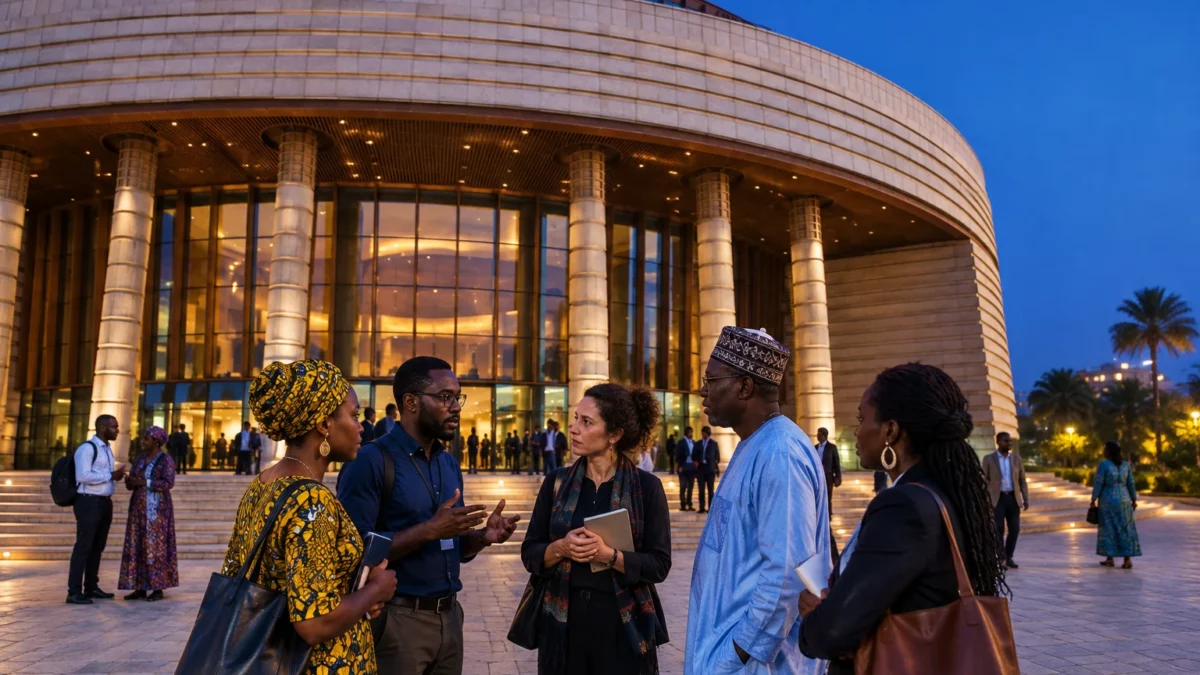
In Dakar, talking about contemporary art also means asking a question of power: who produces knowledge, chooses images and defines what deserves to be passed on? This question runs through the Biennale of African Contemporary Art and takes on particular significance with the commemoration of an intellectual gathering held in Paris in 1956.
From the Sorbonne to Dakar, a living memory
The first International Congress of Black Writers and Artists was held at the Sorbonne in Paris from 19 to 22 September 1956. Initiated by Alioune Diop and the journal Présence Africaine, it brought together nearly 60 delegates from Africa, the Caribbean, the Indian Ocean and the Americas. The gathering, sometimes described as a “cultural Bandung”, debated the effects of colonial and racial domination on the cultures of the Black world. The archives of the National Museum of the History of Immigration trace its main themes.
The comparison with Bandung refers to the Afro-Asian Conference held in Indonesia in 1955. In both cases, voices long relegated to the margins sought to come together and take part in defining a shared order. But the Paris congress had its own history: it placed cultural expression, Black experiences and the right to represent oneself at the centre.
In 2026, this memory meets another chapter in Senegal’s history. The year also marks 60 years since the World Festival of Negro Arts, held in Dakar in 1966. The festival placed African creativity in an international public arena. The Museum of Black Civilisations, which is hosting the commemorative symposium, carries forward this ambition to preserve, research and promote heritage.
A symposium at the heart of the Biennale
The international symposium marking the 70th anniversary of the congress opened on Thursday 26 November at the Museum of Black Civilisations. Scheduled to run until Saturday 28 November, it brings together writers, artists, researchers and cultural practitioners under the theme “Creations, Bodies, Images and Cosmologies”. The Senegalese Press Agency reports that Présence Africaine and the African Community of Culture, Senegal section, are organising the event with a university partner based in Sharjah. The programme announced in Dakar includes discussions on the legacy of 1956 and Negro-African cultures.
Senegal’s Minister responsible for Culture, Creative Industries and Historical Heritage, Mame Coumba Diop, presented the commemoration as more than an exercise in remembrance. She called for this legacy to be passed on to younger generations and used as a resource for thinking about the present. The APS also reported her wish for this history to contribute to cultural sovereignty. Her remarks at the opening link three milestones: 1956, 1966 and 2026.
The symposium is being held alongside Dak’Art 2026, which opened in Dakar on 19 November and runs until 19 December. The Biennale, a major event in African contemporary art, features exhibitions, meetings and events across the capital. An Associated Press report confirms that the 16th edition is under way and describes an official selection of 54 artists and 22 designers, as well as a parallel programme of several hundred exhibitions. The report on the Dakar Biennale presents its theme as a reflection on the ability to turn vulnerability into strength.
Representation, beyond the artworks
The meeting of the Biennale and the 1956 anniversary is therefore about more than the calendar. It brings a concrete question back to the fore: do African artists and researchers have the means to produce, disseminate and preserve their own narratives? The presence of works in an international exhibition matters, but it is not enough. Funding, access to decision-making spaces, distribution networks and the preservation of archives also determine which creations circulate and remain visible.
For artists, curators and cultural institutions, Dak’Art provides a space for meetings and visibility. For Dakar’s audiences, the stakes also include access to exhibitions and the place given to local art scenes within an event that attracts professionals from around the world. The “OFF” programme, spread across different venues, broadens the spaces for presentation. Its reach, however, depends on venues’ ability to welcome audiences and sustain exchanges beyond the month of the Biennale.
The symposium’s theme also opens a debate about forms of knowledge. To talk about bodies, images and cosmologies is to question how the world is narrated and experiences passed on, without reducing them to imported categories. This does not mean setting African knowledge against other forms of knowledge. Rather, it means recognising its capacity to engage in dialogue, generate ideas and shape the definition of the universal.
A Senegalese and pan-African issue
For Senegal, this moment is part of a long history of cultural diplomacy, from Présence Africaine and the 1966 festival to today’s Biennale. It also raises a question of continuity: how can major events be turned into lasting support for artists, research centres and heritage institutions? A commemoration passes on a memory; sustained cultural policies can give it practical, lasting effect.
Across West Africa and the continent, Dakar remains a meeting point for artists from Africa and the diaspora. This exchange does not erase the diversity of national, linguistic and artistic histories. Instead, it allows experiences to be compared and shared spaces to be built, without assuming a uniform African culture.
The Biennale runs until 19 December, while the symposium ends on 28 November. Its legacy will be measured less by commemorative phrases than by the traces these meetings leave: accessible archives, lasting collaborations and new opportunities for creativity. Seventy years after Paris, the challenge remains to make Black voices heard as producers of thought, not merely as objects of representation.