Algeria
 Egypt
 Libya
 Morocco
 Sudan
 Tunisia
 Benin
 Burkina Faso
 Cabo Verde
 Côte d'Ivoire
 Ghana
 Guinea
 Guinea-Bissau
 Liberia
 Mali
 Mauritania
 Niger
 Nigeria
 Senegal
 Sierra Leone
 The Gambia
 Togo
 Cameroon
 Central African Republic
 Chad
 DR Congo
 Equatorial Guinea
 Gabon
 Republic of the Congo
 São Tomé and Príncipe
 Burundi
 Comoros
 Djibouti
 Eritrea
 Ethiopia
 Kenya
 Madagascar
 Malawi
 Mauritius
 Mozambique
 Rwanda
 Seychelles
 Somalia
 South Sudan
 Tanzania
 Uganda
 Angola
 Botswana
 Eswatini
 Lesotho
 Namibia
 South Africa
 Zambia
 Zimbabwe
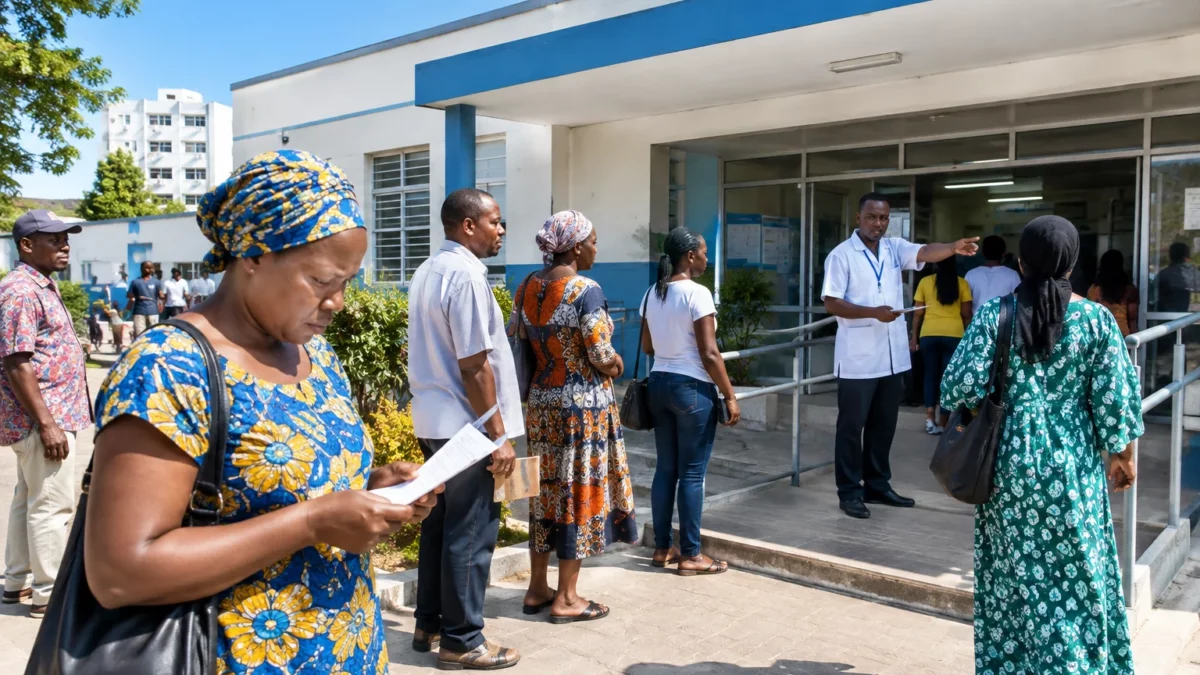
A prescription can become an unexpected expense, sometimes impossible to afford. In several African countries, reducing dependence on donors will not be enough: the transition must also avoid shifting the cost of care onto patients.
Continental commitments amid a rising bill
Two recent gatherings have put this issue at the heart of the debate. In Dakhla, Morocco, the second edition of the Dakhla Global Summit ended on 21 November 2026 with the adoption of a declaration setting out ten commitments. It provides for a roadmap through to 2030, focusing in particular on health coverage, staff training, local production and financial protection for households. Representatives from 30 African countries and other regions took part.
In Addis Ababa, Ethiopia, the fifth International Conference on Public Health in Africa (CPHIA) is taking place from 23 to 27 November. Organised by Africa CDC — the African Union’s public health agency — and the Ethiopian government, it is also addressing sustainable financing, local manufacturing and preparedness for health emergencies. Both meetings reflect the same political priority: strengthening African states’ capacity to make decisions and fund their health systems.
The financial pressure is already measurable. In its 2026 health financing reform handbook, Africa CDC estimates that official development assistance for health in Africa fell from a peak of $25.8 billion in 2021 to about $13 billion in 2025. The first figure reflects the exceptional circumstances of the Covid-19 pandemic. The same document estimates that out-of-pocket payments by households account for 35% of health spending on the continent, with significant differences between countries and regions.
Local financing does not mean making patients pay
The concept of domestic financing can obscure an essential distinction. Public money raised through taxes and national budgets does not have the same effect as a payment demanded from a patient at the time of a consultation. In both cases, the resources are local. But only the first mechanism makes it possible to pool risk and distribute contributions according to people’s means.
Vulnerability is particularly high in economies where informal employment is widespread. Conventional payroll contributions then cover only part of the population. Without sustainable public revenues or appropriate risk-pooling arrangements, an illness can push a household into debt, force it to draw on its savings or delay care. Self-employed workers and rural families, often far from services, may face both financial and geographical barriers.
Regional data from the World Health Organization confirm that the problem is not simply a lack of announced funding. In the WHO African Region, out-of-pocket payments by households still accounted for 34% of health spending in 2022, down from 37% in 2012. The WHO considers this share too high and notes that public health spending remains far below the target of 15% of national budgets set by the 2001 Abuja Declaration. Continental averages, however, do not describe the situation in every country.
From approved budgets to care actually received
Governments face real budget constraints. Rising debt and needs in other sectors limit the room available. But increasing allocations is not enough if funds are not disbursed on time, facilities lack medicines or providers are left waiting for payment. Africa CDC also points out that management bottlenecks and inefficiencies reduce the impact of the money invested.
The response therefore requires several complementary measures: prioritising essential care, improving medicine procurement, paying facilities on predictable schedules and targeting protection at the most exposed households. Insurance schemes and public coverage mechanisms can help pool risk, provided they are sustainably funded and do not leave out people working outside the formal sector.
To assess progress, governments would benefit from publishing not only approved budgets but also the funds actually spent, the share of costs paid directly by patients and the time taken to reimburse healthcare facilities. They should also track protection against health expenses that seriously undermine household budgets. These indicators make visible the gap between a political pledge and a patient’s experience, in cities and rural areas alike.
From declarations to results: a test for the African Union
The Dakhla Declaration 2026 provides for a first Health Investment Index in 2027. The tool is intended to compare investments made and health outcomes using public data, according to an independent and auditable methodology. No ranking was published during the summit. Its usefulness will therefore depend on the quality of national data and governments’ ability to account for both spending and results.
In Addis Ababa, CPHIA concludes on 27 November. Africa CDC places domestic financing within a broader programme: the production of medicines and vaccines, pooled procurement, research and emergency preparedness. These efforts matter for health security, but they do not replace household protection. Autonomy will be measured not only by the share of resources raised on the continent, but also by whether a sick person can obtain care without risking impoverishment.