Algeria
 Egypt
 Libya
 Morocco
 Sudan
 Tunisia
 Benin
 Burkina Faso
 Cabo Verde
 Côte d'Ivoire
 Ghana
 Guinea
 Guinea-Bissau
 Liberia
 Mali
 Mauritania
 Niger
 Nigeria
 Senegal
 Sierra Leone
 The Gambia
 Togo
 Cameroon
 Central African Republic
 Chad
 DR Congo
 Equatorial Guinea
 Gabon
 Republic of the Congo
 São Tomé and Príncipe
 Burundi
 Comoros
 Djibouti
 Eritrea
 Ethiopia
 Kenya
 Malawi
 Mauritius
 Mozambique
 Rwanda
 Seychelles
 Somalia
 South Sudan
 Tanzania
 Uganda
 Angola
 Botswana
 Eswatini
 Lesotho
 Namibia
 South Africa
 Zambia
 Zimbabwe
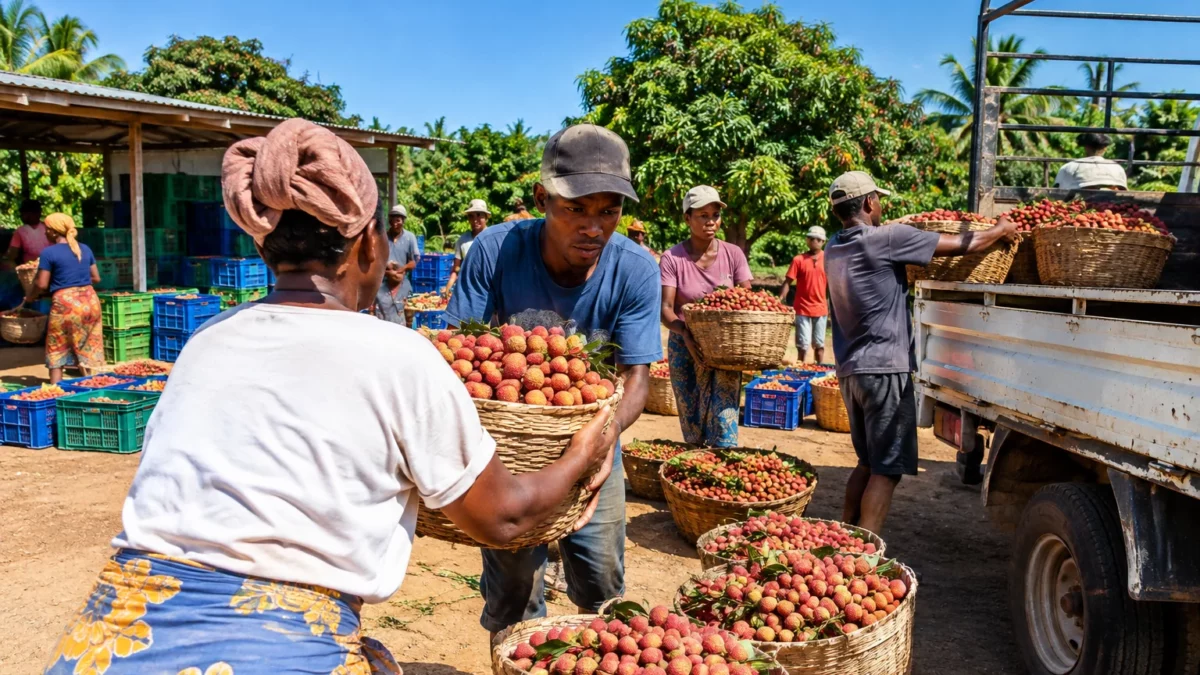
In Madagascar, this year’s lychee season depends on a delicate balance: finding enough fruit for export markets without making producers and collectors bear the full cost of the shortage. On the east coast, Cyclone Gezani left orchards unproductive and shifted harvesting areas.
Orchards hit, collection moving further afield
Cyclone Gezani struck Toamasina, also known as Tamatave, on 10 February 2026. Along the coast near the port city, damaged trees did not produce fruit this season. Collection must therefore extend to more distant areas, particularly around Vatomandry and Soanierana, according to information reported by the Malagasy press, based on observations by the Tamatave Horticultural Technical Centre (CTHT).
The distance complicates the entire supply chain. Collectors have to travel more kilometres, use more fuel and coordinate purchases across scattered locations. For growers, the absence of a harvest in some localities also means a direct loss of income. The sector supports many rural families in the east, but the frequently cited figure of 100,000 families was not confirmed by a second independent source among the material consulted.
Gezani came during a particularly difficult cyclone season. After Cyclone Fytia hit north-western Madagascar on 31 January, Gezani reached the central-east coast on 10 February. As of 25 February, the National Office for Risk and Disaster Management had reported 62 deaths and more than 431,000 people affected. Météo-France also documented the severity of the impact on Toamasina. The human and material damage gives a sense of the shock suffered by production areas, beyond its effects on exports.
Export target maintained despite tensions
The 2026–2027 season began on 19 November in the Atsinanana and Analanjirofo regions. Forecasts reported by Newsmada and 2424.mg set the export target at 18,000 tonnes. The announced markets include Europe, Russia, Dubai and Mayotte. This figure is a target, not a final harvest total: the volumes actually loaded will depend, in particular, on the pace of ripening and collection.
The minimum purchase price for export was raised from 2,000 to 2,200 ariary per kilo following discussions between the Ministry of Trade, exporters, producers and collectors. The increase followed complaints from those working on the ground. It sets a floor for purchases, but does not in itself guarantee growers’ net income: transport costs, losses and distances travelled also affect the calculation.
The first days of the season revealed disagreements over pay. Growers and collectors went on strike to protest against the initial rate, according to Midi Madagasikara. The price at which fruit reaches packing stations was subsequently reported at 3,000 ariary per kilo. This delivery rate should not be confused with the minimum price paid by exporters to collectors.
Quality alone cannot solve the logistical problem
Those in the industry must align fruit ripeness, labour availability and the departure of refrigerated ships. Any delay can shorten the collection window and make it harder to fill cargoes. Before the harvest began, the CTHT had also reported delayed ripening linked to low rainfall in October. The fall in production is therefore not explained solely by trees affected by Gezani.
The sector must therefore balance two imperatives: going further afield to find fruit and fulfil orders, while preserving acceptable pay for those who harvest and transport the produce. Higher prices may help some sellers, but they also increase the cost of supplying packing stations and add to uncertainty around export contracts.
A challenge for producing regions and regional trade
Lychees connect villages on the east coast to the port of Toamasina and then to foreign buyers. This system makes local incomes dependent on the weather, roads, maritime transport and commercial negotiations. The effects are not the same for everyone: a collector based near the port does not face the same costs as an operator who has to travel inland to more distant areas, while households without productive trees do not directly benefit from the higher price.
Madagascar, an island state in East Africa, is a member of the Southern African Development Community (SADC), a regional grouping for economic and political cooperation. The season is not, in itself, an issue for the entire region. It does, however, illustrate a question shared by Indian Ocean countries: how to sustain agricultural sectors and rural incomes after extreme weather events, while maintaining links to markets.
What happens next will depend on the volumes actually collected, the cargoes loaded and the pay provided throughout the supply chain. Maintaining the 18,000-tonne target demonstrates the importance placed on market access, but does not yet show that the harvest will meet exporters’ needs without difficulty.