Algeria
 Egypt
 Libya
 Morocco
 Sudan
 Tunisia
 Benin
 Cabo Verde
 Côte d'Ivoire
 Ghana
 Guinea
 Guinea-Bissau
 Liberia
 Mali
 Mauritania
 Niger
 Nigeria
 Senegal
 Sierra Leone
 The Gambia
 Togo
 Cameroon
 Central African Republic
 Chad
 DR Congo
 Equatorial Guinea
 Gabon
 Republic of the Congo
 São Tomé and Príncipe
 Burundi
 Comoros
 Djibouti
 Eritrea
 Ethiopia
 Kenya
 Madagascar
 Malawi
 Mauritius
 Mozambique
 Rwanda
 Seychelles
 Somalia
 South Sudan
 Tanzania
 Uganda
 Angola
 Botswana
 Eswatini
 Lesotho
 Namibia
 South Africa
 Zambia
 Zimbabwe
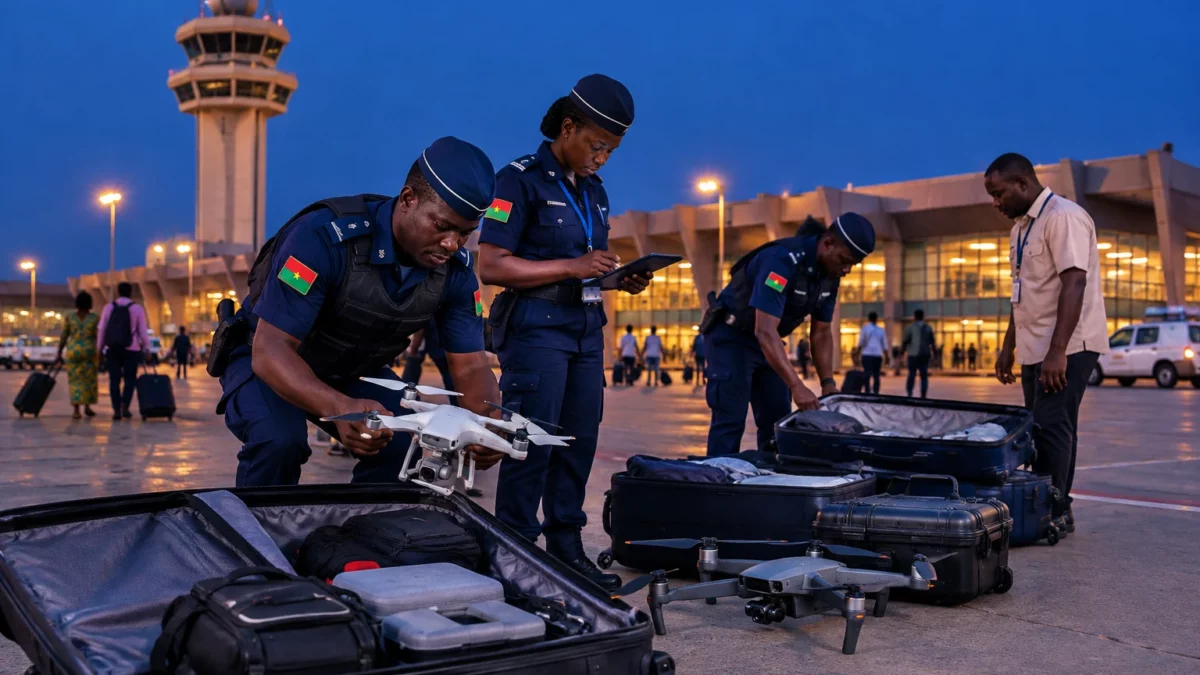
At Ouagadougou airport, a suitcase can now raise a question that goes beyond customs: when does civilian equipment become a security risk? The seizure announced by Burkina Faso’s authorities on 25 November highlights this challenge, without establishing who the equipment was intended for.
Airport interception, recipients unknown
The Directorate General of Customs says its special brigade at Ouagadougou airport intercepted 181 drones, Starlink satellite terminals and various items of equipment. The drones are worth more than 80 million CFA francs, or about €122,000. The Agence d’information du Burkina (AIB) and African Press Agency (APA) also reported these figures.
The publicly released list also includes communications equipment, military-style clothing, bulletproof vests and helmets. The devices are not all thought to be of the same type: some are described as civilian, while others could serve civilian or military purposes. That distinction matters. A surveillance drone is not, in itself, proof of hostile use.
According to explanations attributed to the regional director of customs for the Centre region, checks were carried out on travellers and their accompanied baggage. Equipment was reportedly found in suitcases and trolleys. At this stage, the authorities have not made public the identities of the carriers, any importer or the intended destination of the equipment.
Customs says the goods have been handed over to the state and confiscation proceedings are under way. The seizure alone therefore does not allow the conclusion that there was an attempt to deliver the equipment to an armed group or a specific network. The investigation and legal proceedings must establish responsibility and the circumstances.
Dual-use equipment, rules to enforce
The difficulty stems from the “dual-use” nature of some of the equipment. Drones can be used to map a construction site, inspect infrastructure or take aerial images. The same capabilities can also support military surveillance. Satellite terminals, meanwhile, provide access to a connection independent of local mobile networks. Their presence in a shipment does not prove an illegal plan, but their import and use are subject to applicable rules.
Burkina Faso has a specific legal framework for civilian drones. The 2021 law regulates, in particular, their import, sale, acquisition and operation. The National Civil Aviation Agency (ANAC) also provides practical information on the procedures involved in importing and using them. Requirements may vary according to the type of equipment and its intended use: the question is not simply whether a device is prohibited, but whether the required authorisations have been obtained.
Customs authorities say the relevant equipment must be accompanied by regulatory documents. According to remarks attributed in the Burkinabè press to the regional customs official, importers have three to four months to submit supporting documents; if they fail to do so, the administration can ask the courts to order confiscation. This procedure must be distinguished from a criminal conviction: in itself, it says nothing about the intentions of the people involved.
This distinction matters for civilian activities. Farmers, construction companies, telecommunications operators and researchers may use drones and satellite connections. Clear, predictable checks protect public safety while avoiding the assumption, without evidence, that legitimate uses are military activities.
A security issue in a changing region
Burkina Faso is facing an armed insurgency that is mobilising its defence and security forces and placing infrastructure, communications and supply chains under scrutiny. The authorities present seizures of sensitive equipment as a way to reduce the risk of diversion. This concern is legitimate to examine, but the customs statement does not show that the intercepted items were intended for a hostile operation. Their destination remains unknown.
The seizure also comes as political and security frameworks in West Africa are evolving. Burkina Faso, Mali and Niger withdrew from the Economic Community of West African States (ECOWAS), a regional organisation for economic and political integration, on 29 January 2025. They have strengthened their cooperation within the Alliance of Sahel States (AES). This reconfiguration makes practical coordination all the more important: the movement of goods, border controls and information-sharing, despite institutional differences.
For travellers and traders, the immediate impact is mainly regulatory: carrying equipment in personal baggage does not exempt anyone from declarations or supporting documents. For businesses and civilian users, the challenge is to identify the applicable authorisations in advance. For security services, effectiveness will depend on checks that can distinguish between equipment and its uses, and then submit cases to the courts with verifiable evidence.
What happens next will depend on further details about the confiscation proceedings, the missing documents and those responsible for importing the equipment. Publishing verifiable information would help clearly distinguish any customs offence from an allegation of a security threat. In Ouagadougou and across the region, that distinction will determine the operation’s real significance: preventing diversion without turning possession of dual-use technology into automatic proof of guilt.