Algeria
 Egypt
 Libya
 Morocco
 Sudan
 Tunisia
 Benin
 Burkina Faso
 Cabo Verde
 Côte d'Ivoire
 Ghana
 Guinea
 Guinea-Bissau
 Liberia
 Mali
 Mauritania
 Niger
 Nigeria
 Senegal
 Sierra Leone
 The Gambia
 Togo
 Cameroon
 Central African Republic
 Chad
 DR Congo
 Equatorial Guinea
 Gabon
 Republic of the Congo
 São Tomé and Príncipe
 Burundi
 Comoros
 Djibouti
 Eritrea
 Ethiopia
 Kenya
 Madagascar
 Malawi
 Mauritius
 Mozambique
 Rwanda
 Seychelles
 Somalia
 South Sudan
 Tanzania
 Uganda
 Angola
 Botswana
 Eswatini
 Lesotho
 Namibia
 South Africa
 Zambia
 Zimbabwe
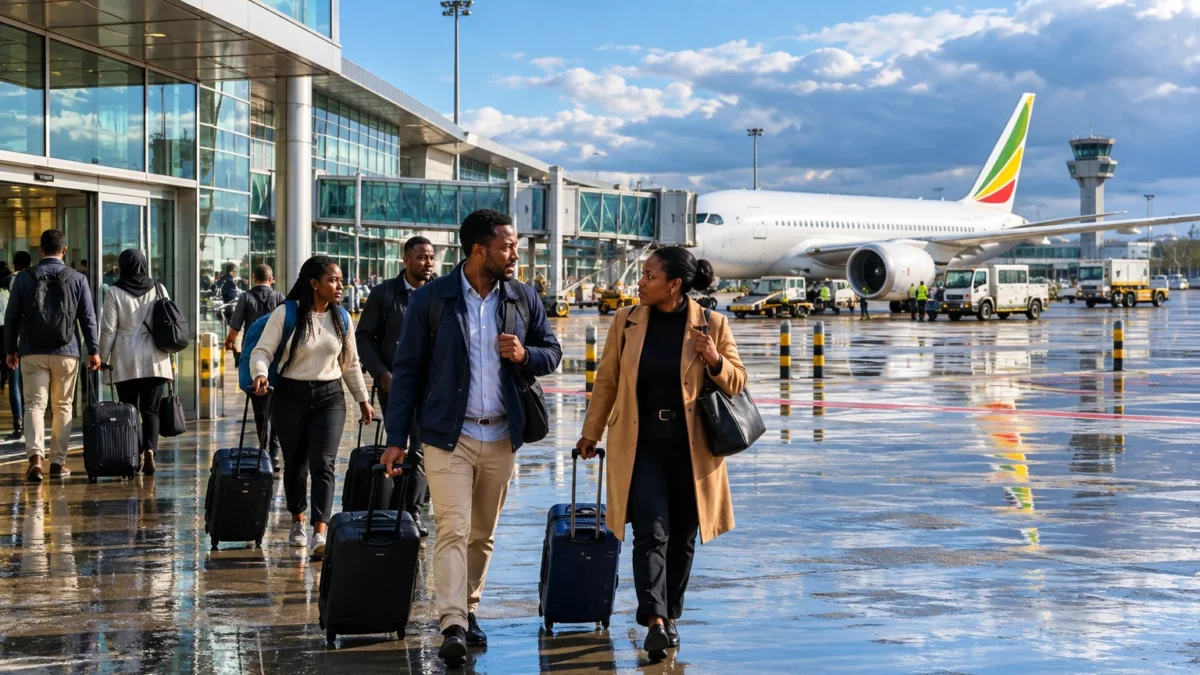
An airport can handle more passengers without the country’s airlines automatically benefiting. For African states, the challenge is twofold: expand infrastructure that is sometimes under pressure and enable the continent’s carriers to connect regional markets more effectively.
Growth expected, but highly uneven
Air travel demand in Africa is expected to rise sharply in the coming decades. Projections from Airports Council International (ACI), the international association of airports, put passenger traffic at African airports at 754 million in 2054, compared with about 274 million in 2025. The organisation estimates average annual growth of 3.6% between 2024 and 2054. These figures are projections, not a guarantee of traffic or profitability.
This potential increase is unfolding against a backdrop of differing national realities. Major airport hubs, such as Addis Ababa in Ethiopia, Nairobi in Kenya and Johannesburg in South Africa, do not face the same needs as secondary airports, which are often essential for domestic travel and regional connections. Expanding a terminal in a capital city does not, by itself, solve the shortage of connections between the continent’s cities.
The issue is linked to the Single African Air Transport Market (SAATM), an African Union initiative to liberalise routes between participating countries. Its implementation depends on concrete decisions by states: traffic rights, bilateral agreements, fees and market access conditions. Greater openness can make travel easier, but it also exposes local carriers to more competition.
Funding runways and terminals
The International Civil Aviation Organization’s (ICAO) seventh Worldwide Air Transport Conference was held in Montreal from 16 to 20 November 2026. Discussions focused in particular on infrastructure financing, market access and the sector’s resilience. ICAO listed the mobilisation of blended finance — combining public funds and private capital, among other sources — as a priority for the meeting.
ACI estimates that global airport infrastructure will require $4.1tn in investment by 2055. For African airports, needs include terminals, runways, navigation equipment and aircraft parking stands, as well as baggage and passenger processing. These elements determine an airport’s capacity to handle traffic without disrupting the regularity of operations.
Public-private partnerships can provide capital and expertise. They do not, however, replace public oversight of priorities, charges and service obligations. Investors seek predictable revenue; authorities must also take account of smaller airports, whose role in providing connections can be important despite modest passenger numbers. Stable rules and projects assessed according to their actual needs will be crucial.
African airlines remain under pressure
Building or modernising airports is not enough to ensure that African carriers capture an equivalent share of growth. According to the African Airlines Association (AFRAA), passenger traffic carried by the continent’s airlines could reach 137.3 million in 2026, up from 113 million in 2025. The association nevertheless warns of very narrow financial margins and high costs.
Data published by AFRAA for August 2026 show that African airlines held 37.6% of capacity on intercontinental routes, compared with 62.4% for non-African carriers. This proportion refers to available seats, not the share of passengers actually carried. It nevertheless highlights the weight of foreign airlines on routes between Africa and other regions of the world.
To increase capacity, airlines need to finance aircraft, maintain their fleets, launch routes and coordinate their networks. Commercial partnerships and better-organised connections can broaden their customer base. But expansion remains difficult when fuel, maintenance and airport charges weigh heavily on budgets. The benefits of increased traffic are therefore not automatically shared between airports, airlines and travellers.
Cargo and regional connections in focus
Passenger travel is not the only source of business. Cargo, warehouses, handling and customs facilities can diversify airport revenues and support trade. This requires suitable equipment and coordination between airports, carriers, customs services and logistics companies. The benefits can extend to exporters and e-commerce, but vary according to markets and available infrastructure.
Connecting countries to one another also remains a continental priority. The African Union is advancing SAATM, while regional economic communities can facilitate coordination between neighbouring states. Formal market opening must translate into authorisations and actual routes. For travellers, the issue is tangible: access to more destinations with simpler journeys, without charges making air travel unaffordable.
The Montreal conference put financing, market rules and skills at the heart of international discussions. For African countries, what happens next will depend above all on implementation: appropriate investment, predictable regulatory frameworks and regional co-operation. It is at this level that the continent’s ability to turn projected growth into networks that better serve people and local economies will be determined.
Traffic projections are set out in ACI’s global airport traffic forecasts for 2025-2054. Airline capacity figures and sector issues are reported by AFRAA in its August 2026 review. The dates and priorities of the conference are detailed by ICAO for ATConf/7.