Algeria
 Egypt
 Libya
 Morocco
 Sudan
 Tunisia
 Benin
 Burkina Faso
 Cabo Verde
 Côte d'Ivoire
 Ghana
 Guinea
 Guinea-Bissau
 Liberia
 Mali
 Mauritania
 Niger
 Nigeria
 Senegal
 Sierra Leone
 The Gambia
 Togo
 Cameroon
 Central African Republic
 Chad
 DR Congo
 Equatorial Guinea
 Gabon
 Republic of the Congo
 São Tomé and Príncipe
 Burundi
 Comoros
 Djibouti
 Eritrea
 Ethiopia
 Kenya
 Madagascar
 Malawi
 Mauritius
 Mozambique
 Rwanda
 Seychelles
 Somalia
 South Sudan
 Tanzania
 Uganda
 Botswana
 Eswatini
 Lesotho
 Namibia
 South Africa
 Zambia
 Zimbabwe
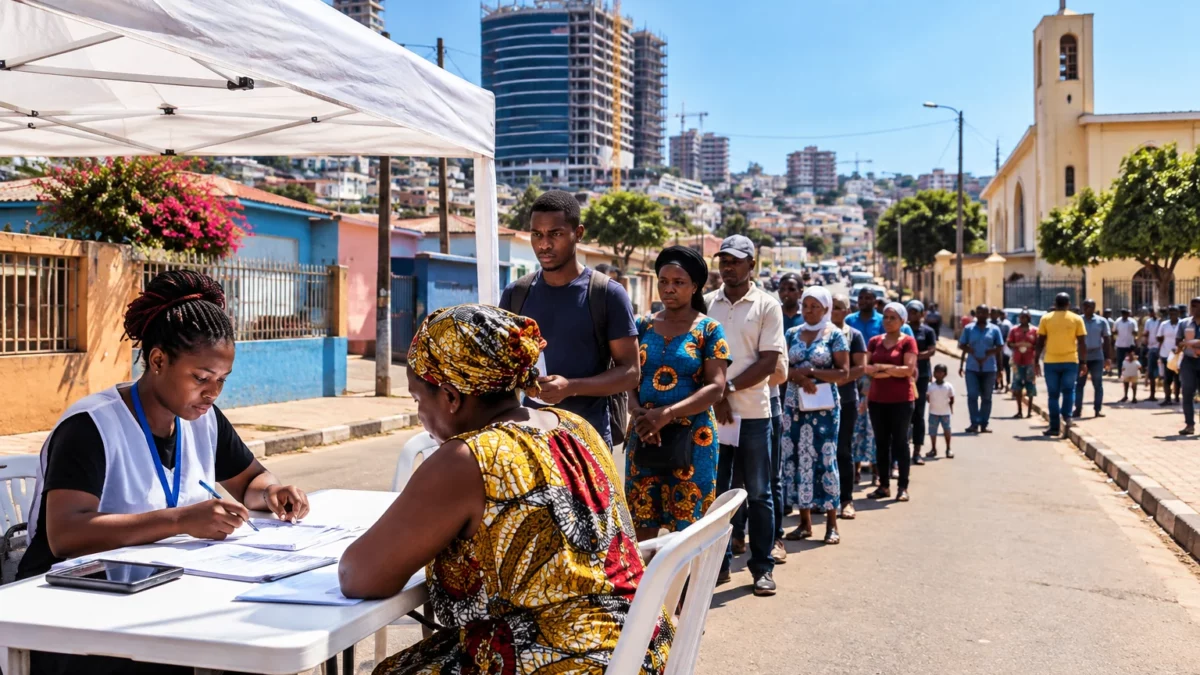
In Luanda, a tent set up near a place of worship can reduce to a few minutes a process that keeps some citizens from the ballot box. Yet as the 2027 general election approaches, the challenge goes beyond speed: every Angolan of voting age must also be able to register.
The 2027 election is being prepared now
Angola holds general elections under a system in which citizens elect MPs and the head of state is chosen from the list of the party that comes first. The country is a member of the Southern African Development Community (SADC), a regional organisation bringing together several southern African states. Preparations for the election will therefore be followed beyond the country’s borders, particularly on questions of turnout and electoral confidence.
The previous election, held on 24 August 2022, pitted the ruling People’s Movement for the Liberation of Angola (MPLA), in power since independence, against the National Union for the Total Independence of Angola (UNITA), the main opposition force. The official results gave the MPLA 51.17% of valid votes and UNITA 43.95%. But turnout remained low: 6,454,109 people voted out of 14,399,391 registered voters, or 44.82%. The corresponding abstention rate is 55.18%, rather than the 54% sometimes cited. These figures appear in the official result published in the Journal of the Republic and are also included in the electoral database of International IDEA.
Low turnout alone is not enough to explain the reasons why people abstain. It is nevertheless an important benchmark for the authorities, parties and civic organisations preparing for the next electoral cycle.
Going to voters, rather than waiting for them
In Luanda, outreach teams go on foot through some neighbourhoods. Others set up mobile registration points near universities or places of worship. The principle is simple: bring registration closer to where residents study, work or meet, and avoid making an administrative process require an additional journey.
Accounts gathered in the capital describe people registering quickly, receiving information about their polling station and being given a QR code. A 19-year-old voter said he had registered for the first time after being approached by an agent. These accounts illustrate the potential value of local outreach. On their own, however, they do not show how widely the schemes cover the country or what effect they have on turnout.
This distinction matters. A campaign can make the process more visible without persuading someone who doubts that their vote matters. And registration does not guarantee that a voter will be able to reach the polling station on election day. Travel, working hours, distance and trust in the process also influence the decision.
Identity documents: a prerequisite
The main obstacle is not always the voter registration form. Access to identity documents remains difficult for part of the population. In September 2025, Angola’s Secretary of State for Justice estimated that about half of the population did not have an identity card. The Angolan news agency Angop reported this estimate and announced measures to expand civil registration and the issuing of identity cards. The World Bank, for its part, notes that the civil war, which ended in 2002 after 27 years, destroyed civil registration infrastructure and led to the loss of many documents.
The situation is not uniform. In rural areas, the distance to government services can make it harder to obtain a document. In cities, the time involved, queues and work commitments can also discourage people from taking the necessary steps. Women and people with irregular incomes may face specific obstacles when accessing documents requires several journeys or supporting documents.
One point of method is therefore essential: teams that make voter registration easier cannot replace an accessible civil registration system. The National Electoral Commission says voters must be on the electoral roll, while the Ministry of Territorial Administration expects about 16 million adult citizens to be eligible to vote in the 2027 election. This figure, published by the NEC, indicates the scale of the operation ahead; it does not mean that all these people have already completed the necessary steps.
Trust also depends on the rules
The opposition is calling for a transparent process without favouritism. This demand is a reminder that turnout does not depend solely on the convenience of registration. It also rests on trust in the management of electoral rolls, equal access to polling stations, the counting of votes and the publication of results.
For the authorities, mobile teams can make the service more accessible and update electoral information. For citizens, they address only some of their concerns. Young people voting for the first time, residents on the outskirts of Luanda and communities far from administrative centres do not face the same constraints. The geographical reach of the schemes must therefore be assessed, not just the number of people reached in the capital.
At the level of SADC and the African Union, Angola’s election forms part of debates on civic participation and electoral credibility. The challenge in the coming months will be twofold: bring registration closer to voters and ensure that the rules are understood and applied equally. The milestones to watch are the updating of electoral rolls, access to identity documents and the publication of practical information about voting. The concrete results on these fronts, rather than the deployment of mobile teams alone, will show how well the country is preparing for the 2027 election.