Algeria
 Egypt
 Morocco
 Sudan
 Tunisia
 Benin
 Burkina Faso
 Cabo Verde
 Côte d'Ivoire
 Ghana
 Guinea
 Guinea-Bissau
 Liberia
 Mali
 Mauritania
 Niger
 Nigeria
 Senegal
 Sierra Leone
 The Gambia
 Togo
 Cameroon
 Central African Republic
 Chad
 DR Congo
 Equatorial Guinea
 Gabon
 Republic of the Congo
 São Tomé and Príncipe
 Burundi
 Comoros
 Djibouti
 Eritrea
 Ethiopia
 Kenya
 Madagascar
 Malawi
 Mauritius
 Mozambique
 Rwanda
 Seychelles
 Somalia
 South Sudan
 Tanzania
 Uganda
 Angola
 Botswana
 Eswatini
 Lesotho
 Namibia
 South Africa
 Zambia
 Zimbabwe
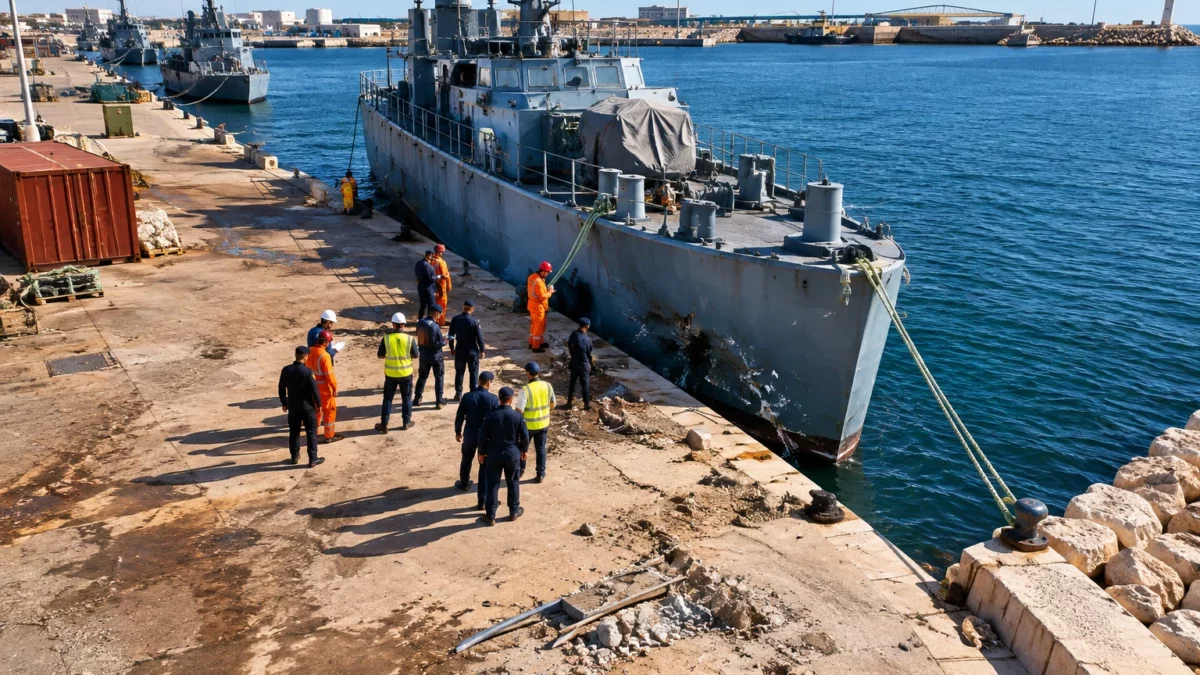
In Benghazi, the issue is not limited to the damage caused by an explosion. When a vessel linked to Russia is hit in a Libyan port, maritime security collides head-on with international rivalries and the country’s political divisions.
An investigation amid two rival authorities
Libya remains divided between two competing authorities. The Government of National Unity, led by Abdelhamid Dbeibah, is based in Tripoli, the capital, while an administration in the east is backed by Khalifa Haftar’s forces. This division complicates decision-making over ports, armed forces and agreements with foreign partners.
The country belongs to the Arab Maghreb Union (AMU), which brings together several North African states. But this regional organisation alone does not offer a maritime security mechanism capable of resolving a crisis of this kind. The Mediterranean links Libyan ports to trade and energy routes along which vessels associated with rivalries between powers also travel.
Institutional fragility remains a risk factor. In a report published in November 2026, the Office of the Prosecutor of the International Criminal Court said that factions in the east and west had signed an agreement on 30 August paving the way for elections within two years. It also noted the continued presence of armed groups and local tensions. The political agreement therefore does not erase the fragmentation of the security apparatus.
Two incidents reported on 22 November
On Sunday 22 November 2026, an explosion followed by a fire occurred aboard a Russian vessel moored at the Benghazi naval base. Initial reports mentioned a fire in an ammunition store. The eastern government later said the explosion had taken place on the vessel and that preliminary findings suggested a drone attack.
The eastern authorities said the vessel was heading for Russia and had stopped in Benghazi to refuel under maritime cooperation agreements. They announced an investigation conducted with the Russian authorities. No group had claimed responsibility for the attack at the time of the first reports, and neither Moscow nor Kyiv had issued an official response.
The nature of the damage and the human toll should be reported with caution. Reuters, citing medical sources, reported that ten people, Libyan and Russian, had been slightly injured. The Associated Press described a Russian corvette, the Merkury, as badly damaged, citing Libyan military officials. The eastern government, for its part, said the port and naval facilities had suffered no lasting damage and that operations had resumed.
A second incident was reported off Benghazi that same evening. Local media reported that a merchant ship, said to be flying the Maltese flag, had been targeted by an explosive-laden maritime device. According to Reuters, Libyan forces rescued its crew. The number of injured people cited in initial accounts differs between sources, so a precise toll cannot be established on that basis alone.
Figures for interceptions also vary. A local television channel cited more than twelve maritime drones neutralised. Military sources quoted by Reuters put the number of devices intercepted that evening at more than twenty. These figures remain attributed to their sources and have not been confirmed by a single independent assessment.
Libyan ports exposed to external conflicts
Both Libyan authorities condemned the idea of the country’s territory or waters being used as a theatre for foreign confrontations. The Tripoli government expressed particular concern about the use of ports and civilian infrastructure for activities linked to external conflicts. The eastern government said Libya was party to no war beyond its borders.
These statements highlight a practical difficulty: maritime sovereignty is being exercised in a country where authority is divided. A port can remain open to trade while hosting port calls governed by political or military agreements. Without coordination recognised by both sides, ship monitoring, control of facilities and responses to an attack can become points of domestic rivalry.
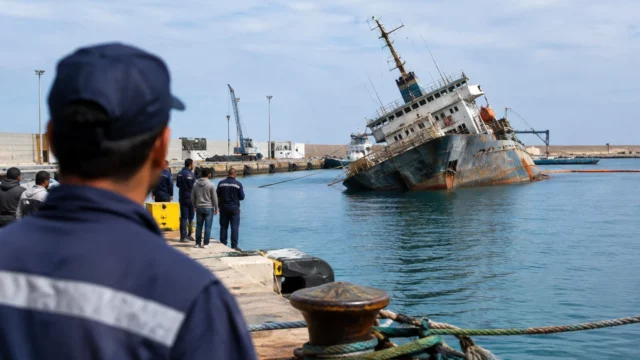
The incident also echoes tensions surrounding Russian vessels in the Mediterranean. In March 2026, a Russian gas carrier was damaged and then sank off the Libyan coast. Moscow accused Ukraine, but responsibility for the attack has not been independently established in the information available. This precedent makes the possibility of a link to the Russia-Ukraine war sensitive, but is not enough to identify those responsible for the events in Benghazi.
For residents and port workers, the immediate priority is the safety of crews, facilities and civilian operations. Official assurances that traffic has resumed will need to be assessed against the findings of the investigation. In sectors linked to maritime trade, even an unclaimed threat can lead to additional checks, delays and higher insurance costs.
Further checks will be decisive
The significance of the case will depend first on the investigation announced by the eastern administration: identification of the vessels, the origin of the devices, the actual damage and any physical evidence. Statements by the Libyan, Russian and Ukrainian authorities will need to be distinguished from independent technical findings. At this stage, no responsibility can be said to have been established.
Across North Africa, the episode is a reminder that a country’s internal divisions can turn its strategic infrastructure into a regional flashpoint. It does not, by itself, demonstrate that the war in Ukraine has spread to North Africa. But it raises an immediate question for Libya: who actually controls the ports, and under what rules can foreign vessels call there?