Algeria
 Egypt
 Libya
 Morocco
 Sudan
 Tunisia
 Benin
 Burkina Faso
 Cabo Verde
 Côte d'Ivoire
 Ghana
 Guinea
 Guinea-Bissau
 Liberia
 Mali
 Mauritania
 Niger
 Nigeria
 Senegal
 Sierra Leone
 The Gambia
 Togo
 Cameroon
 Central African Republic
 Chad
 DR Congo
 Equatorial Guinea
 Gabon
 Republic of the Congo
 São Tomé and Príncipe
 Burundi
 Comoros
 Djibouti
 Eritrea
 Ethiopia
 Kenya
 Madagascar
 Malawi
 Mauritius
 Mozambique
 Rwanda
 Seychelles
 Somalia
 South Sudan
 Tanzania
 Angola
 Botswana
 Eswatini
 Lesotho
 Namibia
 South Africa
 Zambia
 Zimbabwe
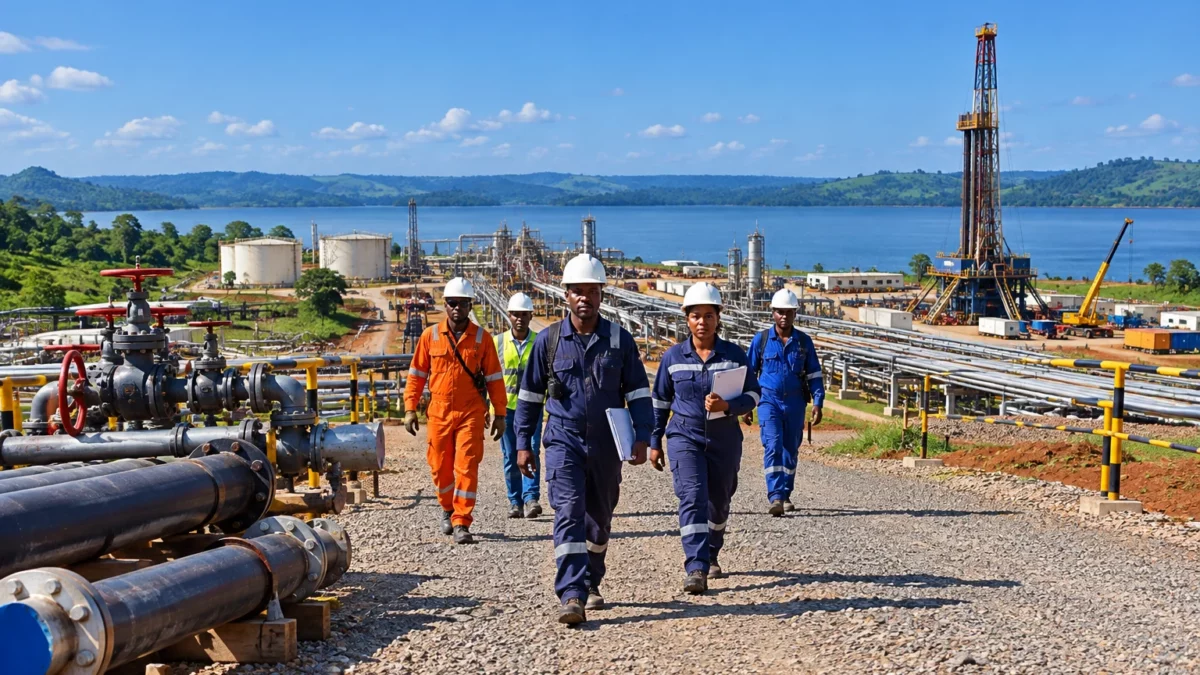
For Uganda, producing oil will not be enough to transform its economy in a lasting way. It must also decide where to refine it, how to transport fuels and which regional markets will buy them. Kampala and Dodoma want to coordinate their projects around these choices.
An oil supply chain shared between two countries
Uganda, a landlocked country in East Africa, is developing its oil fields around Lake Albert. Tanzania, which has access to the Indian Ocean, is to host the export terminal at Tanga for Ugandan crude. The 1,443-kilometre EACOP pipeline links these two economic areas.
On 18 November 2026, in Entebbe, Presidents Yoweri Museveni and Samia Suluhu Hassan called for the Tanga energy hub project to be accelerated. They also stressed the need for better coordination with the planned Ugandan refinery at Hoima. Their stated aim is to avoid redundant investment and divide refining, storage and distribution functions. Uganda’s Ministry of Foreign Affairs said EACOP was then 93.9% complete. A Tanzanian government statement, reported in September, gave a different figure of 92.7%; the estimates relate to separate monitoring dates.
This cooperation is taking place within the East African Community, which includes Uganda, Tanzania and Kenya, among others. But bilateral announcements alone cannot create an integrated energy market: cross-border pipelines, trade rules and regional demand must also follow.
Hoima is primarily targeting the Ugandan market
At Kabaale, in Hoima district, Uganda plans to build a refinery with a capacity of 60,000 barrels per day. State-owned Uganda National Oil Company (UNOC) says the project also includes a refined-products pipeline to a storage terminal at Namwabula, in Mpigi district.
The agreement signed in 2025 provides for a 60% stake for UAE-based Alpha MBM Investments and 40% for the Ugandan side. The announced investment is close to $4 billion. The timing of the final investment decision remains a point to watch, however: deadlines have shifted in public announcements. UNOC and Uganda’s public broadcaster have documented the capacity and ownership structure, but delivery still depends on financial close and contractual commitments.
For Kampala, the refinery could reduce dependence on fuel imports, valued at around $2 billion a year in official Ugandan reports. It could also create industrial and logistics activity around Hoima. For consumers, however, lower costs are not automatic: they will depend on prices at the refinery gate, transport, taxation and competition from imported products.
Tanga: a broader project, still to be defined
The Tanzanian project is not limited to a refinery. On 6 August 2026, UNOC, the Tanzania Petroleum Development Corporation (TPDC) and Vitol Bahrain signed a memorandum of understanding to develop a package of infrastructure at Tanga. Tanzania’s public daily newspaper Daily News reports that coordination teams have begun work and that the planned complex would include refining facilities, storage capacity and pipelines for refined products.
A figure of more than $20 billion has been associated with the hub’s overall ambition in press reports. At this stage, it is not proof of secured financing. The available information does not specify Tanga’s refining capacity. The distinction matters: a memorandum and implementation studies are not the same as a final investment decision or a funded construction project.
The division of roles therefore remains to be established. Hoima is intended primarily to meet Uganda’s domestic needs; Tanga could become a processing, storage and distribution point for several markets. But the two projects could also compete for crude, capital, buyers and infrastructure. Complementarity will depend on concrete commercial decisions, not presidential statements alone.
Regional competition changes the equation
Kenya is also entering the industrial race. In Lamu, on the Indian Ocean coast, authorities launched the Dangote East Africa refinery project in September 2026, announcing a capacity of 700,000 barrels per day and an investment of $16 billion. According to Kenya’s Special Economic Zones Authority, the complex is also to include facilities for plastics, fertilisers and chemicals.
This announcement gives the Tanga project a new dimension. Investors will compare access to ports, transport costs, crude availability and the size of potential markets. Countries in the region, meanwhile, will seek to guarantee regular supplies without building up costly excess capacity. The Lamu project also highlights that energy projects remain subject to land, environmental and social issues, as well as actual access to finance.
Benefits will depend on delivery
For both governments, the stakes go beyond crude exports. Local refining can support jobs, suppliers and public revenue. But those benefits will not be shared automatically: local companies will need to be able to access markets, while households and small businesses will depend on fuel prices and availability.
Energy cooperation must also rely on other infrastructure. The leaders called for a 400-kilovolt power interconnection between Wobulenzi, Masaka, Ibadakuli and Shinyanga to be accelerated. Tanzania and Uganda are also studying links for gas and refined petroleum products. These networks could facilitate trade, but each requires financing, regulatory agreements and technical steps that remain to be completed.
The next concrete milestone is the commissioning of EACOP, which several statements published in 2026 say is close to completion. The pipeline is to transport Ugandan crude to Tanga; it does not, on its own, guarantee that the planned refineries will be built. Attention will therefore focus on investment decisions at Hoima, financing and studies for the Tanzanian hub, and the ability of both projects to find a place alongside Lamu. This is where the ambition of regional integration will truly be put to the test.