
 Algeria
 Egypt
 Libya
 Morocco
 Sudan
 Tunisia
 Benin
 Burkina Faso
 Cabo Verde
 Côte d'Ivoire
 Ghana
 Guinea
 Guinea-Bissau
 Liberia
 Mali
 Mauritania
 Niger
 Nigeria
 Senegal
 Sierra Leone
 The Gambia
 Togo
 Cameroon
 Central African Republic
 Chad
 Equatorial Guinea
 Gabon
 Republic of the Congo
 São Tomé and Príncipe
 Burundi
 Comoros
 Djibouti
 Eritrea
 Ethiopia
 Kenya
 Madagascar
 Malawi
 Mauritius
 Mozambique
 Rwanda
 Seychelles
 Somalia
 South Sudan
 Tanzania
 Uganda
 Angola
 Botswana
 Eswatini
 Lesotho
 Namibia
 South Africa
 Zambia
 Zimbabwe
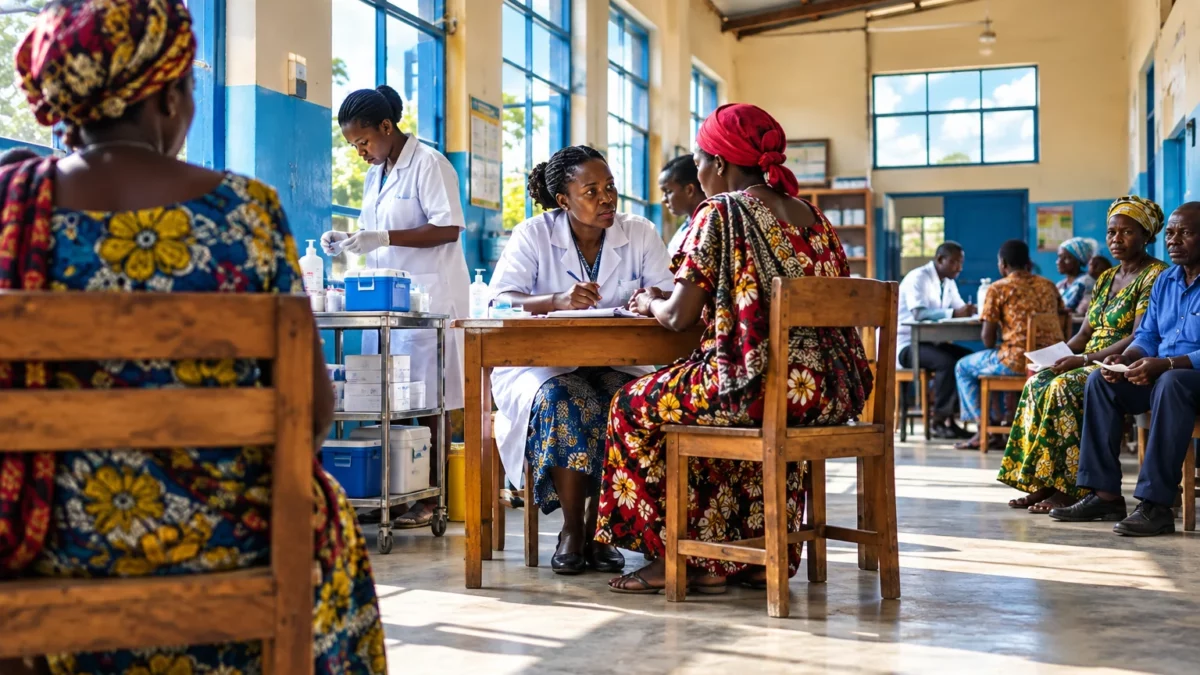
An Ebola response is measured by more than the sums pledged. In the east of the Democratic Republic of the Congo, the question also arises in health centres, displacement sites and hard-to-reach villages: can teams identify patients, protect health workers and earn residents’ trust?
Six months after the outbreak was declared, these obstacles remain central to the crisis. They shed light on the debate over how funding is used, as well as the place communities are given in the public health response.
A health emergency in an already fragile region
Declared on 15 May 2026 in Ituri province, the 17th Ebola outbreak in DR Congo is caused by the Bundibugyo virus. The World Health Organization classified it as a public health emergency of international concern. Transmission spread beyond Ituri amid insecurity, population displacement and cross-border trade with Uganda.
There is no licensed vaccine or approved specific treatment for the Bundibugyo strain. The response therefore relies in particular on screening, isolation, supportive care, contact tracing and infection prevention. But these measures become less effective when residents are far from health centres or teams cannot move freely.
The WHO has also warned that areas of transmission overlap with territories affected by conflict and displacement. Violence hampers surveillance and access to care, while the outbreak disrupts routine health services. Neighbouring countries are also at risk: Uganda was affected at the start of the outbreak, and the organisation is calling for stronger regional coordination.
Funding pledged, needs still evident
Funding has become another point of tension. On 15 October, Africa CDC said donors had disbursed nearly $962 million to international organisations and NGOs tasked with carrying out response activities. The agency specified that the money had not been paid to the Congolese government.
According to the same statement, only 30% of the organisations concerned had provided information at a monitoring meeting. Those that responded said they had received about $220 million, of which $120 million had already been spent. Africa CDC said it had no information on more than $700 million. This finding points to a lack of visibility for the authorities; on its own, it is not enough to establish that the funds have disappeared or gone unused.
On the ground, humanitarian and health workers nevertheless describe shortages and overstretched services. In Bukavu, doctor De-Joseph Kakisingi, president of the National Council of Humanitarian and Development NGO Forums, cited delays in staff payments and facilities with limited capacity. These difficulties do not, by themselves, prove what happened to each allocation. They do, however, raise a practical question: how can the sums mobilised be linked to the care, equipment and salaries actually available?
The Associated Press also reports delays in paying health workers and weaknesses in contact tracing and isolation. The agency quotes Africa CDC as saying that a large share of new cases were going undetected by surveillance. As of 15 November, the authorities had recorded more than 11,000 cases; nearly half of those infected had died, according to government data reported by the agency. These figures describe an evolving situation and should be read as of the publication date.
Communities, a central link in the response
The Norwegian Refugee Council (NRC) advocates an approach that better integrates health, humanitarian aid and local engagement. The NGO notes that families living in displacement sites may lack water, toilets or space to isolate someone who is ill. In these conditions, following health guidance can be difficult, even when residents understand its importance.
Community engagement is not simply a matter of sharing prevention messages. It requires listening to local concerns, working with community leaders and making services accessible. It also means supporting everyday needs — water, hygiene and routine care — which determine whether people can protect themselves against the virus.
This approach also addresses an epidemiological challenge. The WHO has noted that only a limited share of cases was identified through contact tracing. Without rapid identification, chains of transmission remain difficult to reconstruct. Trust, the safety of teams and access to care all partly determine the quality of this surveillance.
Implications for DR Congo and neighbouring countries
In Kinshasa, the authorities must coordinate ministries, health services and international partners, while making funding more transparent. In the affected provinces, the challenge is different: maintaining care and prevention despite fighting, displacement and difficult roads. The consequences therefore vary for institutions, health workers, city residents and families far from health facilities.
At regional level, the outbreak is a reminder that borders do not reflect the daily movement of people and goods. The WHO has highlighted risks to neighbouring countries, particularly those linked to affected areas by cross-border trade. Surveillance and preparedness must therefore be coordinated between DR Congo, Uganda and other countries in the region.
The next steps will depend as much on the ability to slow infections as on transparency over resources. DR Congo and its partners will need to show where funds are committed, which services they support and which needs remain unmet. Without this visibility, financial pledges risk remaining far removed from the experience of residents and frontline teams.
The WHO on the Bundibugyo Ebola outbreak in DR Congo · Africa CDC’s statement on response funding · The NRC’s work with displaced communities



