Algeria
 Egypt
 Libya
 Morocco
 Sudan
 Tunisia
 Benin
 Burkina Faso
 Cabo Verde
 Côte d'Ivoire
 Ghana
 Guinea
 Guinea-Bissau
 Liberia
 Mali
 Mauritania
 Niger
 Nigeria
 Senegal
 Sierra Leone
 The Gambia
 Togo
 Cameroon
 Central African Republic
 Chad
 DR Congo
 Equatorial Guinea
 Gabon
 Republic of the Congo
 São Tomé and Príncipe
 Burundi
 Comoros
 Djibouti
 Eritrea
 Ethiopia
 Kenya
 Madagascar
 Malawi
 Mauritius
 Mozambique
 Rwanda
 Seychelles
 Somalia
 South Sudan
 Tanzania
 Uganda
 Angola
 Botswana
 Eswatini
 Lesotho
 Namibia
 South Africa
 Zambia
 Zimbabwe
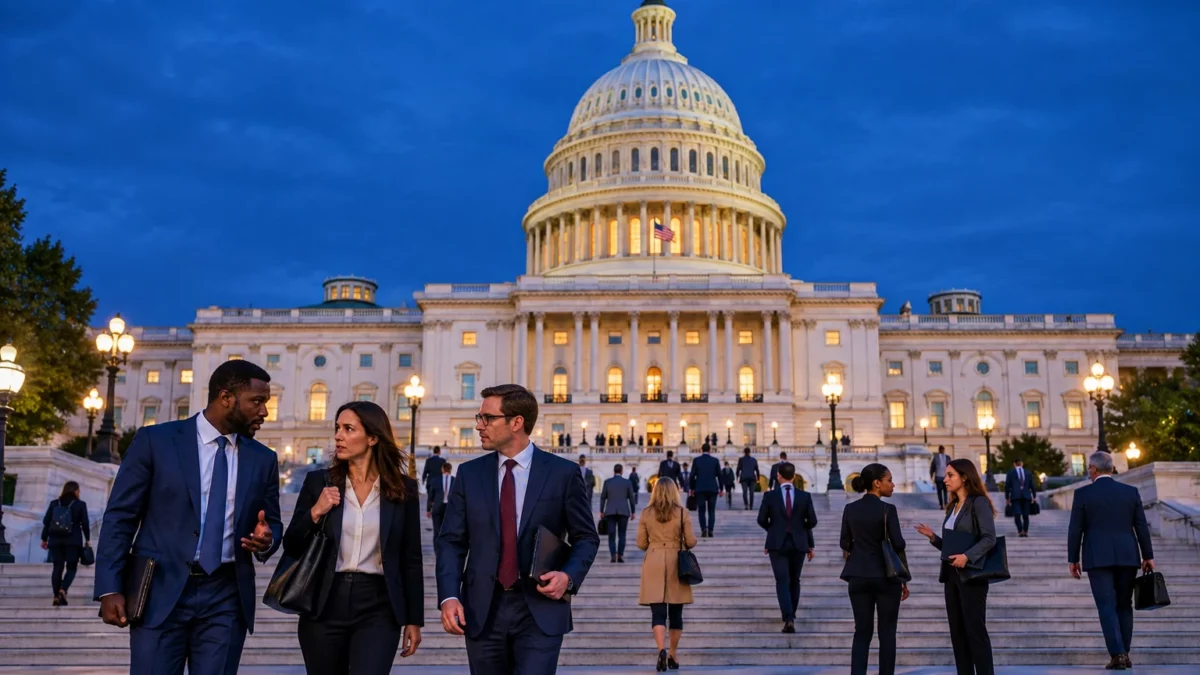
The Democratic victory in the US midterm elections opens a period of confrontation in Washington. For sub-Saharan African countries, the immediate issue is not an automatic change in policy, but Congress’s ability to influence budgets, trade and scrutiny of agreements concluded by the White House.
The results of the 3 November vote give Democrats control of both chambers. But the newly elected members will not take office until 3 January 2027. Until then, Republicans retain their majority in the outgoing Congress. This transition matters: the practical effects will depend on laws passed, available funding and presidential decisions that may be taken in the meantime. The Associated Press has reported that Democrats won both chambers. The count in the US midterm elections
Congress can restrain foreign policy, but not dictate it alone
The US system divides powers. The president leads much of the country’s foreign policy and can veto legislation passed by Congress. Lawmakers, for their part, control federal funding, can hold hearings and can demand answers from the administration. They would need a two-thirds majority in both chambers to override a presidential veto.
This division limits rapid change. It nevertheless gives lawmakers budgetary and oversight tools. Democrats could, in particular, demand greater transparency on aid programmes or partnerships involving critical minerals. This guarantees neither the continuation of funding nor changes to agreements: each initiative will have to pass through the legislative process and withstand a possible veto.
AGOA illustrates the uncertainty. This trade preference scheme allows eligible sub-Saharan African countries to export certain goods to the US market duty-free. Contrary to what the original text indicates, the programme is due to expire on 31 December 2026, not in September 2025; the available information does not confirm an extension until December 2028. A Congressional Research Service report published in August 2026 says Congress has yet to decide whether to renew the scheme, and for how long. The Congressional Research Service’s update on AGOA’s expiry
For African exporters, timing matters as much as the outcome. A late or short renewal would complicate investment decisions and sales planning. The consequences would vary by country and sector: preferential access does not apply to all economies in the same way. Country eligibility is also determined by presidential decisions, limiting the room for manoeuvre of a Congress seeking to prevent a suspension.
Aid, health and minerals: budgetary levers under scrutiny
Foreign aid funding is another arena for confrontation. Lawmakers can try to preserve funding through budget legislation. The issues cited include HIV programmes, among them PEPFAR, the US initiative dedicated to HIV/AIDS prevention and treatment. However, protecting some funding would not necessarily restore programmes cut or reorganised by the executive.
Needs vary from country to country. In southern Africa, health budgets and HIV treatment services could be particularly exposed if external funding declines. Governments, healthcare facilities and patients would not all experience the same effects. In the absence of cross-checked data in the available material, it is not possible to attribute a precise amount to the cuts or provide a country-by-country assessment here.
Agreements on critical minerals raise a different question: who oversees the terms and conditions of investment? The United States and the Democratic Republic of the Congo (DRC), whose capital is Kinshasa, signed a framework agreement on 4 December 2025 covering critical minerals, infrastructure and governance, among other areas. The International Energy Agency’s entry confirms the date and these areas of co-operation. The IEA’s entry on the strategic partnership between Washington and Kinshasa
Congress cannot necessarily cancel an executive agreement with a simple vote. It can, however, review the associated federal funds and demand safeguards on their use. Closer congressional scrutiny could therefore slow some projects or lead to additional conditions, particularly on transparency. For the DRC, the challenge is also to turn access to resources into investment, infrastructure and local economic benefits, rather than merely exports of raw materials.
External competition, with no single answer for the continent
The US vote does not suspend decisions already taken by the administration. Tensions with Pretoria and Abuja, for example, concern distinct bilateral relationships and should not be conflated. South Africa, a member of the Southern African Development Community (SADC), and Nigeria, a major power in West Africa, do not have the same trade interests or relations with Washington.
Economic competition is also intensifying with other partners. Since 1 May 2026, China has applied an expanded duty-free access scheme covering products from 53 African countries with which it has diplomatic relations, according to its Ministry of Finance. Eswatini, which recognises Taiwan, is not covered. This opening alone does not guarantee an increase in exports: production capacity, standards, logistics and local processing remain decisive. China’s duty-free access arrangements African Press Agency’s report on the measure
The impact of the US result will therefore be measured from January 2027: budget votes, a possible renewal of AGOA, hearings on mining agreements and executive decisions. For the countries concerned, Democratic control could increase scrutiny and complicate some decisions. It does not, by itself, amount to a shift in US policy. Each African government will also have to negotiate its priorities in an environment of competition among external partners, while choices on regional integration and economic transformation remain primarily African.