Algeria
 Egypt
 Libya
 Morocco
 Sudan
 Tunisia
 Benin
 Burkina Faso
 Cabo Verde
 Côte d'Ivoire
 Ghana
 Guinea
 Guinea-Bissau
 Liberia
 Mali
 Mauritania
 Niger
 Nigeria
 Senegal
 Sierra Leone
 The Gambia
 Togo
 Cameroon
 Central African Republic
 Chad
 DR Congo
 Equatorial Guinea
 Gabon
 Republic of the Congo
 São Tomé and Príncipe
 Burundi
 Comoros
 Djibouti
 Eritrea
 Ethiopia
 Kenya
 Madagascar
 Malawi
 Mauritius
 Mozambique
 Rwanda
 Seychelles
 Somalia
 South Sudan
 Tanzania
 Uganda
 Botswana
 Eswatini
 Lesotho
 Namibia
 South Africa
 Zambia
 Zimbabwe
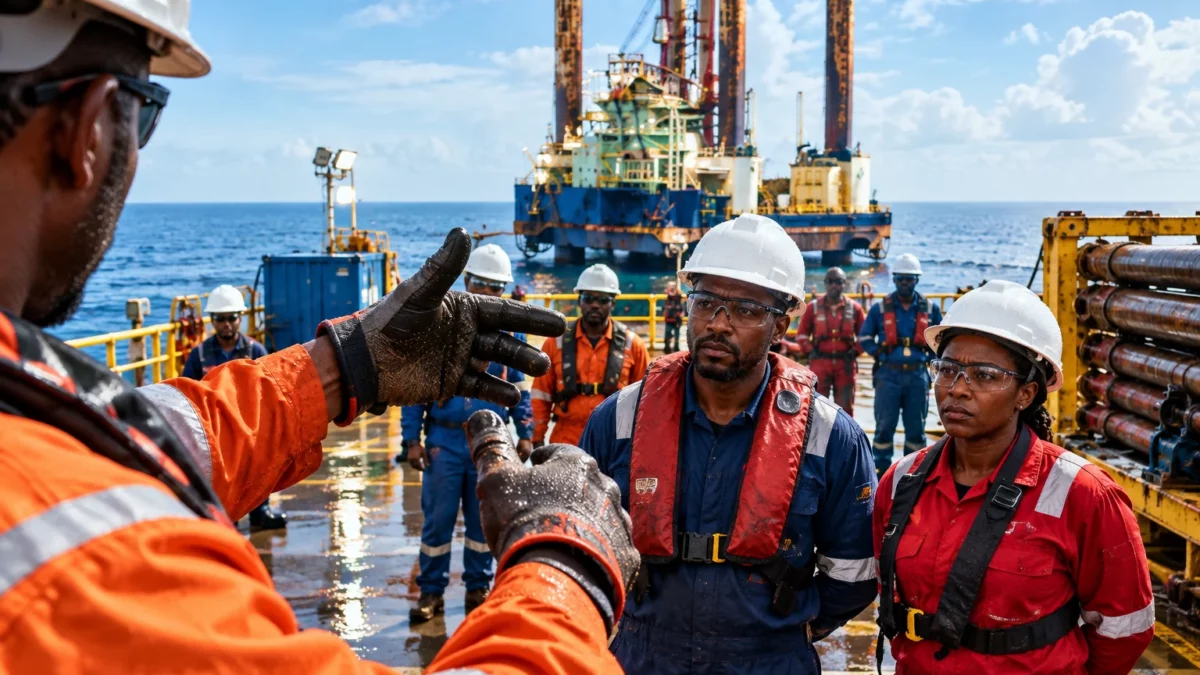
Could an offshore discovery alter Angola’s oil trajectory? In Luanda, the answer will depend less on the announcement than on the analyses to come: no commercially recoverable volume has yet been established for the Burututu-1 well.
A discovery, not yet new production
The well was drilled in offshore Block 5/06, in the Kwanza Basin. Sonangol Exploração & Produção, the operator and 100% stakeholder in the block, carried out the work. The state-owned company and the National Agency for Petroleum, Gas and Biofuels (ANPG) announced the discovery on Wednesday 18 November.
Burututu-1 reached 3,882 metres below the surface, in an area where the water is 259 metres deep. The teams identified 25 metres of hydrocarbon-bearing reservoir. However, the available data provide neither an estimate of the volume nor confirmation that production would be profitable. The ANPG and Sonangol say technical studies must establish the characteristics and extent of the area.
This distinction is essential. A geological discovery does not automatically become a proven reserve, let alone a producing field. The reservoir must be characterised, the recoverable share estimated, costs studied and the viability of the necessary infrastructure assessed. For now, Burututu-1 is an exploration result, not an immediate increase in available barrels.
The well marks a first for Block 5/06: the sources consulted describe it as the first hydrocarbon discovery in its pre-salt reservoirs, located beneath layers of salt. The result sheds light on the geology of the Kwanza Basin, but does not yet establish that the area contains a commercial field.
The challenge of replacing declining barrels
The discovery comes against the backdrop of a wider challenge. Angolan production stands at around one million barrels a day, well below levels reached in the early 2000s. A document from Angola’s Ministry of Finance gives an average of 1.036 million barrels a day in 2025, followed by a slight increase in the second quarter of 2026. The IMF, for its part, projects production of about 1.03 million barrels a day in 2026.
The often-cited figure of 1.1 million barrels a day is therefore closer to a target or an approximate level than a guaranteed output. Existing fields decline over time. To stabilise volumes, Sonangol and its partners must find new resources, finance their development and offset falling production at mature sites.
In 2024, Sonangol estimated that about 1.5 billion barrels of oil had originally been present in Block 5/06. This figure, reported in the available material, represents neither proven reserves nor the quantity that could be extracted. The analyses of Burututu-1 should help move from geological potential to a more precise assessment.
The campaign adds to other exploration and appraisal activities carried out by the company. But each well addresses different questions: work in another block or on a gas reservoir does not guarantee that Burututu-1 will be profitable. Investments, timelines and results vary from one project to another.
Assessing benefits beyond the oil sector
Oil remains an important source of public revenue and foreign exchange for Angola. A discovery that can be developed could eventually support state revenues, local business activity and employment linked to offshore operations. But these effects depend on several stages, which can take years. They will also depend on development costs, contracts and the share of value retained in the country.
For Angolans, the announcement does not mean an immediate improvement in purchasing power or public services. Any benefits would depend on budget decisions, investment and how oil revenues are redistributed. In Luanda, the authorities are monitoring production and revenue prospects. In regions and activities far removed from the oil sector, the effects will depend in particular on jobs, local procurement and public spending actually delivered.
This reliance on hydrocarbons also makes public finances sensitive to fluctuations in global prices. The discovery does not resolve the challenge of economic diversification. It could extend the sector’s contribution, while the country must also develop other sources of growth and revenue.
A regional signal, still subject to next steps
Regionally, Angola is a major member of the Southern African Development Community (SADC), which brings Southern African states together around economic and political co-operation. Angola’s oil trajectory matters to the region’s trade and energy balance. But a single discovery does not, on its own, change regional supply: it must first be shown to be developable.
The country left OPEC in 2024 after a disagreement over its production baseline. Since then, its room to decide on output has no longer been governed by the organisation’s quotas. This does not remove technical constraints or the influence of global markets, but underscores Luanda’s choice to defend its ability to produce in line with its national interests.
The next steps will depend on the results of reservoir studies and on investment decisions by Sonangol and the authorities. Until recoverable volumes, costs and commercial viability are established, Burututu-1 remains a prospect to be assessed. For Angola’s oil sector, the signal is real; its economic weight remains to be demonstrated.