Algeria
 Egypt
 Libya
 Morocco
 Sudan
 Tunisia
 Benin
 Burkina Faso
 Cabo Verde
 Côte d'Ivoire
 Guinea
 Guinea-Bissau
 Liberia
 Mali
 Mauritania
 Niger
 Nigeria
 Senegal
 Sierra Leone
 The Gambia
 Togo
 Cameroon
 Central African Republic
 Chad
 DR Congo
 Equatorial Guinea
 Gabon
 Republic of the Congo
 São Tomé and Príncipe
 Burundi
 Comoros
 Djibouti
 Eritrea
 Ethiopia
 Kenya
 Madagascar
 Malawi
 Mauritius
 Mozambique
 Rwanda
 Seychelles
 Somalia
 South Sudan
 Tanzania
 Uganda
 Angola
 Botswana
 Eswatini
 Lesotho
 Namibia
 South Africa
 Zambia
 Zimbabwe
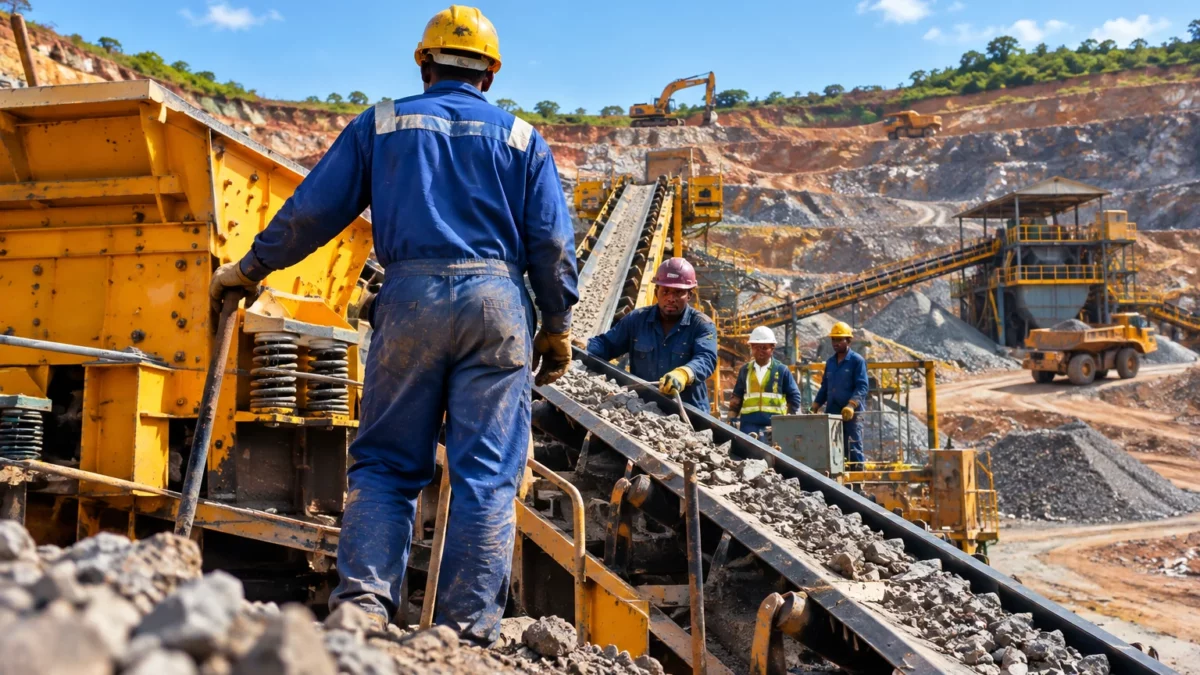
In western Ghana, two neighbouring gold mines now face the same challenge: returning production to a viable path without further delaying their owner’s financial obligations. Asante Gold is seeking both an operational turnaround and strategic options. For nearby communities, employees and suppliers, what happens next will also determine whether activity on the ground can be maintained.
Two mines in a Ghanaian mining district
Bibiani and Chirano are in north-western Ghana, close to each other and about 250 kilometres from the capital, Accra. The mining district forms part of an economy in which gold contributes significantly to exports and public revenue. It is also a reminder that extraction volumes alone do not show whether an operation is profitable or financially sound.
Asante, a Canadian company listed in Ghana and Canada, acquired Bibiani in 2021 and Chirano in 2022. The group presented the assets as a combined platform for growth. But bringing them together does not erase the difficulties at each site: equipment and processing problems reported at Bibiani are now weighing on consolidated results, while Chirano recorded higher production in the third quarter.
The issue extends beyond the company. In Ghana, industrial mines operate alongside artisanal mining, as public policy takes a closer interest in gold management. In this context, the authorities, local communities and residents have distinct interests: revenue and jobs matter, but so do continuity of operations, commitments to nearby communities and the management of local impacts.
Strategic review, with no deal announced
On 18 November 2026, Asante’s board announced a strategic review of its activities, alongside an operational turnaround plan for Bibiani and Chirano. The company said it had received unsolicited, non-binding expressions of interest. It has not disclosed their source or nature, and says no decision has been made.
Such a review can be used to consider different options, but it does not mean that a sale or other transaction has been agreed. Asante said it would appoint advisers. The company also plans to set out the causes of the difficulties and its corrective measures at a presentation brought forward to 20 November, rather than the date initially planned in January 2027.
The decision follows the withdrawal, on 13 November, of production and cost guidance for 2026. The company had previously targeted annual production of 275,000 to 300,000 gold equivalent ounces. It now acknowledges that it can no longer confirm this target. The withdrawal is a clear sign of operational uncertainty, but does not mean that the two mines have stopped producing.
At Bibiani, Asante cites several factors: insufficient availability of equipment from the main mining contractor, power cuts, lower gold recovery at the plant and delays to the resettlement programme for nearby residents. An independent technical review of the plant, completed in September, identified crushing and grinding as the main operational bottlenecks. The company also announced that a second contractor would come on board to speed up waste stripping in the main pit.
Revenue rises, but cash remains under pressure
The third-quarter figures show a mixed picture. According to results published by Asante, consolidated production in the first nine months of 2026 rose 41% year on year to 165,594 gold equivalent ounces. Chirano produced 34,420 ounces in the third quarter, up 34.4% year on year. Bibiani produced 14,097 ounces over the period.
Revenue for the nine months reached $756.7m, compared with $372.1m for the comparative period used by the company. The increase reflects higher gold sales and a higher average price. Even so, it was not enough to offset costs and short-term obligations. At Bibiani, the all-in sustaining cost reported for the quarter was $7,681 an ounce, while the stated average selling price was $3,873.
These are figures published by the company and should be read within the scope of its accounting. They nevertheless illustrate the difference between revenue, margin and available cash: higher sales do not automatically provide the funds needed to pay creditors, suppliers and operating expenses.
As at 30 September, liabilities and other short-term obligations exceeded current assets by $309.7m, according to figures reported by the company. Asante must also raise at least $100m in new financing under its financing agreements. After several extensions, the deadline was set for 30 November 2026. Lenders agreed to extend certain waivers and approved a technical plan of operational measures, but the expected financing is not yet secured.
Cost savings announced earlier in 2026, including the deferral or cancellation of about $50m of planned capital expenditure for 2026, illustrate the dilemma. Cutting spending can preserve cash in the short term. But delaying investment needed at the plant or to access ore could also slow the turnaround if equipment remains a bottleneck.
Consequences beyond the financial markets
For investors, the strategic review and financing deadline are two immediate milestones. For employees, contractors and local suppliers, the priority is more tangible: whether operations can return to a regular pace and whether payments and contracts will be maintained. In the communities concerned, the resettlement delays at Bibiani also give a social dimension to a problem described primarily in terms of production.
Ghana is a member of ECOWAS, the Economic Community of West African States, which promotes regional co-operation. Asante’s situation is not an indicator of the entire gold sector or West African economies. It does, however, highlight a challenge shared by producer countries: attracting capital and developing extraction while ensuring that operations, jobs and local commitments remain sustainable.
The next steps are now dated: the turnaround plan presentation is scheduled for 20 November, followed by the financing deadline on 30 November. It remains to be seen whether Asante secures the funds, whether work on Bibiani’s processing circuit improves results in practice, and whether the strategic review leads to a concrete proposal. For now, the company has announced a process and measures; it has not announced a sale agreement or a definitive financing solution.