Algeria
 Egypt
 Libya
 Morocco
 Sudan
 Tunisia
 Benin
 Burkina Faso
 Cabo Verde
 Côte d'Ivoire
 Ghana
 Guinea-Bissau
 Liberia
 Mali
 Mauritania
 Niger
 Nigeria
 Senegal
 Sierra Leone
 The Gambia
 Togo
 Cameroon
 Central African Republic
 Chad
 DR Congo
 Equatorial Guinea
 Gabon
 Republic of the Congo
 São Tomé and Príncipe
 Burundi
 Comoros
 Djibouti
 Eritrea
 Ethiopia
 Kenya
 Madagascar
 Malawi
 Mauritius
 Mozambique
 Rwanda
 Seychelles
 Somalia
 South Sudan
 Tanzania
 Uganda
 Angola
 Botswana
 Eswatini
 Lesotho
 Namibia
 South Africa
 Zambia
 Zimbabwe
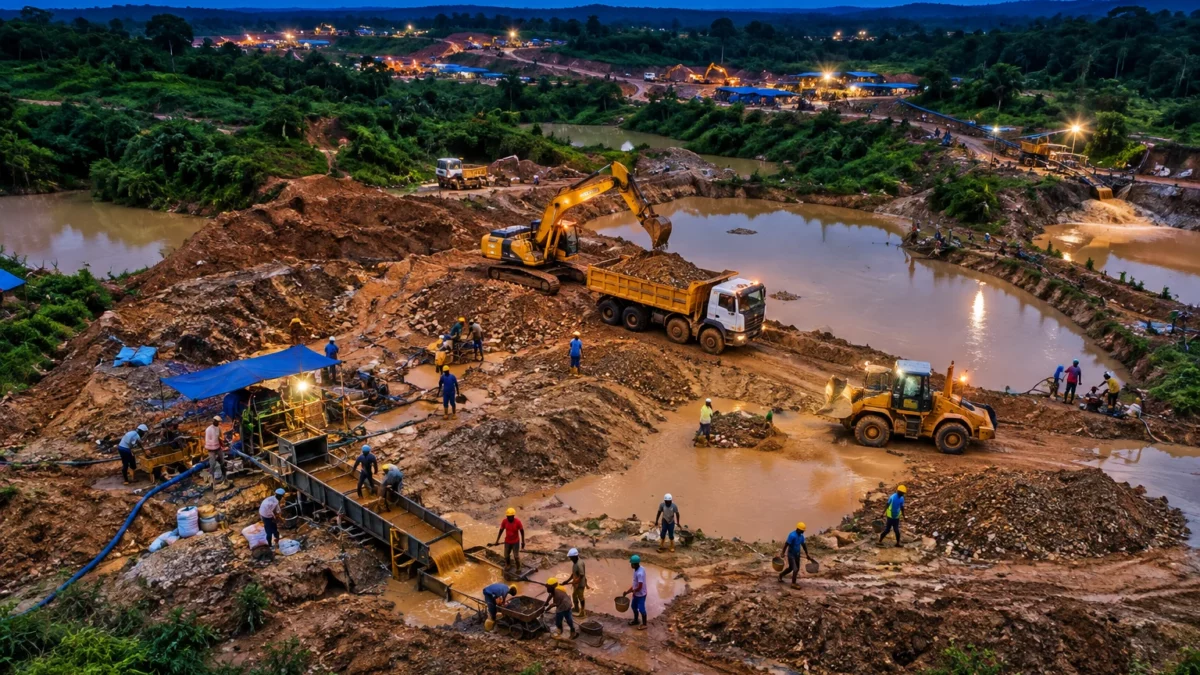
In Siguiri prefecture, gold draws both industrial projects and thousands of people who depend on it for their daily livelihoods. Asara Resources’ proposed expansion therefore raises a practical question: could its new permits feed a future mine, and on what terms for Guinea?
The project is located in the Siguiri gold basin, in the country’s north-east, near the Malian border. The area is already home to an industrial mine operated by AngloGold Ashanti, as well as artisanal and small-scale mining. The region is part of a West African area where workers and gold-trading networks cross national borders.
The issue resonates particularly strongly as Guinean authorities have recently stepped up controls against unauthorised gold mining in Siguiri. Deadly clashes were reported in Balato in November. This context is a reminder that mining is not just about permits and investment: it also affects livelihoods, access to land and the management of environmental risks.
An acquisition still subject to conditions
On 19 November 2026, Asara Resources announced that it had entered into a binding framework agreement with Canadian company Siguiri Gold Corp to negotiate the acquisition of all its share capital. Siguiri Gold holds the Tamba North and Western gold exploration permits in the Siguiri basin. The two areas lie about 30 kilometres north of the Massan deposit, at the heart of Asara’s Kada project.
The announced consideration could reach A$50 million, or about US$34 million. It would be paid in Asara shares, not cash. The arrangement provides for an initial issue of A$9 million in shares after the Tamba permit is renewed. Up to a further A$41 million would then depend on permit renewals and independently verified mineral resource milestones.
The maximum amount is therefore neither an immediate payment nor proof that the transaction has been completed. The two companies have a 120-day exclusivity period to conduct the necessary due diligence and negotiate definitive documents. The transaction remains subject to the conditions set out in the agreement, including permit renewals and applicable approvals.
This distinction matters when assessing the announcement’s real significance. The announced value will depend on progress with the work and administrative conditions. It is also denominated in shares: meeting the targets could increase the number of Asara shares in circulation and dilute existing shareholders’ stakes. This mechanism ties part of the price to future results, but does not remove the uncertainties of exploration.
Kada: resources and technical decisions
Asara is already developing Kada, whose main deposit is Massan. The company estimates the project’s mineral resources at 2.08 million ounces of gold. A mineral resource is a geological estimate of the metal potentially present; it does not automatically amount to exploitable reserves or a profitable mine. Costs, infrastructure, permits and operating conditions still need to be studied.
Siguiri Gold’s permits could expand Asara’s exploration area and, in time, offer an additional source of ore for a planned facility at Kada. The company has raised the possibility of transporting this ore by truck. But this prospect depends on further drilling, a reliable resource estimate and then proof of its economic value. At this stage, no ore supply from Tamba or Western is assured.
The Kada project itself is not yet a mine under construction. Asara has said it is targeting a definitive feasibility study in mid-2026, a stage that helps define technical and economic choices before an investment decision. The public information reviewed does not, on its own, establish whether this deadline was met or what conclusions the study may have reached. Any acquisition of Siguiri Gold would therefore add to a project with several steps still to be documented.
Permits, local benefits and public responsibility
For Guinea, the issue is not limited to the value of shares exchanged between two companies. The mining code governs the award and renewal of permits, while the authorities must balance exploration, mining, environmental protection and economic benefits. The presence of neighbouring permits may facilitate joint planning, but it guarantees neither the profitability of a future mine nor automatic local benefits.
The consequences will differ for the groups concerned. For the company, the aim is to consolidate a portfolio and assess nearby resources. For Siguiri’s communities, the practical questions concern access to land and water, employment, income, safety and coexistence with artisanal mining. The effects will depend in particular on the work actually undertaken, the rules enforced on the ground and the mechanisms for dialogue with local people.
The contrast between an industrial operator’s planned expansion and tighter measures against certain forms of gold mining makes this relationship particularly sensitive. The government presents the controls as a way to limit environmental damage. At the same time, artisanal gold mining provides a livelihood for many households. Both realities must be considered to understand local tensions, without confusing the announced exploration permits with mining that has already been authorised or is operational.
A signal to watch beyond Guinea
The case illustrates a broader trend in West Africa: companies are seeking to consolidate permits around known deposits to extend the potential life of their projects. But exploration remains a gamble, subject to the quality of discoveries, the regulatory framework and local acceptance. Promised synergies only become results after verifiable work and decisions.
The next step will be to see whether Asara and Siguiri Gold conclude definitive agreements at the end of their exclusivity period, and whether the necessary permits are renewed. Results from work at Tamba and Western, documented progress at Kada and the arrangements for local consultation will then make it possible to assess the project’s scope. For Conakry and regional stakeholders alike, the challenge will be to turn geological interest into regulated activity, without treating economic benefits and local impacts as mere promises.