Algeria
 Egypt
 Libya
 Morocco
 Sudan
 Tunisia
 Benin
 Burkina Faso
 Cabo Verde
 Ghana
 Guinea
 Guinea-Bissau
 Liberia
 Mali
 Mauritania
 Niger
 Nigeria
 Senegal
 Sierra Leone
 The Gambia
 Togo
 Cameroon
 Central African Republic
 Chad
 DR Congo
 Equatorial Guinea
 Gabon
 Republic of the Congo
 São Tomé and Príncipe
 Burundi
 Comoros
 Djibouti
 Eritrea
 Ethiopia
 Kenya
 Madagascar
 Malawi
 Mauritius
 Mozambique
 Rwanda
 Seychelles
 Somalia
 South Sudan
 Tanzania
 Uganda
 Angola
 Botswana
 Eswatini
 Lesotho
 Namibia
 South Africa
 Zambia
 Zimbabwe
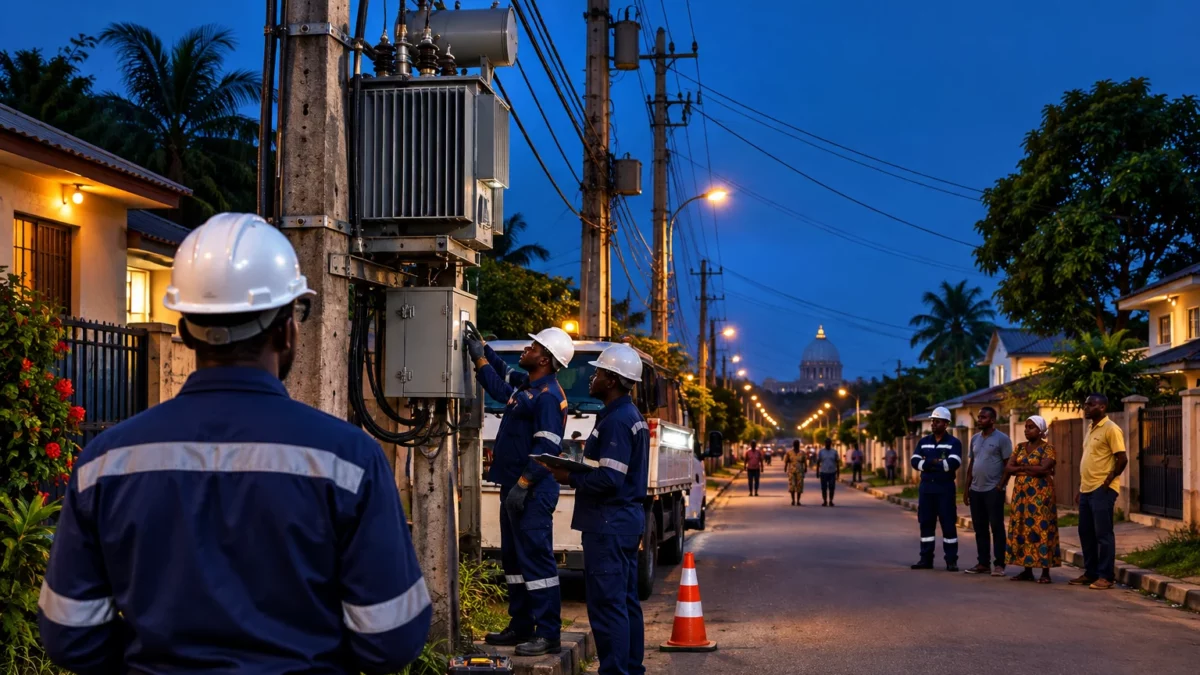
Increasing electricity generation is not enough to guarantee a reliable daily supply. Power must also be transmitted, households connected and the grid maintained so that it can handle rising demand. Côte d’Ivoire aims to address this challenge through its 2027 targets.
A capacity target included in the budget
On 13 November 2026, the National Assembly’s Committee on Economic and Financial Affairs unanimously adopted the 2027 budget for the Ministry of Mines, Petroleum and Energy. Presented by Minister Mamadou Sangafowa-Coulibaly, the allocation totals CFA francs 738.82 billion, up 4.64% on the previous year, according to the ministry.
Among the announced priorities is installed electricity capacity of 4,000 megawatts (MW) in 2027. The minister also cited the development of renewable energy, increased oil production and the launch of an online petroleum cadastre. The budget therefore covers several sectors; its total does not correspond solely to electricity investment.
To support connections, the government plans 550,000 additional connections in 2027 under the Electricity for All Programme (PEPT), which helps households gain access to connections. In 2025, 288 localities were electrified and more than 560,000 new connections were made, according to the minister’s report.
New capacity, but also a grid to reinforce
The 4,000 MW target extends a notable rise: installed capacity increased from 1,391 MW in 2011 to 3,019 MW in 2024, a 117% rise. The ministry said it exceeded 3,300 MW in 2025. These figures are not directly interchangeable: they refer to different years and reports.
The National Development Plan 2026-2030, meanwhile, sets a target of 3,360 MW in 2027, followed by 3,812 MW in 2028. The new budget target of 4,000 MW for 2027 is therefore higher than the trajectory set out in this planning document. In the material consulted, the authorities have not publicly explained how the two benchmarks fit together. The gap warrants monitoring as announcements are made and implementation proceeds.
The issue is not limited to power stations. In 2024, the grid had nearly 7,700 kilometres of high-voltage lines, as well as medium- and low-voltage networks. Delivering electricity to cities, villages and economic zones requires continued expansion and maintenance of these networks. Additional generation capacity alone does not improve continuity of service for customers.
Access is growing, but is not the same as a connection
Electrification indicators describe different realities. In 2024, the locality coverage rate reached 94.3%, while the population access rate was estimated at 98.6%. The first compares electrified localities with a national baseline; the second estimates the share of people living in a locality served by electricity. Neither means that every household has a meter or an account.
The government announced a coverage rate of 97.71% in 2025. This recent figure, presented by the minister, does not necessarily measure the same thing as indicators calculated using the 2014 census. These percentages should therefore not be read as a perfectly comparable series. The number of connections is a separate indicator, more closely linked to households’ actual access to the service.
This distinction matters in rural areas, where a locality may be connected even though not all its residents can afford the fees or equipment required. It also matters in cities, where households and businesses depend on grid quality and a regular supply. The challenge is therefore one of access, cost and reliability, not just available capacity.
A mix still dominated by thermal power
In 2024, thermal power stations accounted for about 75% of gross generation on the interconnected grid, compared with nearly 25% for hydropower. Solar power then contributed only a fraction of generation. Building solar plants can diversify the fleet, but their expansion must be accompanied by transmission capacity and solutions to balance supply and demand.
The sector plan includes several generation projects, particularly solar, hydroelectric and thermal, as well as a biomass power station in Aboisso. It aims for renewables to account for 45% of the energy mix in 2030. The delivery, financing and timing of these projects will determine whether the announced capacity increase is accompanied by a real change in the composition of the fleet.
Côte d’Ivoire also exports electricity to several neighbouring countries, including Mali, Burkina Faso and Ghana. In 2024, these exports represented about 5.2% of national generation. This regional role makes planning all the more important: meeting domestic demand and honouring cross-border trade require available capacity and functioning interconnections.
Focus will be on concrete delivery
Within ECOWAS, the Economic Community of West African States, electricity flows between several national grids. Côte d’Ivoire’s capacity can therefore contribute to regional supply. But benefits for residents will also depend on local distribution, the pace of new connections and service quality, including in regions far from Yamoussoukro, the political capital.
The next step will be to check how the adopted budget translates into construction work, power stations brought online and connections actually completed. The capacity figures announced for 2027 will also need to be compared with the National Development Plan targets. This monitoring will help distinguish stated ambition from measurable progress for households, economic activity and regional partners.