Algeria
 Egypt
 Libya
 Morocco
 Sudan
 Tunisia
 Benin
 Burkina Faso
 Cabo Verde
 Côte d'Ivoire
 Ghana
 Guinea
 Guinea-Bissau
 Liberia
 Mali
 Mauritania
 Niger
 Nigeria
 Sierra Leone
 The Gambia
 Togo
 Cameroon
 Central African Republic
 Chad
 DR Congo
 Equatorial Guinea
 Gabon
 Republic of the Congo
 São Tomé and Príncipe
 Burundi
 Comoros
 Djibouti
 Eritrea
 Ethiopia
 Kenya
 Madagascar
 Malawi
 Mauritius
 Mozambique
 Rwanda
 Seychelles
 Somalia
 South Sudan
 Tanzania
 Uganda
 Angola
 Botswana
 Eswatini
 Lesotho
 Namibia
 South Africa
 Zambia
 Zimbabwe
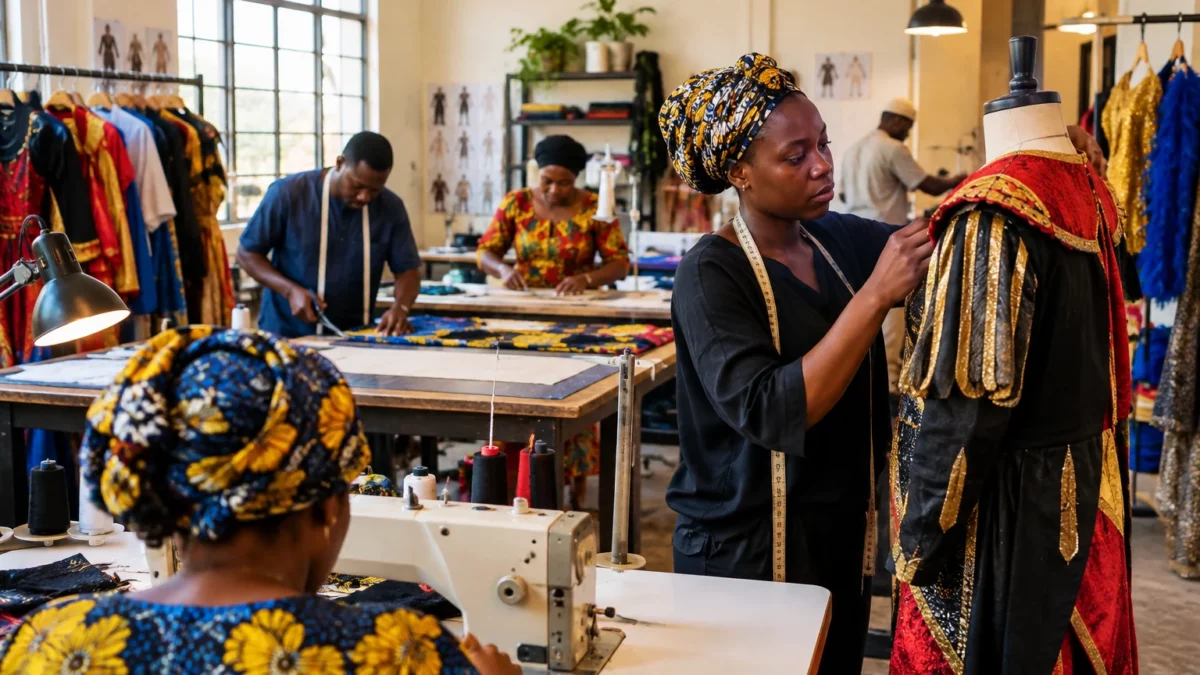
On screen, a costume may be visible for only a few minutes. Making it, however, requires design, cutting, fitting and coordination well in advance. At the Dakar Youth Olympic Games (YOG), this work involved Senegalese designers and workshops, including costume designer Dior Diagne, who was tasked with contributing to more than 300 outfits.
A ceremony conceived as a Senegalese story
On 31 October 2026, Abdoulaye-Wade Stadium in Diamniadio hosted the YOG opening ceremony. The Games, held until 13 November in Dakar, Diamniadio and Saly, marked the first edition of an Olympic event on the African continent. The ceremony was therefore intended not only to launch a sporting competition, but also to present a story rooted in place: that of a diverse Senegal, looking towards the continent and the world.
The staging brought history into dialogue with contemporary creativity and scenes of urban life. The kingdoms of Cayor, markets, street vendors, music and wrestling featured in several tableaux. The Senegalese Press Agency also noted the presence of Senegalese and Gambian artists and musicians. Senegalese Radio and Television described a narrative combining heritage and popular practices.
In this production, clothing was not merely an accessory. It helped situate the characters, periods and visual worlds. The costumes had to remain legible in a stadium, accommodate the performers’ movements and keep pace with a large-scale show. These are practical constraints rarely visible from the stands.
From the workshop to the stage
Dior Diagne described the challenges involved in producing more than 300 costumes. This figure refers to the scope of her work as presented in the report on the costume designer. It should not be confused with the total number announced for the ceremony: RTS reports that nearly 1,500 costumes were made locally for the show as a whole.
The two figures are not necessarily contradictory. They appear to refer to different scales: a commission or collection overseen by one professional, on the one hand, and total production on the other. The available information does not, however, detail the exact allocation of orders or the number of pieces handled by each workshop. It is therefore better to maintain this distinction than to attribute all the outfits to one person.
This production relies on a chain of skills: design, choice of materials, pattern-making, sewing, fittings, alterations and coordination with artistic teams. For a group performance, clothes must also be adapted to movement, quick changes and the technical demands of the stage. The tight schedule adds another challenge: pieces must arrive at the right time, in the right sizes and ready to be worn during rehearsals as well as on opening night.
Dior Diagne’s work thus sheds light on one part of a much larger production. Senegalese sources cite several artistic leads and professions involved. RTS names Khady Niang as ceremonies director, Xalil Cissé as artistic director and Adama Diop as stage director. Costume designers, craftspeople and technicians are part of the same framework, even if their contribution is less often visible in the final images.
A showcase, but also an economic question
Making costumes locally for an international event can raise the profile of workshops and demonstrate their ability to fulfil a major commission. But a showcase alone does not guarantee lasting contracts. What follows will depend in particular on orders, access to equipment and funding, training, and the ability of teams to retain their skills in Senegal.
This question extends beyond the creators directly involved in the ceremony. The benefits could reach tailors, fabric suppliers, craftspeople, make-up artists, dancers and technicians, as well as trainees. They will not, however, automatically be shared between Dakar and the rest of the country, or between established businesses and smaller workshops. The public information consulted does not yet make it possible to measure these effects or determine which jobs will continue after the Games.
The YOG’s record also shows that the success of a major event must be judged on several fronts. The competition brought together nearly 2,700 athletes aged 14 to 17 across 25 sports, according to the Associated Press. But the agency also reports that Senegalese have raised questions about spending and that displaced businesses believe the preparations affected their activities. Artistic success therefore does not remove the need to examine costs, beneficiaries and the real legacy of infrastructure and contracts.
A precedent for Africa’s creative industries
At a regional level, Dakar 2026 gave Senegalese professionals experience of a major production, visible to organisers and artists from elsewhere. This could matter for future commissions for shows, festivals or sporting ceremonies in West Africa. But turning that experience into a regular market is not guaranteed: it requires professional relationships, accessible tenders and investment in creative professions.
The Games’ continental significance also lies in the shift in perspective they brought about. The first Olympic event held in Africa showcased local skills to an international audience without reducing the story to a uniform backdrop. Costumes are a tangible part of this: they make visible the professions, workshops and aesthetic choices that come before the show.
The next challenge will be less about counting outfits than tracking what they leave behind. Contracts arising from this production, the continuity of workshops and young professionals’ access to new projects will show whether the Dakar experience has created lasting opportunities. For Dior Diagne and the other craftspeople involved, the tangible follow-up will be one measure of the YOG’s cultural legacy.