Algeria
 Egypt
 Libya
 Morocco
 Sudan
 Tunisia
 Benin
 Burkina Faso
 Cabo Verde
 Côte d'Ivoire
 Ghana
 Guinea
 Guinea-Bissau
 Liberia
 Mali
 Mauritania
 Niger
 Nigeria
 Senegal
 Sierra Leone
 The Gambia
 Togo
 Cameroon
 Central African Republic
 Chad
 Equatorial Guinea
 Gabon
 Republic of the Congo
 São Tomé and Príncipe
 Burundi
 Comoros
 Djibouti
 Eritrea
 Ethiopia
 Kenya
 Madagascar
 Malawi
 Mauritius
 Mozambique
 Rwanda
 Seychelles
 Somalia
 South Sudan
 Tanzania
 Uganda
 Angola
 Botswana
 Eswatini
 Lesotho
 Namibia
 South Africa
 Zambia
 Zimbabwe
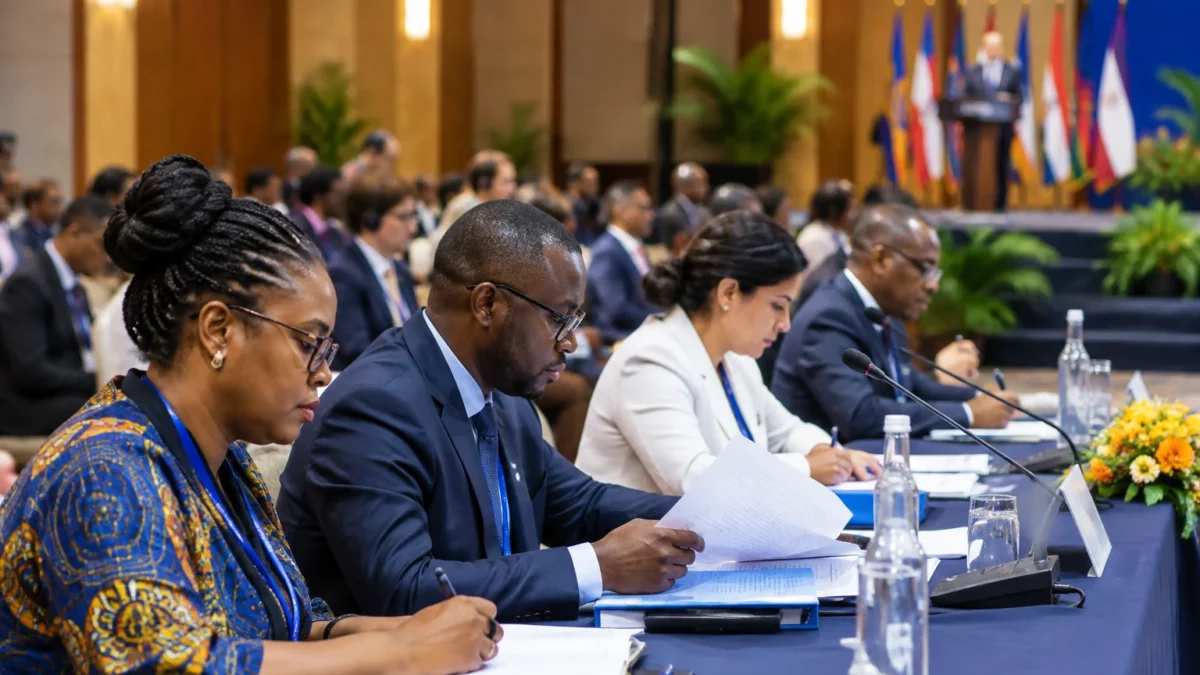
At Phnom Penh, disagreement over the leadership of the Francophonie highlighted a broader question: what role do African states intend to play in an organisation where they make up a major share of the members and French speakers? For the Democratic Republic of the Congo (DRC), the debate also touches on its relations with Rwanda and its capacity for diplomatic influence.
Postponement averts deadlock but does not resolve it
Heads of state and government meeting at the 20th Summit of the International Organisation of La Francophonie (OIF), on 15 and 16 November 2026 in Phnom Penh, did not appoint a successor to outgoing Secretary-General Louise Mushikiwabo. Failing to agree on a candidate or on holding a vote, they extended her term by 12 months. A new election is scheduled for 2027. The OIF confirmed the decision in its summit review. The official closing communiqué of the Phnom Penh summit also states that three texts were adopted on peace, crises and the protection of cultural heritage.
The outcome was reported by several independent media outlets, including the Associated Press and Deutsche Welle. Rwanda will not put forward a candidate at the next election, according to reports circulated after the summit. The postponement therefore breaks an immediate deadlock, but resolves neither the disagreement over the succession nor tensions between Kinshasa and Kigali. The Associated Press report describes the secretary-general’s temporary continuation in office, while Deutsche Welle reports on the postponement and Rwanda’s announced decision not to field a candidate.
DR Congo defends its place in the Francophone world
The DRC was represented in Phnom Penh by President Félix Tshisekedi. The head of state’s presence underlines the importance Kinshasa attaches to the OIF, beyond linguistic issues alone. The organisation brings together 53 full members, within a broader grouping of states and governments. It provides a framework for political, cultural and diplomatic cooperation in which African countries have numerical weight, but alliances and national interests remain decisive.
For the DRC, the succession to the secretary-general’s post unfolded against a delicate regional backdrop. Kinshasa accuses Kigali of supporting M23, an armed group active in eastern Congo; Rwanda denies the allegations. This political and security confrontation spilled over into Francophone discussions, without the OIF being able to resolve it. The Congolese Press Agency had announced Félix Tshisekedi’s arrival in Cambodia to attend the summit. The ACP report on Congo’s participation thus places the issue in the context of Kinshasa’s diplomacy.
The debate also concerns African representation in international institutions. Congolese officials argued that the continent’s demographic and political weight should count for more in selecting OIF leaders. But African states do not form a homogeneous bloc: choices over candidates, external partnerships and regional rivalries can divide them. The Phnom Penh debate showed that having a large number of African members does not, by itself, guarantee a common position.
An organisation facing its own rules
The postponement raises an institutional question. The appointment procedure calls for efforts to reach consensus and, failing that, a vote. In Phnom Penh, however, leaders could not agree either on a candidate or on holding a ballot. Extending the outgoing secretary-general’s term served as a temporary compromise. It gives states an additional year to review the rules and prepare for a new election, but also defers the political decision the summit was meant to take.
For the public, these negotiations may seem far removed from everyday priorities. Yet the Francophonie works in tangible areas: education, training, culture, institutional cooperation and support for certain political processes. The choice of its leadership affects its priorities and the organisation’s ability to make its members’ voices heard. In the DRC, the impact will differ for political actors in Kinshasa, national institutions, cultural organisations and French speakers living far from the capital.
The role of French is also part of a diverse reality. In the DRC, it is the official language and serves as a common language in a country where many national languages are spoken. Defending Congo’s place in the OIF is therefore not simply a matter of claiming a post: it concerns the representation of a multilingual society and how its priorities are reflected in Francophone programmes.
The next meeting will be decisive
The summit also adopted a resolution on crisis situations and the consolidation of peace. This gives the OIF a framework for continuing its work in support of mediation and stability. But texts cannot replace the capacity for political action, especially when member states themselves disagree. For the DRC and its neighbours, the impact of these commitments will depend on their implementation and on the trust placed in the organisation.
The coming year will therefore need to clarify the succession rules and prepare for the election announced for 2027. It will be important to follow how members distribute their support, as well as the place given to African candidates and regional issues. Phnom Penh did not settle the question of the Francophonie’s leadership. Instead, the summit made a balance of power visible: between the search for compromise, national ambitions and the influence African countries wish to wield in an organisation they do much to sustain.