Algeria
 Egypt
 Libya
 Morocco
 Sudan
 Tunisia
 Benin
 Burkina Faso
 Cabo Verde
 Ghana
 Guinea
 Guinea-Bissau
 Liberia
 Mali
 Mauritania
 Niger
 Nigeria
 Senegal
 Sierra Leone
 The Gambia
 Togo
 Cameroon
 Central African Republic
 Chad
 DR Congo
 Equatorial Guinea
 Gabon
 Republic of the Congo
 São Tomé and Príncipe
 Burundi
 Comoros
 Djibouti
 Eritrea
 Ethiopia
 Kenya
 Madagascar
 Malawi
 Mauritius
 Mozambique
 Rwanda
 Seychelles
 Somalia
 South Sudan
 Tanzania
 Uganda
 Angola
 Botswana
 Eswatini
 Lesotho
 Namibia
 South Africa
 Zambia
 Zimbabwe
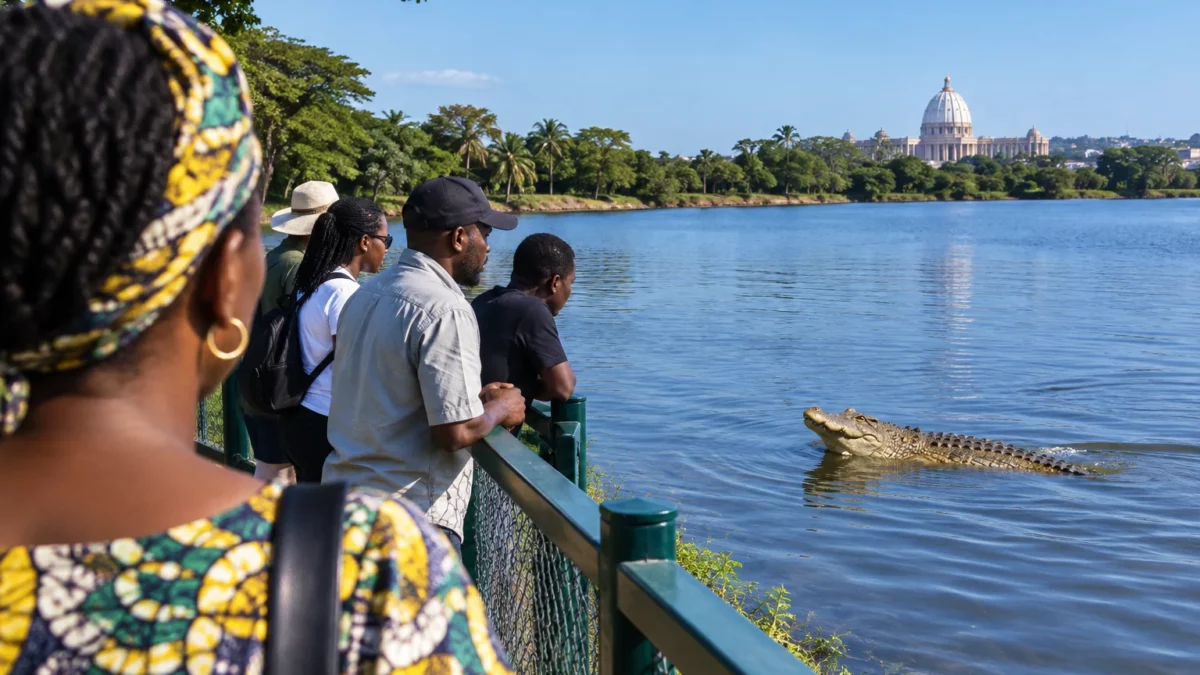
In Yamoussoukro, visitors encounter crocodiles behind a barrier, beside a lake linked to the history of Ivorian power. The site draws visitors, but also raises a very practical question: how can a symbolic place be preserved while protecting both the animals and the public?
A site shaped by political memory and tourism
Yamoussoukro is the political and administrative capital of Côte d’Ivoire. Abidjan, however, remains the country’s main economic centre and is home to many of its institutions. This contrast between the official capital and the busy metropolis is part of the city’s distinctive history.
The crocodile lake adjoins the former presidential palace of Félix Houphouët-Boigny, Côte d’Ivoire’s first president. It is part of a group of artificial lakes created around the palace. The reptiles are thus associated with the urban landscape, the memory of political power and the capital’s visitor attractions.
Their origins are recounted in several stories. The animals are said to have been given to Houphouët-Boigny by African leaders, including Mali’s Modibo Keïta. This story has circulated for a long time, but details vary between accounts. It recalls political relations between the continent’s heads of state in the years following independence, but is not enough to establish the precise origin of each animal.
The presence of crocodiles near the palace has also fuelled stories about their role in protecting it. This is part of local memory and beliefs. It should not be confused with an officially documented security function.
A daily ritual requiring considerable logistics
In a report about the site, a keeper named Jean-Luc says he has looked after the reptiles for 14 years. He says he recognises the individual animals and their habits. To feed them, he strikes an iron bar to signal that food is arriving, then distributes the meat from the lakeshore.
In his estimate, the animals consume about ten cattle a month, divided into two feeding periods. This figure, like the number of crocodiles in the pools, has not been confirmed by a second independent source. It should therefore be treated as the keeper’s account, rather than a verified count.
The presence of an experienced keeper does not eliminate the risk. In August 2012, the Ivorian News Agency reported the death of Dicko Toké, an elderly feeder, following an attack beside the lake. A Senegalese media outlet also reported the news at the time. Published accounts attributed the accident to dangerous proximity to the animals, amid requests from visitors for photographs. The incident highlights the risks associated with staged encounters and crossing safety barriers. The Ivorian News Agency on the 2012 accident ; a report in the Senegalese press.
The report also mentions the death of a pupil who allegedly tried to retrieve a phone that had fallen into the water. As this detail could not be independently corroborated from an accessible source, it remains attributed. The safety rule, however, is clear: no object is worth approaching the shore or climbing down into the pool.
Managing the lakes involves more than the spectacle
The issue is not limited to visitors. In October 2022, the Ivorian government said that Yamoussoukro’s lakes were being affected by human activities. The Ministry of Water and Forests had announced a development and preservation project. The statement also reported attacks on crocodiles and the regular discovery of dead animals. The Ivorian government on the lake development project.
This assessment broadens the issue. Maintaining the shores, water quality, monitoring the animals and keeping people safe must all be considered together. Visitors enjoy the site, while staff responsible for animal care and maintenance face daily exposure to risk. Residents, meanwhile, live in a city where several lakes are part of the landscape and are not simply tourist backdrops.
A technical note published by the UNEP-DHI programme records a significant presence of crocodiles and caimans in several lakes, and discusses the restoration of water bodies and management measures. These observations show that the issue is also environmental: feeding the animals is not enough to maintain the balance of an aquatic ecosystem. The technical note on aquatic plant management and Ivorian lakes.
A local issue with regional resonance
The crocodile lake contributes to Yamoussoukro’s image among Ivorian and West African travellers. In January 2024, during the Africa Cup of Nations hosted by Côte d’Ivoire, visitors who had come for the tournament also went to the site. The competition was a reminder that a major sporting event can introduce people to other parts of the country, beyond the stadiums and big cities. A report on visitors to the lake during AFCON 2024.
This increased visibility can support local tourism, but it also makes safe visitor facilities and clear information more important. The presence of police, mentioned in the report, helps prevent incidents; it does not replace suitable barriers or strict instructions, especially when visitors try to photograph the animals at close range.
For the Ivorian authorities, the challenge is to preserve a place steeped in history without reducing the crocodiles to an attraction. The announced monitoring of the lakes, their maintenance and access rules will be decisive. In Yamoussoukro, passing on this political memory also means protecting the city’s waterways, workers and visitors today.