Algeria
 Egypt
 Libya
 Morocco
 Sudan
 Tunisia
 Benin
 Burkina Faso
 Cabo Verde
 Côte d'Ivoire
 Ghana
 Guinea
 Guinea-Bissau
 Liberia
 Mali
 Mauritania
 Niger
 Nigeria
 Senegal
 Sierra Leone
 The Gambia
 Togo
 Cameroon
 Central African Republic
 DR Congo
 Equatorial Guinea
 Gabon
 Republic of the Congo
 São Tomé and Príncipe
 Burundi
 Comoros
 Djibouti
 Eritrea
 Ethiopia
 Kenya
 Madagascar
 Malawi
 Mauritius
 Mozambique
 Rwanda
 Seychelles
 Somalia
 South Sudan
 Tanzania
 Uganda
 Angola
 Botswana
 Eswatini
 Lesotho
 Namibia
 South Africa
 Zambia
 Zimbabwe
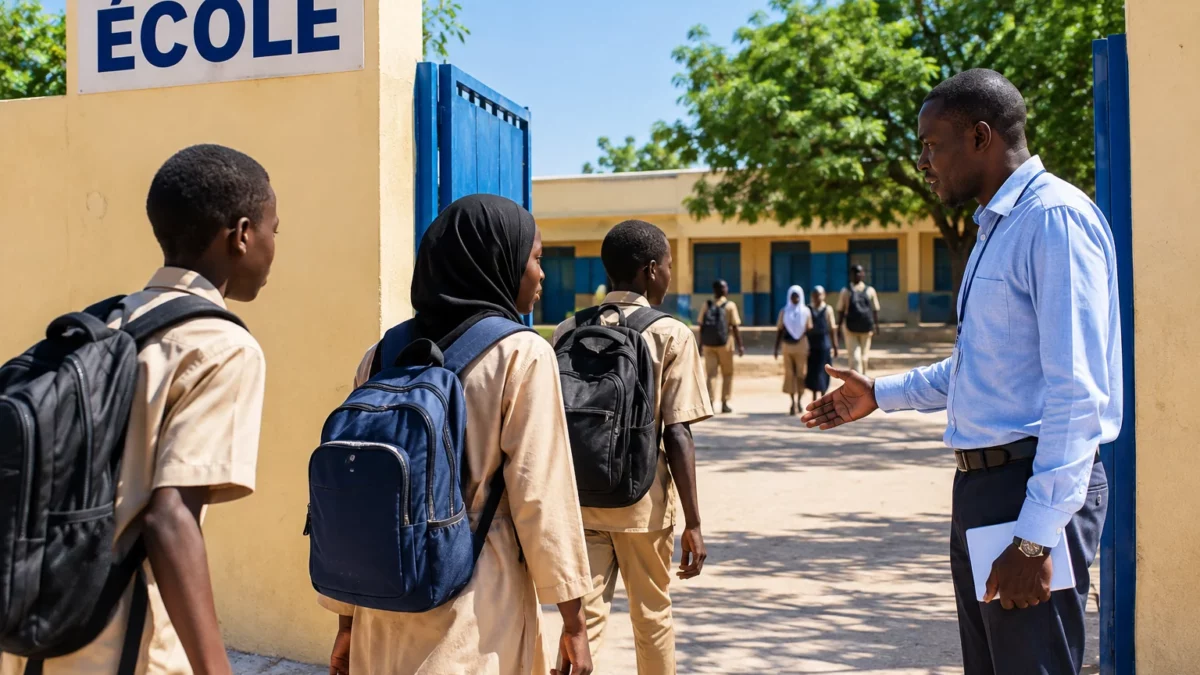
A newly built classroom does not, on its own, guarantee that a child will learn to read. In Chad, the new basic education programme is investing in buildings, teachers, textbooks and school canteens. The challenge will be to turn these financial commitments into lasting services, including in provinces far from N’Djamena.
A nationwide project amid strong demand
Chad has 23 provinces and a very young population. The growing number of children is putting pressure on schools, particularly in rural areas and localities where infrastructure is lacking. UNICEF estimates that more than three million school-age children are out of school. The organisation says more than 9,000 classrooms would need to be built to meet demand. These are UNICEF estimates, not an updated count released at the project launch. UNICEF data on access to education in Chad also highlight learning difficulties.
The pressure is particularly visible in the east of the country. Since the war in Sudan began on 15 April 2023, refugees and Chadians returning home have arrived in border provinces. Schools are therefore taking in additional children, while host communities also need public services. The World Bank describes this dual demand as a challenge for a system already constrained by limited resources and capacity. The World Bank’s analysis of integrating refugee pupils stresses the value of including them in the national system rather than creating separate arrangements.
Construction, equipment and training planned through 2030
Launched in N’Djamena on 16 November 2026, the Basic Education Transformation Project, known as SMARTED, is set to cover all 23 provinces between 2026 and 2030. Its announced funding totals $173.152 million. The Chadian government is co-financing it with several partners, including the Islamic Development Bank, BADEA, the Global Partnership for Education, the OPEC Fund for International Development, the Saudi Fund for Development and the World Food Programme.
The programme includes 2,800 classrooms in 744 schools, as well as 744 boreholes to improve access to water at the participating institutions. It also includes 56,000 desk-benches and chairs, 5.33 million textbooks and 76,200 teaching guides. Some 35,000 teachers are to receive training. School canteens are also planned for 300,000 pupils each year.
Published figures on the scope of the construction work are not all expressed in the same way. A BADEA procurement notice consulted for this project refers to interventions in 760 institutions, including 665 primary schools and 95 middle schools. The difference from the 744 schools announced at the launch may reflect different scopes or categories of work. The available documents do not make it possible to determine the reason. BADEA’s notice details the planned funding and contracts.
Success will depend on local implementation
Infrastructure addresses an immediate need, but its usefulness will depend on how it is distributed and maintained. A borehole must remain operational. A classroom must have a teacher and materials. The authorities will also need to ensure that new buildings reach the least well-equipped areas, not only localities where construction is easier to carry out.
Training 35,000 teachers is therefore a central part of the programme. It will need to translate into practical support in the classroom and improved learning, particularly in reading and mathematics. UNICEF reports high levels of learning difficulties in Chad. This is a reminder that increasing the number of available places and improving the quality of teaching are related but distinct goals.
Canteens can also encourage school attendance, but their regular operation will depend on supplies, management and annual funding. In areas hosting refugees, needs affect both displaced children and children from Chadian communities. The programme’s fairness will therefore also be measured by its ability to ensure that expanding services for some does not reduce access for others.
A coordination test for Chad and its partners
SMARTED combines Chadian public resources with several sources of external funding. This arrangement could bring together substantial resources, but it requires clear coordination between donors, ministries, provincial services and schools. Monitoring will need to specify the funds actually disbursed, construction progress, teacher availability and the condition of equipment after delivery. The launch sets out an ambition; it is not yet a record of achievements.
The challenge extends beyond Chad’s borders. In Central Africa, Chad is a member of CEMAC, the Economic and Monetary Community of Central Africa, but education remains primarily a national responsibility. The displacement of people from Sudan nevertheless gives the issue a regional dimension: school systems must be able to accommodate displaced children without neglecting pupils from host communities.
For families, the impact will be felt in very practical ways: an accessible school, water on site, supplies available and a teacher present. The next steps will be to publish construction schedules and verify their implementation in the provinces. It is at this level that the announced investment can begin to change the school lives of Chadian children.