Algeria
 Egypt
 Libya
 Morocco
 Sudan
 Tunisia
 Benin
 Burkina Faso
 Cabo Verde
 Côte d'Ivoire
 Ghana
 Guinea
 Guinea-Bissau
 Liberia
 Mali
 Mauritania
 Niger
 Nigeria
 Senegal
 Sierra Leone
 The Gambia
 Togo
 Cameroon
 Central African Republic
 Chad
 Equatorial Guinea
 Gabon
 Republic of the Congo
 São Tomé and Príncipe
 Burundi
 Comoros
 Djibouti
 Eritrea
 Ethiopia
 Kenya
 Madagascar
 Malawi
 Mauritius
 Mozambique
 Rwanda
 Seychelles
 Somalia
 South Sudan
 Tanzania
 Uganda
 Angola
 Botswana
 Eswatini
 Lesotho
 Namibia
 South Africa
 Zambia
 Zimbabwe
A year after the Democratic Republic of the Congo (DR Congo) and the United States signed a strategic partnership, a first question is being asked in Kinshasa: are Congolese minerals finding more markets, or is the country also starting to process more resources at home? The initial results are primarily commercial. Industrial investment, meanwhile, remains to be realised.
An agreement spanning security, supply and industrialisation
Signed in Washington on 4 December 2025, the agreement serves converging interests. Washington is seeking to diversify its supplies of critical minerals, particularly copper and cobalt. Kinshasa aims to attract capital, develop local processing and secure support amid the continuing conflict in the east of the country.
The text establishes a framework for cooperation, but is not in itself a contract awarding mines or guaranteeing financing. It provides, in particular, for the examination of mining, energy and infrastructure projects. The distinction matters: a political agreement opens up possibilities, while each investment still requires negotiations, authorisations and confirmed funding.
Competition among major powers to secure raw materials also weighs on the issue. DR Congo, a major copper and cobalt producer, is seeking to turn its mining clout into industrial capacity and revenue. The challenge is to avoid remaining merely a supplier of minerals shipped elsewhere for processing.
Copper moves faster than factories
The clearest tangible signal concerns copper. In January 2026, state-owned Gécamines formalised a deal involving 100,000 tonnes from Tenke Fungurume’s production, destined for the US with the support of trader Mercuria. Gécamines had held a right to purchase these volumes since an agreement reached in 2023 with operator CMOC.
The deal could strengthen the state-owned company’s commercial role and enable it to direct a greater share of production. But announcing a volume destined for the US market does not mean the metal will be processed in DR Congo. Trade is therefore progressing faster than the industrialisation goal championed by Kinshasa.
Other deals are at different stages. A memorandum of understanding between the Orion consortium, backed by the US Development Finance Corporation (DFC), and Glencore concerns a possible stake in the Mutanda and Kamoto mines. A memorandum, however, is not a completed transaction. Similarly, discussions on cobalt supplies for a future US refinery will depend on final contracts.
Meanwhile, the sale of Chemaf to US-based Virtus Minerals and India’s Lloyds Metals was completed in March 2026. The company says it is accelerating work at its copper and cobalt facilities at Étoile and Mutoshi. The deal is part of a broader reshaping of mining interests in DR Congo, but is not enough to measure the benefits of the partnership signed in December.
Local processing remains the decisive test
The Buenassa copper and cobalt refinery project in Lualaba province illustrates the gap between ambition and delivery. In September 2026, the US Trade and Development Agency (USTDA) announced funding for a pre-feasibility study. It is to examine the conditions for building the plant and possible sources of supply. This is a preparatory step, not yet a decision to build or an operational plant.
For DR Congo, the value added will depend on its ability to process more minerals on its territory, provide reliable power and transport products at a competitive cost. These conditions affect the creation of skilled jobs and local revenue. They also matter to small operators and workers in mining areas, whose activities are distinct from those of large industrial groups.
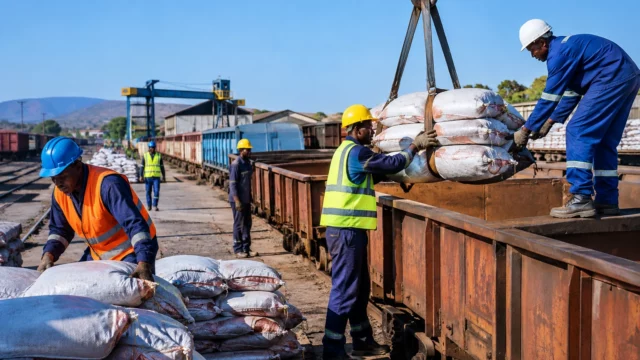
Transport is one of the obstacles. The Lobito Corridor links the mining regions of DR Congo and Zambia to the port of Lobito in Angola. Modernising the Congolese railway line between Sakania and Dilolo is intended to improve this connection. But the concession and financing discussions do not, on their own, guarantee that the work will be carried out. Electricity is another major issue, particularly for energy-intensive projects such as refining.
Congolese expectations, results still to be verified
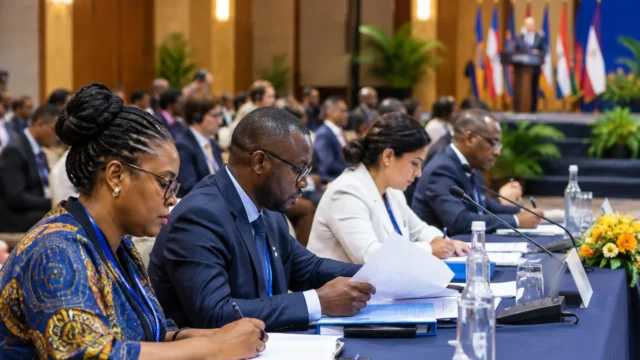
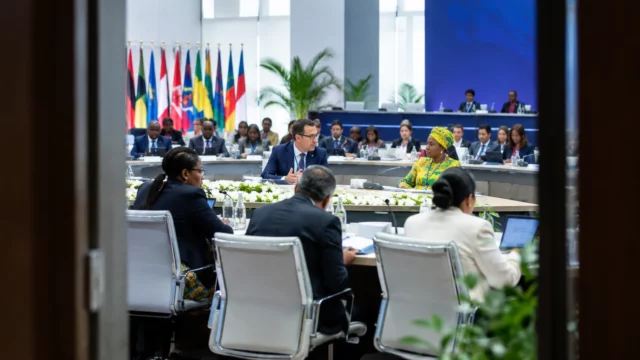
Kinshasa has submitted a list of strategic projects to the United States, including Grand Inga and energy infrastructure. This list should not be confused with mining assets that could be offered to investors. At the steering committee meeting held in Paris on 5 November 2026, the two governments reaffirmed their commitment to advancing the projects. The meeting did not, however, announce any new confirmed funding in itself.
Daniel Mukoko Samba, DR Congo’s economy minister, summed up Kinshasa’s expectations by linking the agreement’s success to completed projects, jobs created and the return of peace to the country. This is a more demanding measure than counting memorandums or meetings. It also requires distinguishing the benefits to the state and large companies from those felt by people in mining provinces.
The security dimension remains particularly sensitive. The economic partnership has developed amid conflict in the east, where fighting and population displacement cannot be resolved simply by opening up mining markets. Peace, relations with neighbouring countries and the state’s ability to protect civilians remain distinct issues, even if diplomatic agreements bring them closer to economic questions.
At regional level, the Lobito Corridor brings together DR Congo, Angola and Zambia along a transport route to the Atlantic. It could diversify export routes and support cross-border trade. But its impact will depend on the infrastructure actually delivered and the share of added value retained in producing countries.
After nearly a year, the picture is therefore mixed: a copper sale has been formalised, several transactions or supply agreements remain to be confirmed, and a refinery project has advanced to the study stage. The next step will be to turn these commitments into funded investment, local production capacity and verifiable benefits for the Congolese people.