Algeria
 Egypt
 Libya
 Morocco
 Sudan
 Tunisia
 Benin
 Burkina Faso
 Cabo Verde
 Côte d'Ivoire
 Ghana
 Guinea
 Guinea-Bissau
 Liberia
 Mali
 Mauritania
 Niger
 Nigeria
 Senegal
 Sierra Leone
 The Gambia
 Togo
 Cameroon
 Central African Republic
 Chad
 DR Congo
 Equatorial Guinea
 Gabon
 Republic of the Congo
 São Tomé and Príncipe
 Burundi
 Comoros
 Djibouti
 Eritrea
 Ethiopia
 Kenya
 Madagascar
 Malawi
 Mauritius
 Rwanda
 Seychelles
 Somalia
 South Sudan
 Tanzania
 Uganda
 Angola
 Botswana
 Eswatini
 Lesotho
 Namibia
 South Africa
 Zambia
 Zimbabwe
A trade deal can open up a market. On its own, it cannot guarantee that Mozambican businesses will benefit. For Maputo, the challenge will be to turn closer ties with Abu Dhabi into new market opportunities, productive investment and benefits beyond major projects.
A closer relationship as part of an opening-up strategy
Mozambique is seeking to attract capital and diversify an economy in which natural resources play a major role. Its ports and transport corridors link it to several countries in southern Africa. The country is a member of the Southern African Development Community (SADC), which aims, among other things, to strengthen trade and regional economic integration.
The partnership with the United Arab Emirates adds an external dimension to this strategy. Abu Dhabi is seeking to expand its trade and investment across the continent. For Mozambican businesses, the issue is not simply to export more to the Gulf: it is also to find partners, financing and routes into new markets.
This opening comes as the country needs to forge stronger links between infrastructure and resource-extraction projects and the activities of local businesses. The benefits of a deal will therefore depend on its practical terms, but also on the ability of Mozambican producers to meet market requirements and transport their goods.
Trade negotiations concluded, but deal not yet in force
On 14 November 2026, during President Daniel Chapo’s visit to Abu Dhabi, the two countries announced the conclusion of negotiations on a comprehensive economic partnership agreement, known by its English acronym, CEPA. The deal aims to reduce some customs duties, remove barriers to trade and improve market access. These measures will apply only after the agreement has been signed and ratified and has entered into force.
The distinction matters: concluding negotiations does not mean the new rules are already applicable. Businesses will have to wait for the legal steps to be completed and then learn which sectors and products are covered, as well as the implementation timetable. The Mozambican presidency, for its part, has presented the closer relationship as a broader commitment to trade, infrastructure, energy, agriculture, logistics and tourism.
Non-oil bilateral trade reached $2.56 billion in 2025, according to the Mozambican presidency, which reports a 91.35% increase year on year. UAE figures cited when the CEPA was announced show growth of 91.6%, to a rounded total of $2.6 billion. The two sets of figures are close, but the precise values differ slightly depending on the source.
In the first nine months of 2026, non-oil trade reportedly reached about $2.5 billion, up 49% year on year, according to the UAE’s WAM news agency. This pace confirms the intensification of trade, but does not in itself show which Mozambican products are benefiting or how gains are distributed among economic actors.
Funding announced, with terms still to be clarified
The visit also led to the announcement of $500 million in funding from the Abu Dhabi Fund for Development. The Mozambican presidency describes it as a loan to support national priorities. However, a Mozambican organisation promoting local content says the terms, deadlines and disbursement arrangements still need to be negotiated.
This clarification matters when assessing the commitment: an announced sum does not necessarily mean funds are immediately available. The projects selected, the cost of credit and the repayment schedule will determine its effect on public finances and infrastructure. The share of Mozambican businesses and workers in the funded projects will also need to be monitored.
The two governments also discussed co-operation in tourism, energy, rail transport, space exploration and labour. These areas cover very different realities. Transport and energy development can support economic activity, while the benefits of tourism or extractive investments will depend in particular on the jobs created and links established with local suppliers.
Benefits will depend on real market access
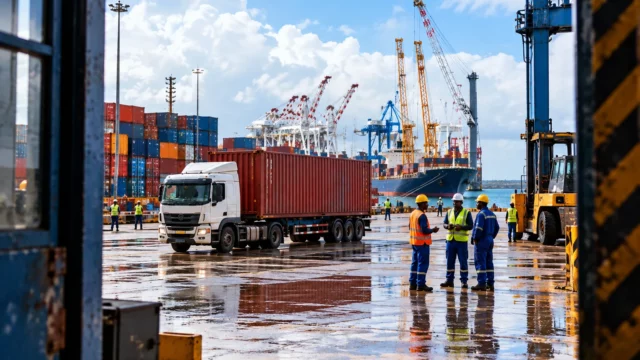
For Mozambican exporters, lower customs duties can improve competitiveness, but are not enough. Transport costs, rules of origin, health standards and the reliability of supply can also determine whether a business can effectively access the UAE market. Small-scale producers and informal businesses do not always have the same resources as large groups to meet these requirements.
UAE investment in Mozambique reportedly exceeded $4 billion between 2015 and 2026, including about $2 billion in direct investment, according to figures from the Mozambican presidency cited in announcements related to the visit. These amounts indicate the scale of the partnership, but do not detail the sectors involved or the geographical distribution of projects. Their contribution to employment and local processing therefore remains to be assessed.
The regional impact will also depend on how this bilateral partnership fits with Mozambique’s commitments within SADC. A deal with an external partner can open up markets and attract capital. But its impact on regional integration will depend on whether it complements value chains and infrastructure shared with neighbouring countries, rather than concentrating trade along a single route.
Next steps to watch
In the short term, the milestones are legal and financial: signing and then ratifying the CEPA, publishing its provisions, and clarifying the terms of the announced loan. The test of implementation will follow. Data on exports, funded projects, jobs and Mozambican businesses’ participation will help distinguish diplomatic announcements from measurable economic effects.
For Maputo, the deal could diversify trading partners and help fund national priorities. For this opening to benefit local businesses and people beyond major centres as well, market access will need to be accompanied by production, transport and processing capacity. This is the level at which the lasting significance of closer ties with Abu Dhabi will be judged.
The Mozambican presidency on bilateral trade and economic co-operation · Announced outcomes of Daniel Chapo’s visit to the UAE · Details of the funding and terms still to be negotiated · Trade figures and announcement that CEPA negotiations have concluded · SADC trade statistics