
 Algeria
 Egypt
 Libya
 Morocco
 Sudan
 Tunisia
 Benin
 Burkina Faso
 Cabo Verde
 Côte d'Ivoire
 Ghana
 Guinea
 Guinea-Bissau
 Liberia
 Mali
 Mauritania
 Niger
 Nigeria
 Senegal
 Sierra Leone
 The Gambia
 Togo
 Cameroon
 Central African Republic
 Chad
 Equatorial Guinea
 Gabon
 Republic of the Congo
 São Tomé and Príncipe
 Burundi
 Comoros
 Djibouti
 Eritrea
 Ethiopia
 Kenya
 Madagascar
 Malawi
 Mauritius
 Mozambique
 Rwanda
 Seychelles
 Somalia
 South Sudan
 Tanzania
 Uganda
 Angola
 Botswana
 Eswatini
 Lesotho
 Namibia
 South Africa
 Zambia
 Zimbabwe
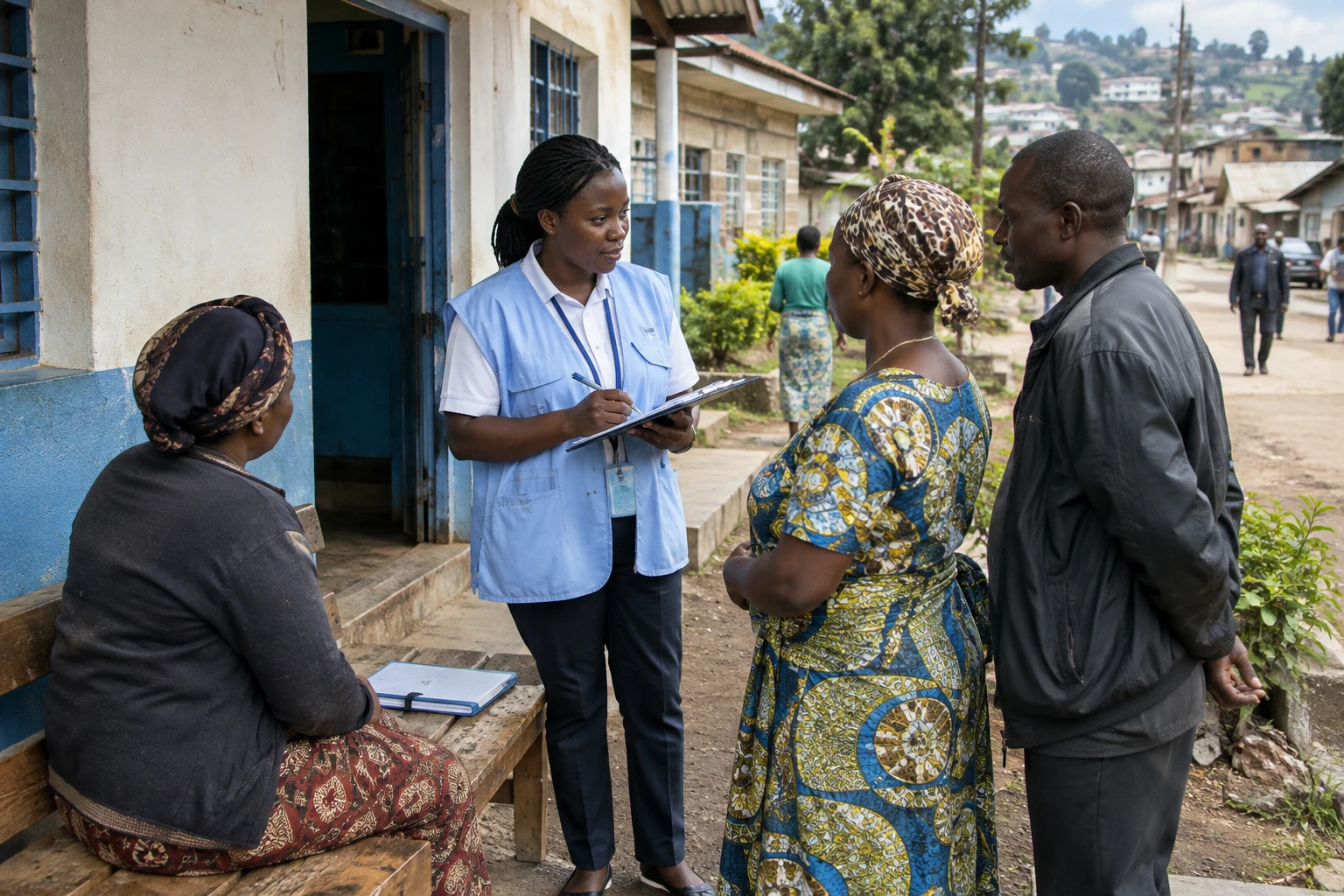
In Cantine-Aloya, North Kivu, the armed attack brought the epidemic’s front line into neighbouring homes. People being monitored after exposure to the virus fled along with residents, while health teams lost access to several patients.
Displacement complicates health monitoring in eastern Congo
Violence is affecting a region where displacement is already common. During the night of 5 to 6 November 2026, an attack attributed to the Allied Democratic Forces (ADF) struck Cantine-Aloya, in Beni territory, west of the city of Beni. Three health facilities were looted and set on fire. Residents fled to nearby communities.
The death toll varies according to initial counts. On 6 November, a civil society organisation cited by the Associated Press reported at least 33 deaths. On 11 November, the World Health Organization (WHO) reported that 66 civilians had been killed, including three health workers. These figures reflect tolls published on different dates and should be attributed to their sources.
Losing contact with exposed people poses a real risk to screening efforts. On 11 November, the WHO reported that more than 1,000 contacts could not be traced and that three people whose infections had been confirmed had not been located. A manager at Cantine hospital had also said that patients, including suspected and confirmed cases, had fled the facility during the attack.
Contact tracing involves finding people who have been exposed, checking their health and quickly referring them for care if symptoms appear. When these people disperse, teams must retrace their movements and inform new communities. This makes surveillance more difficult, but does not mean that every displaced person is infected.
An epidemic involving provinces and neighbouring countries
Since May 2026, the DRC has been facing an outbreak caused by the Bundibugyo virus, a strain of Ebola. The WHO declared it a public health emergency of international concern on 15 May. As of 10 November, its tally recorded 11,114 confirmed cases and 5,433 confirmed deaths in the DRC. Eight provinces had been affected.
There is currently neither an approved vaccine nor a specific treatment for the disease. The response therefore relies in part on supportive care, rapid detection, infection control, contact tracing and informing communities. The DRC has experienced other Ebola outbreaks; this is the 17th since the virus was identified in 1976.
The outbreak is developing in the east of the country, where armed violence, access difficulties and displacement are weighing on public services. The ADF is an armed group of Ugandan origin active in this border area. The WHO had also reported attacks on health workers and medical facilities elsewhere in the affected areas. According to information released in November, the organisation has recorded 81 attacks on health services since the start of the outbreak.
This pressure affects more than teams specialising in Ebola. Local health facilities also provide routine care to residents. When a centre closes or its staff flee, families may have to seek help further away, along routes that are not always safe. Rural areas far from major facilities may then lose access to care more quickly.
Security is crucial to an effective response
For health authorities, the challenge is to maintain screening and care without putting patients or staff at greater risk. Africa CDC, the African Union’s public health agency, condemned the attack on Cantine-Aloya and called for civilians and health facilities to be protected, and for teams to have access to communities. Its intervention underlines that continuity of care is also a regional issue.
Movement between provinces and across borders makes coordination important. The WHO has documented cases linked to the outbreak in Uganda, Kenya, France and Nigeria, with different circumstances and update dates in each country. These reports do not indicate uniform spread; rather, they underline that surveillance must track movement and rely on cooperation between health services.
In Kinshasa, national decisions must therefore translate into resources accessible to teams in North Kivu and Ituri. In the coming days, tracing dispersed contacts, restoring services at damaged centres and ensuring the safety of health-related travel will be key indicators. The ability to find people lost to follow-up will depend as much on access to communities as on the medical tools available.



