Algeria
 Egypt
 Libya
 Morocco
 Sudan
 Tunisia
 Benin
 Burkina Faso
 Cabo Verde
 Côte d'Ivoire
 Ghana
 Guinea-Bissau
 Liberia
 Mali
 Mauritania
 Niger
 Nigeria
 Senegal
 Sierra Leone
 The Gambia
 Togo
 Cameroon
 Central African Republic
 Chad
 DR Congo
 Equatorial Guinea
 Gabon
 Republic of the Congo
 São Tomé and Príncipe
 Burundi
 Comoros
 Djibouti
 Eritrea
 Ethiopia
 Kenya
 Madagascar
 Malawi
 Mauritius
 Mozambique
 Rwanda
 Seychelles
 Somalia
 South Sudan
 Tanzania
 Uganda
 Angola
 Botswana
 Eswatini
 Lesotho
 Namibia
 South Africa
 Zambia
 Zimbabwe

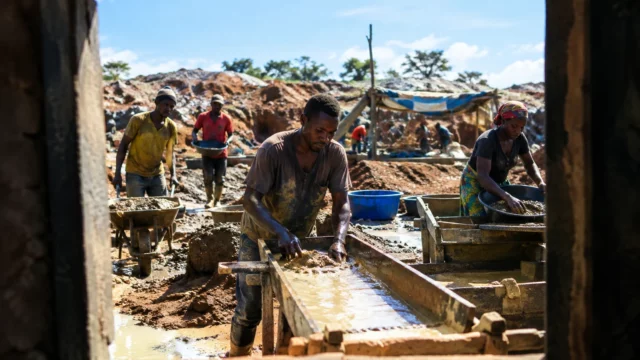
In Bouré-Balato, the closure of gold-panning sites has raised an urgent question: how can a ban be enforced without turning regulation of an economic activity into a confrontation with the communities that depend on it? Clashes on 11 November left the human toll uncertain and exposed tensions around artisanal gold mining in Siguiri.
An operation that turned into a confrontation
On Wednesday 11 November, defence and security forces intervened at the Kassokolenfa site, in the Bouré-Balato area, about 20 kilometres from Siguiri, in Upper Guinea. Young gold miners and officers clashed. Accounts differ over what triggered the confrontation.
Security sources cited in initial reports say the patrol came across miners at work and tried to arrest them. Residents, meanwhile, say machines used at the site were set on fire during the operation. Guinean media also reported burnt machinery and injuries, without independently establishing the precise circumstances.
Local witnesses report gunfire and people wounded by bullets. A resident quoted by Africa Guinee says he saw a man with an abdominal wound die before he could be evacuated. At this stage, this account does not amount to a confirmed toll: no authority has published a verified count of deaths or injuries. Territorial Administration Minister Djénabou Touré said the government would communicate details at a later date.
Protesters reportedly set up barricades using stones and burning tyres. Security reinforcements are said to have later arrived in the area, where clashes continued for several hours. Calm had returned by Thursday morning, according to available information. The situation on the ground and any evacuations remain to be clarified.
A recent ban puts livelihoods at stake
The violence came less than two weeks after artisanal gold mining was suspended across Siguiri prefecture on 29 October. The authorities cited, among other reasons, environmental degradation and security concerns. On 2 November, a security operation was deployed to enforce the measure, according to reports carried by the Guinean press and an economic briefing by the French Treasury.
Pressure has also shifted to the justice system. A joint statement from Guinea’s defence and security ministries, reported by Guinéenews, said 1,263 people arrested in Siguiri had been handed over to the courts. Operations on 7 and 8 November reportedly led to 49 further arrests in the Siguiri mining area. These official figures indicate the scale of the campaign, but do not on their own reveal the circumstances of the arrests or the court decisions.
The policy directly affects people whose incomes come from gold mining, as well as businesses and services that depend on their activity. It also affects local authorities tasked with enforcing the ban and residents exposed to security risks and environmental damage. In a mining area, a blanket suspension can quickly cut off incomes, including those of workers who have no control over the sector’s rules or sales channels.
The measure addresses documented concerns: artisanal mining can degrade soil and waterways, while the use of mercury poses health risks. But enforcement through security operations, without a visible mechanism for consultation or economic transition, can heighten tensions. In Siguiri, the challenge is therefore not only to ban certain practices, but also to clarify the rules, pathways to formalisation and avenues of redress available to workers and communities.
Regulation cannot be limited to operations on the ground
Artisanal gold mining plays an important role in Guinea’s economy. The planetGOLD Guinea project estimates that nearly 350 sites are affected across the country, that more than 240,000 jobs are linked to the sector and that its estimated economic value is $300 million. These figures show why a ban in Siguiri raises issues beyond law and order alone.
In September 2026, representatives of the state, gold-mining organisations, the mining sector and civil society met in Conakry to consider a territorial approach in Siguiri. It aims to bring together the formalisation of activities, mercury reduction, financing and dialogue between communities and mining stakeholders. The clashes in Bouré-Balato show how wide the gap can become between this ambition for consultation and an implementation perceived locally as a coercive intervention.
The next decisive step will be publication of an official toll and an explanation of the 11 November operation. The legal proceedings following the arrests and the practical arrangements for the suspension will also need to be monitored. Without this information, it remains impossible to measure the human cost of the confrontation precisely or assess whether the announced policy protects residents, the environment and the rights of those affected.
Guinea is a member of ECOWAS, the Economic Community of West African States. The Siguiri case also has a regional dimension: gold-mining activities and the movement of workers do not stop at borders. For Conakry and its neighbours, balancing resource control, environmental protection and the dignified treatment of workers remains a tangible challenge. In Bouré-Balato, the first test will now be whether the authorities can establish the facts and report on what follows.