Algeria
 Egypt
 Libya
 Morocco
 Sudan
 Benin
 Burkina Faso
 Cabo Verde
 Côte d'Ivoire
 Ghana
 Guinea
 Guinea-Bissau
 Liberia
 Mali
 Mauritania
 Niger
 Nigeria
 Senegal
 Sierra Leone
 The Gambia
 Togo
 Cameroon
 Central African Republic
 Chad
 DR Congo
 Equatorial Guinea
 Gabon
 Republic of the Congo
 São Tomé and Príncipe
 Burundi
 Comoros
 Djibouti
 Eritrea
 Ethiopia
 Kenya
 Madagascar
 Malawi
 Mauritius
 Mozambique
 Rwanda
 Seychelles
 Somalia
 South Sudan
 Tanzania
 Uganda
 Angola
 Botswana
 Eswatini
 Lesotho
 Namibia
 South Africa
 Zambia
 Zimbabwe
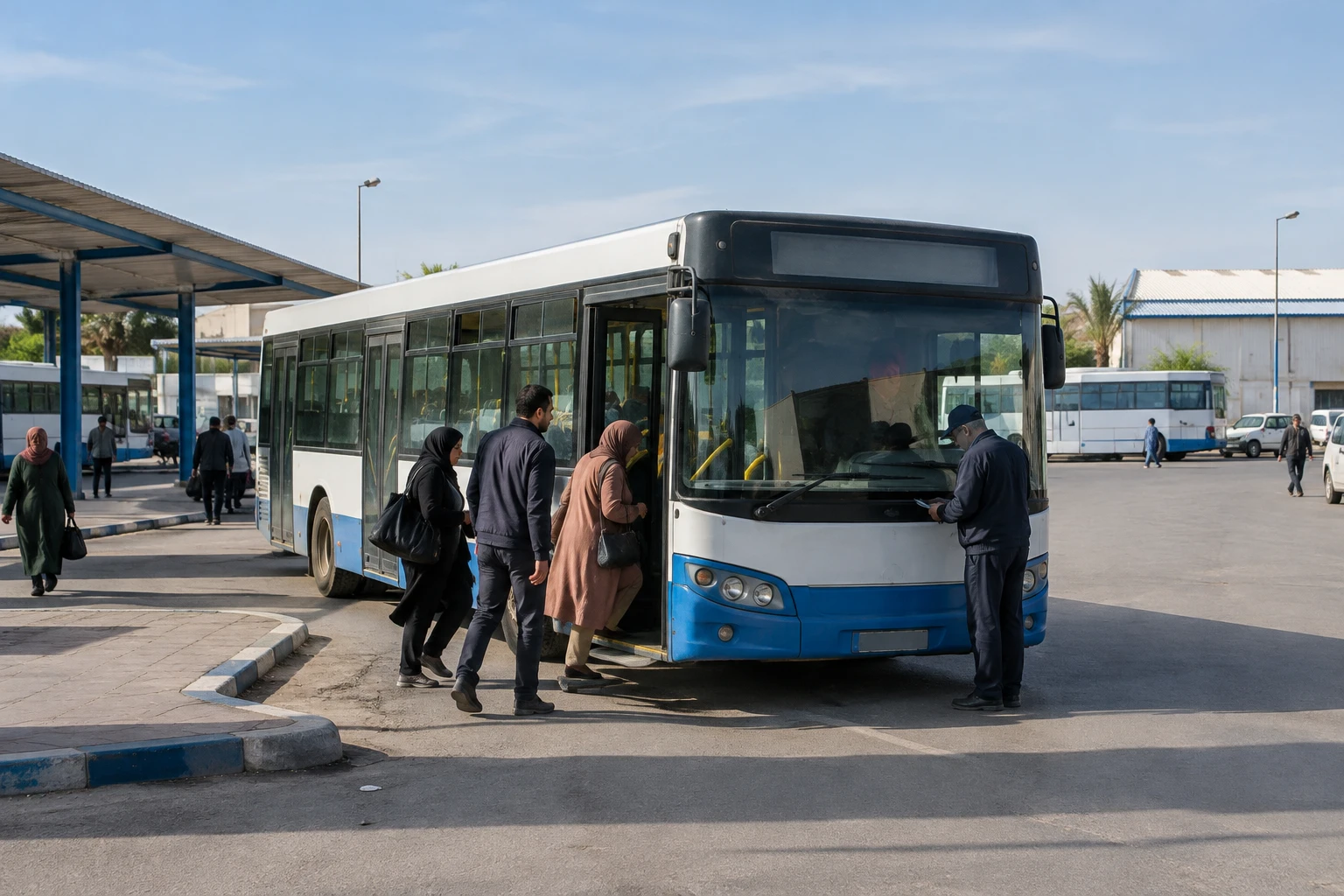
In Tunis and towns in the interior, an announced bus is useful only if it runs, keeps to a timetable and serves neighbourhoods where alternatives are scarce. Tunisia’s plan to acquire 724 additional buses in 2027 therefore raises a practical question: how can fleet renewal be turned into more reliable journeys for passengers?
Services matter beyond the capital
In Tunisia, public transport connects workplaces, schools and public services. Its availability is particularly important for households without a car, pupils and students. In regions far from major centres, regular services also determine access to healthcare and administrative services.
The network extends beyond the Société des transports de Tunis, or Transtu, which serves the capital and part of Greater Tunis. Regional companies provide a significant share of services in other governorates. Expanding the national fleet therefore does not, by itself, guarantee an equivalent improvement everywhere: the allocation of vehicles and the resources to operate them will matter as much as the announced total.
This policy comes amid the gradual renewal of an ageing fleet. On 4 November 2026, Transport Minister Rachid Amri said the number of buses available for service was expected to reach 3,312 by 12 December, up from 2,416 in 2025, according to information reported by the TAP news agency. These figures describe an expected increase, not a final tally of buses actually in service.
724 buses planned for 2027
On 11 November, during parliamentary debates on the draft state budget and economic budget for 2027, Economy and Planning Minister Samir Abdelhafidh announced plans to acquire 724 additional buses. He described transport as a lever for social justice and balance between regions. The announcement was reported by the Tunisian news agency TAP and several Tunisian media outlets.
The programme aims to distribute buses across the country. But so far, the announcement does not specify a detailed delivery schedule, the companies that will receive them or the financing for each batch. These details will be crucial in determining when the buses can actually take to the road and which routes will be strengthened.
The figure comes on top of orders and deliveries launched in 2026. In September, the director-general of land transport at the Transport Ministry had said 727 buses were expected before the end of the year. This was a separate announcement for 2026: that batch should not be confused with the 724 vehicles planned for the following year.
Buses, trains and maintenance: what makes services work
Renewal also covers rail. A contract for 18 new electric trainsets for the Tunis–La Goulette–La Marsa line was signed on 10 July 2026 by Transtu and Chinese manufacturer CRRC Nanjing Puzhen. The first deliveries are expected in early 2028, according to the Tunisian press. The line, often called the TGM, serves several neighbourhoods and municipalities north of the capital.
New equipment will not resolve problems if depots, tracks, workshops and maintenance teams do not keep pace. A bus out of service for lack of spare parts or a train running at irregular intervals does little to improve passengers’ daily lives. Monitoring maintenance costs, ensuring the availability of drivers and technicians, and providing real-time information must therefore accompany purchases.
Operating services is also a financial issue. The state must fund the acquisition, as well as recurring expenses: fuel or electricity, repairs, salaries and infrastructure. With the public budget having to balance competing needs, scheduling deliveries and being transparent about their cost will make it possible to assess whether the project is viable.
The real test will be access
Equitable distribution means more than sending vehicles to every region. It requires assessing needs based on passenger numbers, distances, school and work schedules, and routes that are currently poorly served. Urban centres, where demand is dense, and rural areas, where journeys are longer and less profitable, do not need the same solutions.
For passengers, the most telling indicators will be simple: more services actually running, less waiting, viable connections and accessible vehicles. Informal-sector workers, whose schedules are often less fixed, can be particularly disadvantaged by infrequent or unpredictable services. Better-organised provision, by contrast, can widen access to jobs and services without relying on an individual vehicle.
At the regional level, Tunisia is a member of the Arab Maghreb Union (AMU), a co-operation organisation for North African countries. The bus announcement addresses a national need first and foremost; its pan-African significance lies mainly in a shared challenge: making transport investment sustainable through maintenance, planning and balanced access across territories.
The next step will be to set out the tenders, financing and timetable for putting the 724 buses into service. To assess the outcome, the announced vehicles will then need to be compared with those actually delivered and operated, region by region. It is at this level that the investment may, or may not, translate into shorter journey times for Tunisians.