Algeria
 Egypt
 Libya
 Morocco
 Sudan
 Tunisia
 Benin
 Burkina Faso
 Cabo Verde
 Côte d'Ivoire
 Ghana
 Guinea
 Guinea-Bissau
 Liberia
 Mali
 Mauritania
 Niger
 Nigeria
 Sierra Leone
 The Gambia
 Togo
 Cameroon
 Central African Republic
 Chad
 DR Congo
 Equatorial Guinea
 Gabon
 Republic of the Congo
 São Tomé and Príncipe
 Burundi
 Comoros
 Djibouti
 Eritrea
 Ethiopia
 Kenya
 Madagascar
 Malawi
 Mauritius
 Mozambique
 Rwanda
 Seychelles
 Somalia
 South Sudan
 Tanzania
 Uganda
 Angola
 Botswana
 Eswatini
 Lesotho
 Namibia
 South Africa
 Zambia
 Zimbabwe
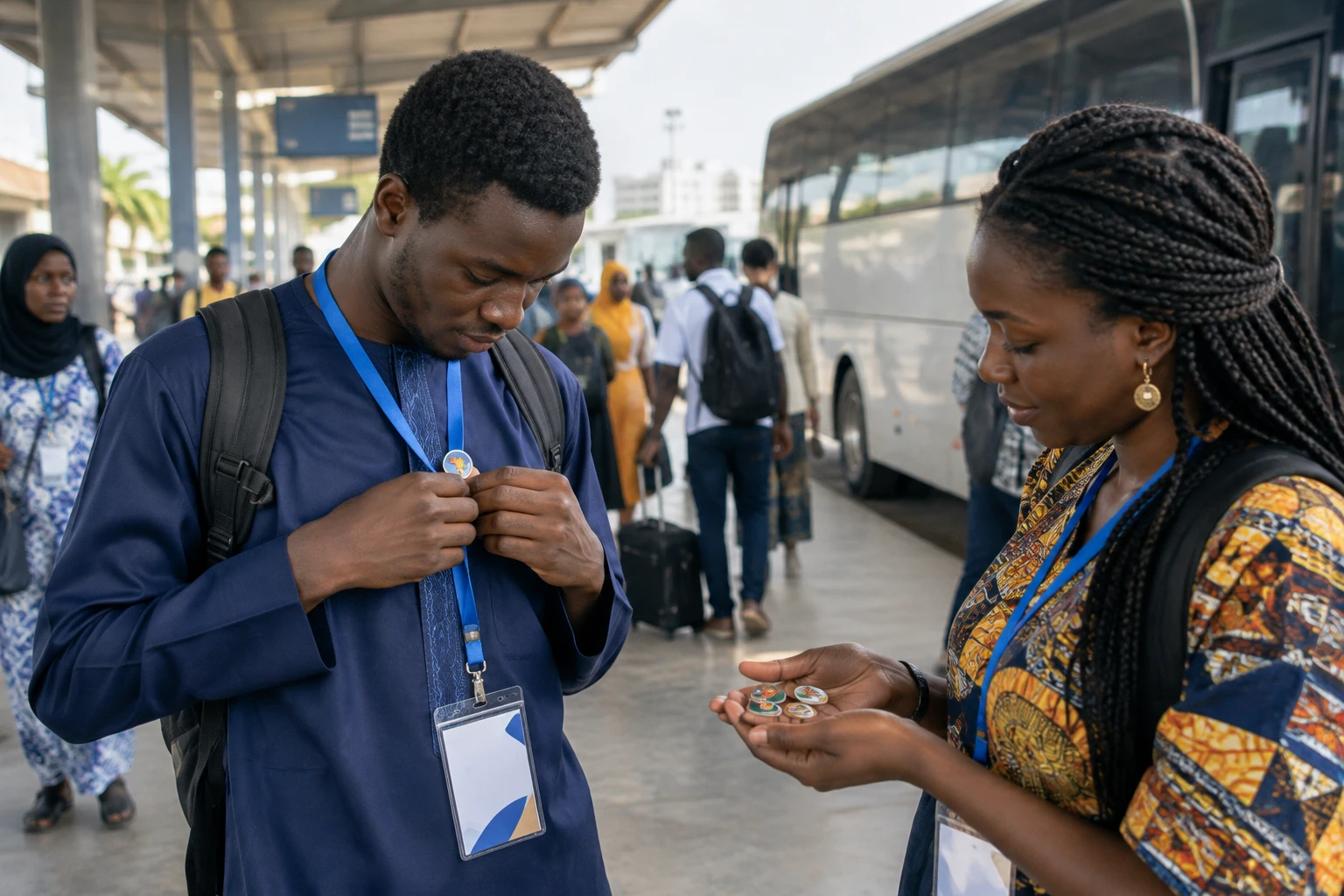
In the Games’ walkways, a small piece of metal can spark a conversation between two people who do not speak the same language. In Dakar, pin badges are traded and collected, becoming small archives of a historic sporting encounter.
The Youth Olympic Games (YOG) are being held in Senegal from 31 October to 13 November 2026. For the first time, an Olympic sporting event is taking place on African soil. But this edition is not told solely through competitions and medals. In the stands, press areas and gathering places, the objects people exchange also tell the story of everyday life at the Games.
A keepsake passed from hand to hand
Attached to bags, caps or lanyards, pin badges have become sought-after items. Athletes, volunteers and visitors trade them to complete their collections or keep a record of their visit. The principle is simple: each person offers a design they own and, if the exchange goes ahead, leaves with one from another delegation or a partner.
Their appeal lies in more than their design or rarity. A pin badge in Dakar 2026 colours can recall participation, a meeting or a particular day. Senegalese content creators Diaw Ketchup and Biggy say they want to keep theirs as lasting mementoes, to pass on one day to their grandchildren. Their testimony expresses an individual experience, but illustrates the place such an object can occupy in the memory of an event.
For Vivian Mora Ratembo, a Kenyan 3×3 basketball player cited in accounts collected around the Games, collecting pin badges from several countries is a way to open up to others and build connections. The national symbol remains visible, but becomes part of a shared collection. Trading thus brings into contact people who might otherwise never have spoken to one another.
Dakar, a meeting point for the Olympic world
The YOG bring together young athletes from many countries, as well as volunteers, media and spectators. Events are being held in Dakar, Diamniadio and Saly. This arrangement links the capital with other Senegalese venues and extends the experience beyond the stadiums. The Games also include educational and cultural activities designed to complement the competitions.
Senegal’s selection as host country is the result of a particular trajectory: Dakar was initially chosen to host the Games in 2022, before they were postponed to 2026. The event is therefore both a sporting occasion and an institutional first for the continent. The International Olympic Committee describes this edition as the first Olympic sporting event to be held in Africa. That historic significance does not remove the need to look at what the Games concretely leave behind for young people, clubs and the host cities.
In this context, pin badge exchanges provide a modest but revealing scene. Delegations display their colours. Visitors look for a distinctive keepsake. Volunteers and athletes can strike up a conversation without protocol. A simple trade turns a promotional or commemorative object into a sign of mutual recognition.
Between personal attachment and commercial visibility
Pin badges also have promotional value. Partners at the venues distribute them to raise awareness of a brand or draw attention to their activities. Some ask visitors to follow their social media accounts or post a mention in exchange for an item. This is common in event marketing: the object attracts attention, while the online action increases the advertiser’s visibility.
This commercial dimension coexists with collectors’ personal attachment. It is a reminder that the Games are also a space where sport, image and marketing meet. For visitors, an exchange may be spontaneous or tied to a promotional campaign. For brands, the pin badge becomes a compact, memorable medium. For organisers and local stakeholders, the broader challenge is to ensure that the visibility generated during the event also benefits Senegalese talent, businesses and initiatives.
The circulation of keepsakes does not erase differences in resources between participants. Some visitors have more items to trade or more regular access to places where pin badges are handed out. Others have to rely on chance encounters. This small informal market cannot be measured solely in financial terms: rarity, a connection to a delegation or the memory of a person may matter more than price.
A story on a continental scale
The Games are taking place in Senegal, a member of ECOWAS, the Economic Community of West African States, which brings countries in the region together around economic and political co-operation. The presence of young athletes from different countries gives Dakar a regional and international dimension. It makes visible a diverse Africa, made up of distinct delegations and experiences rather than a uniform space.
This African Olympic first also raises the question of legacy. Exchanges of keepsakes testify to personal connections, but they are not enough to assess the lasting impact of the Games. It will also be necessary to look at how infrastructure is used, the place young people have in sports policies and the opportunities created for local stakeholders beyond the two-week event.
On 13 November, when the YOG close, the competitions will end, but pin badges will continue to circulate in bags and private collections. Their value will differ for everyone: a reminder of a medal, an exchange or a first visit to Dakar. For Senegal and its West African neighbours, these small objects offer a tangible glimpse of one aspect of the event: encounters between delegations, residents and visitors, beyond the sporting results.