Algeria
 Egypt
 Libya
 Morocco
 Tunisia
 Benin
 Burkina Faso
 Cabo Verde
 Côte d'Ivoire
 Ghana
 Guinea
 Guinea-Bissau
 Liberia
 Mali
 Mauritania
 Niger
 Nigeria
 Senegal
 Sierra Leone
 The Gambia
 Togo
 Cameroon
 Central African Republic
 Chad
 DR Congo
 Equatorial Guinea
 Gabon
 Republic of the Congo
 São Tomé and Príncipe
 Burundi
 Comoros
 Djibouti
 Eritrea
 Ethiopia
 Kenya
 Madagascar
 Malawi
 Mauritius
 Mozambique
 Rwanda
 Seychelles
 Somalia
 South Sudan
 Tanzania
 Uganda
 Angola
 Botswana
 Eswatini
 Lesotho
 Namibia
 South Africa
 Zambia
 Zimbabwe
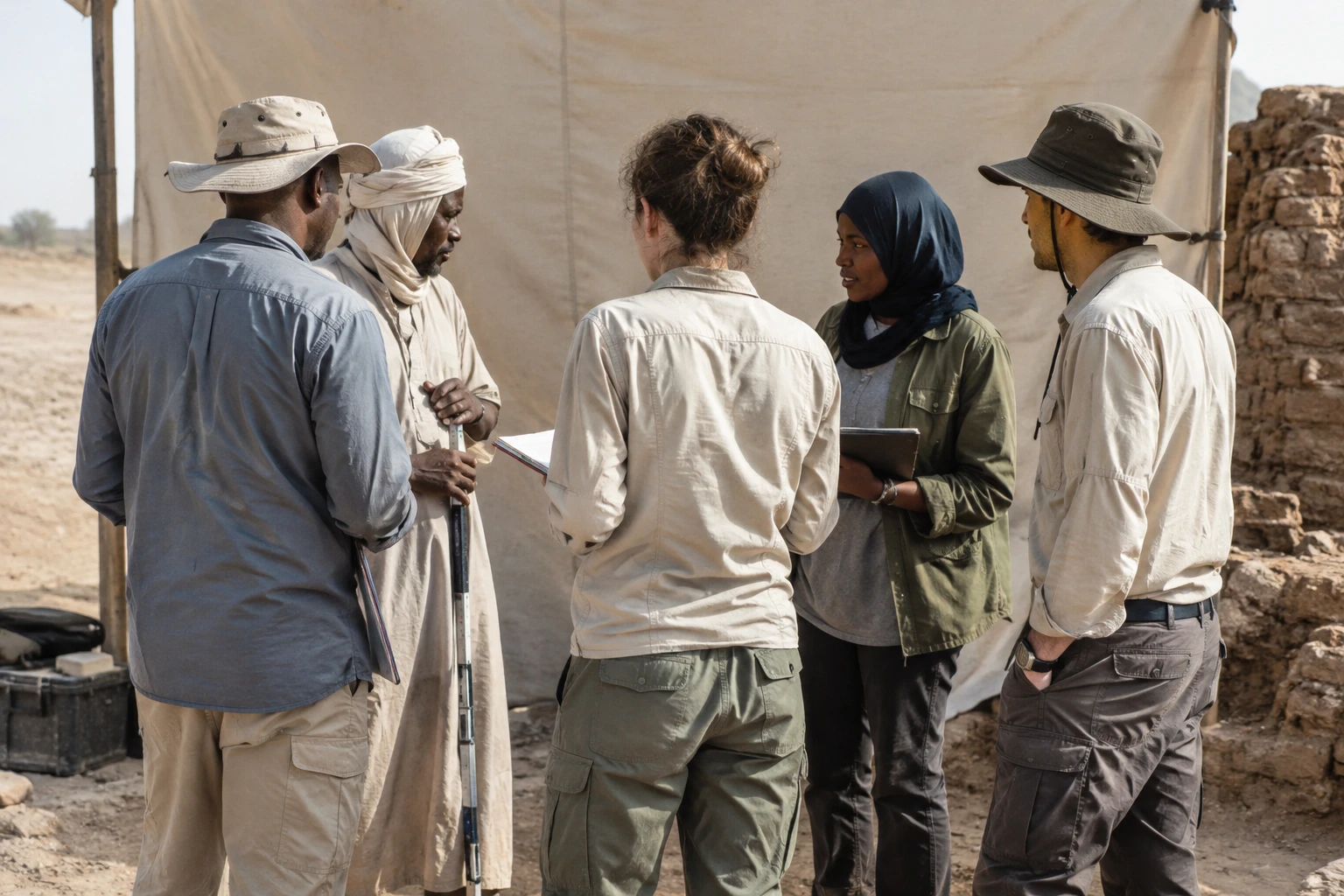
At Old Dongola, a church buried beneath the earth could shed light on a major chapter in Sudanese history: that of a Christian kingdom which organised the political and religious life of part of the Nile Valley for several centuries. Excavations have revealed remarkable dimensions and features, but Sudanese authorities say they still want to clarify some of the details reported in the media.
A major site at the heart of medieval Nubia
Old Dongola is in Northern State, on the eastern bank of the Nile. The city was the capital of Makuria, a Christian Nubian kingdom established between what is now northern Sudan and southern Egypt. Chronological markers vary between studies, but Makuria dominated part of the Nile Valley from around the 7th to the 14th century.
The site contains churches, houses, buildings of power and places of worship from different periods. UNESCO has included it on its World Heritage Tentative List, a step that does not constitute definitive inscription. Sudan’s ministry responsible for heritage also describes it as a central site in the country’s medieval history.
This history is not limited to a succession of religious monuments. Dongola lay on a route linking different communities along the Nile and neighbouring regions. Archaeology makes it possible to study local forms of Christianity, architecture, urban practices and the city’s transformations over time.
What the excavations have uncovered
A Sudanese-Polish mission, bringing together the University of Warsaw’s Polish Centre of Mediterranean Archaeology and the Sudanese National Corporation for Antiquities and Museums, has continued to explore a large building identified in 2021. Recent work has uncovered a grand entrance staircase, buttresses near the apse — the end of the choir — and, for the first time, elements of the original floor level.
The dimensions given by the team are about 47 metres wide and 57 metres long. A height of about 21 metres has also been cited, but this remains an estimate of the ancient structure. It is therefore important to distinguish between the remains observed and the proposed reconstructions: much of the building remains buried.
Reports published in early November by Polish and Sudanese media attributed to the team the identification of the structure as the Great Church of Jesus. The researcher Artur Obłuski, who is leading the work, believes it may have played an important architectural role in Nubia. At this stage, however, this is not enough to establish definitively its exact status or influence on other buildings.
One point calls for particular caution. The Sudanese media outlet Sudanhorizon reported on 10 November that the Minister of Culture, Information, Antiquities and Tourism, Khalid Al-Aiser, was awaiting official clarification. He referred to conflicting accounts of the date of the work, the building’s dimensions and its identification. The figures and interpretation should therefore remain attributed to the mission until the authorities issue a clarification.
Preserving heritage in a country at war
The discovery comes as Sudan faces a war that began on 15 April 2023 between the Sudanese army and the Rapid Support Forces. Fighting, population displacement and disruption to institutions are complicating the protection of collections and sites. IGAD, the regional organisation for the Horn of Africa, has highlighted the regional consequences of the war and called for a coordinated response.
The situation does not mean that all archaeological sites are directly exposed to fighting. It does, however, make monitoring, conservation and the movement of specialists and equipment more difficult. In this context, fieldwork, documentation and cooperation between Sudanese and foreign teams can help preserve irreplaceable data.
Local benefits will also depend on how the project is conducted. The mission and the authorities have discussed continuing the excavations and involving neighbouring communities in protecting the heritage. This requires practical measures: jobs and training where possible, access to information, consultation with residents and appropriate arrangements to protect the site without excluding the people living nearby.
At national level, the ruins of Dongola are a reminder that Sudan’s history cannot be reduced either to contemporary borders or to political crises. They reveal African societies that built urban centres and religious institutions connected to the rest of the Nile Valley. This perspective also matters to the Sudanese diaspora and to debates about the place of heritage in the country’s reconstruction.
What to watch next
The priority will be to establish what is actually known about the building: its plan, dimensions, date and function. An excavation announcement describes a stage of research, not necessarily the conclusion of a study. Publication of the scientific findings and the clarification expected from the authorities will make it possible to distinguish field observations from historical interpretations.
Conservation measures and the role given to local communities will also need to be followed. Old Dongola is on UNESCO’s Tentative List, but any international recognition would not replace either day-to-day protection or the Sudanese institutions responsible for heritage. For Sudan and its neighbours in the Nile basin, the challenge is to preserve a shared heritage without erasing local histories and knowledge.
The significance of this discovery thus goes beyond the size of a building. If the mission’s interpretation is confirmed, it will help us better understand Makuria’s religious and architectural organisation. If it changes, the excavations will still be valuable: they document an ancient city whose traces shed light, from Sudanese territory, on Nubia’s interconnected history.