Algeria
 Egypt
 Libya
 Morocco
 Sudan
 Tunisia
 Benin
 Burkina Faso
 Cabo Verde
 Côte d'Ivoire
 Ghana
 Guinea
 Guinea-Bissau
 Liberia
 Mali
 Mauritania
 Niger
 Nigeria
 Senegal
 Sierra Leone
 The Gambia
 Togo
 Cameroon
 Central African Republic
 DR Congo
 Equatorial Guinea
 Gabon
 Republic of the Congo
 São Tomé and Príncipe
 Burundi
 Comoros
 Djibouti
 Eritrea
 Ethiopia
 Kenya
 Madagascar
 Malawi
 Mauritius
 Mozambique
 Rwanda
 Seychelles
 Somalia
 South Sudan
 Tanzania
 Uganda
 Angola
 Botswana
 Eswatini
 Lesotho
 Namibia
 South Africa
 Zambia
 Zimbabwe
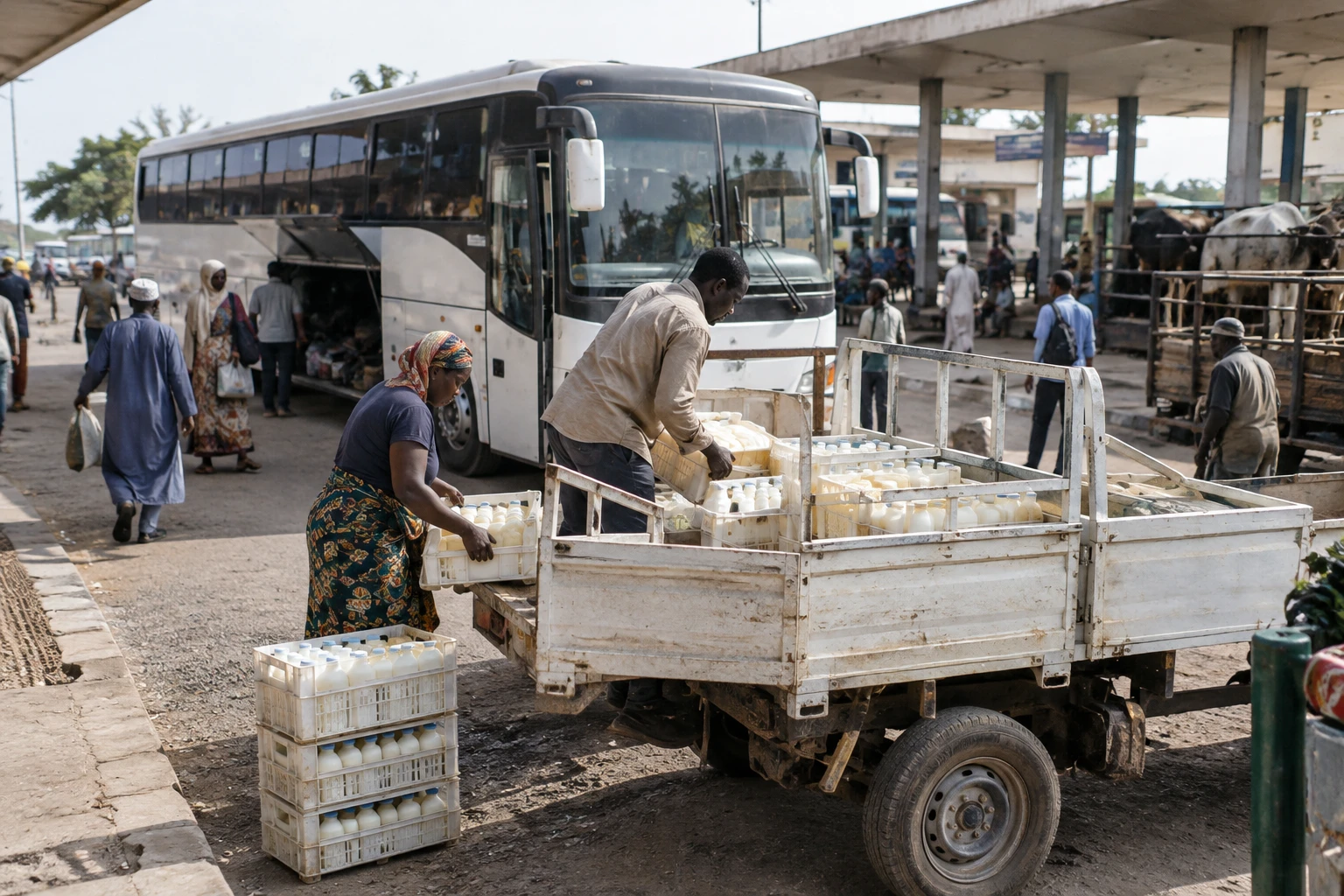
In N’Djamena, a dairy cow or an artisanal cheese also points to an economic question: how can more value be created from a vast livestock herd without leaving out the farmers and processors who sustain it? Chad’s National Livestock Fair puts this ambition on display, but its significance goes beyond competitions and exhibition stands.
A national gathering at the heart of the sector
The second edition of the National Livestock Fair is being held from 4 to 10 November 2026 at Place de la Nation in the Chadian capital. Farmers from all 23 provinces are joined by artisans, producers and processors. Animals take centre stage: cattle, zebu, dromedaries, goats, sheep and horses are presented to the public.
Three competitions distinguish animals by weight, dairy qualities and appearance. But the fair also showcases processed products, including milk, yoghurt, cheese and honey. This bringing together of livestock farming and processing offers a glimpse of a sector that is not limited to the sale of live animals.
Veterinarian Abakar Mahamat Nour Malay presented the Kouri breed, which he says is recognisable by its lack of a hump, straight back, often white coat and large horns. He describes the fair as a way to raise awareness of the breeds and share practices to gradually improve production.
From livestock to added value
The available data give an indication of what is at stake. In 2024, the FAO estimated Chad’s livestock population at more than 140 million head. It also said livestock farming accounted for around 20% of gross domestic product and 40% of exports, and involved 40% of the working population. These estimates are not directly comparable with more recent figures released by the authorities: the methods and reference years differ.
In October 2026, the Minister of Livestock and Animal Production, Abderahim Awat Atteïb, presented an estimate of more than 166 million head for 2025, excluding poultry, as well as more than 37.5 million poultry. These recent official figures give an indication of scale, but do not replace a consistent statistical series that would make it possible to track the sector’s development.
For households, processing can provide another source of income besides selling livestock. Achtar, who runs Ferme Ayoumbou in Amdourman, says she turns cow’s milk into cheeses in different flavours. She reports that demand sometimes exceeds the quantities available. Her example illustrates a practical opportunity: retaining more value locally, provided there is access to collection, storage, equipment and markets.
This prospect also concerns small businesses and women producers, who often face constraints involving transport, energy and finance. In N’Djamena, proximity to consumers can make sales easier. In the provinces, distances and access to veterinary services or markets weigh more heavily on costs. A fair in the capital raises the profile of these players, but does not by itself ensure that opportunities reach rural areas.
Productivity also depends on resources and rules
Most of the livestock is raised in mobile pastoral systems, adapted to different environments and dependent on pasture and water points. Herd mobility is therefore an essential economic practice, not simply an individual choice. It links the provinces and sometimes crosses borders, giving the management of transhumance corridors a regional dimension.
This system can nevertheless create tensions when routes, water points and cultivated land overlap. Conflicts between farmers and herders cannot be reduced to opposition between communities: access to resources, land boundaries, seasonal movements and the enforcement of local rules also matter. Human Rights Watch reported that such violence persisted in Chad in 2025. Developing the sector therefore also requires mechanisms to prevent and resolve disputes.
Animal health, the availability of livestock feed, breed improvement and pasture management are other conditions for progress. In 2024, for example, the FAO documented assistance with animal feed in Kanem and Bahr El Gazel after low biomass production. A competition rewards outstanding specimens; on its own, it cannot address the constraints facing herds and families throughout the seasons.
A challenge for Central Africa
Chad is a member of the Economic and Monetary Community of Central Africa (CEMAC), which brings six states together around a regional market and a common currency. For livestock supply chains, cross-border trade, health standards and transport infrastructure partly determine access to neighbouring markets. Adding value to meat, milk, leather and hides can therefore extend beyond the domestic market.
The fair highlights considerable potential. What follows will depend on more tangible results: markets that producers can access, processing that can meet demand, stronger veterinary services and better management of pastoral resources. For farmers and processors alike, the challenge is to turn a week of visibility into more regular income and sustainable economic activity in the provinces.