
 Algeria
 Egypt
 Libya
 Morocco
 Sudan
 Tunisia
 Benin
 Burkina Faso
 Cabo Verde
 Ghana
 Guinea
 Guinea-Bissau
 Liberia
 Mali
 Mauritania
 Niger
 Nigeria
 Senegal
 Sierra Leone
 The Gambia
 Togo
 Cameroon
 Central African Republic
 Chad
 DR Congo
 Equatorial Guinea
 Gabon
 Republic of the Congo
 São Tomé and Príncipe
 Burundi
 Comoros
 Djibouti
 Eritrea
 Ethiopia
 Kenya
 Madagascar
 Malawi
 Mauritius
 Mozambique
 Rwanda
 Seychelles
 Somalia
 South Sudan
 Tanzania
 Uganda
 Angola
 Botswana
 Eswatini
 Lesotho
 Namibia
 South Africa
 Zambia
 Zimbabwe
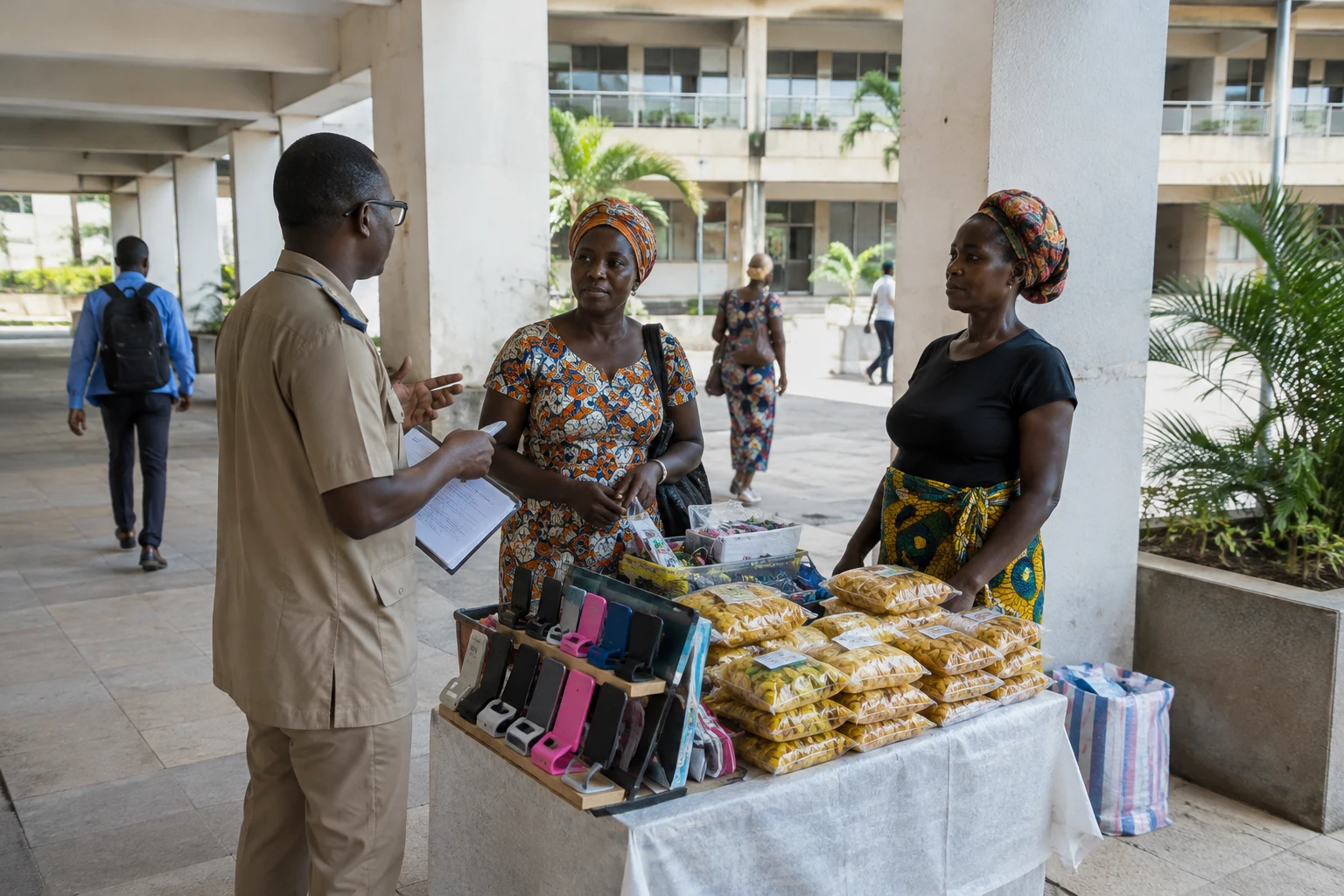
In Abidjan, a red light sometimes opens a window of a few seconds to sell a phone mount, banana crisps or an inflatable toy. For motorists, the offer appears between two lanes of traffic. For vendors, each crossing brings the risk of an accident and depends on an uncertain sale.
This activity lies at the heart of a very real urban tension: the authorities want to clear major roads, while workers seek an income in a city where informal employment remains widespread. The issue is therefore about more than traffic or the use of the road. It also concerns people’s livelihoods and the solutions offered to those affected.
Selling in the gaps in traffic
At busy junctions in Abidjan, women and men vendors offer drivers practical items and products to consume quickly. They adapt their goods to the time vehicles are stopped and to passing customers. Sales are brief, often for single items, and earnings vary with the level of traffic, the weather and the time spent on the road.
This presence is particularly noticeable when cars slow down or stop. But moving between vehicles exposes vendors to an obvious danger: a car pulling away, a change of lane or an inattentive driver can cause a collision. Road users are also affected, as selling on the carriageway can obstruct their view and impede their journeys.
The report on which these details are based mentions vendors from Niger, Mali and Burkina Faso. This identifies the people interviewed, but does not establish the proportion of each nationality among Abidjan’s street vendors. A visible presence should not be mistaken for a representative count.
An activity caught between regulation and necessity
Street trading on major roads is banned by the Autonomous District of Abidjan. In a statement dated 2 April 2024, the institution presented the ban as a measure to combat urban disorder. It is intended to clear public space, but on its own it does not address the incomes of those who used to sell there.
The issue is part of a broader policy to reorganise urban space. Since 2024, operations against installations deemed to be causing congestion have prompted discussion about their effects on traders, residents and road users. The authorities stress traffic flow and public order. Vendors, on the other hand, may lose their pitch, stock or a daily source of income when enforcement drives them away from major roads.
The challenge is to distinguish the legitimate aims of safety and traffic flow from their economic consequences. A ban can reduce the presence of vendors on the carriageway. Without accessible places to sell or a transition plan, however, it risks shifting the activity to other junctions or further weakening workers already exposed to uncertainty.
National data shed light on this context but do not measure trading at traffic lights specifically. The National Office for Population and Employment (ONEF) reports an informal employment rate of 82.3% for 2024, while noting that the corresponding survey data are awaiting validation. This figure covers employment as a whole, not street vendors alone. In its 2021 poverty profile, the National Agency for Statistics and Demography noted the strong predominance of informal work in several activities, including trade.
Migrant workers at the heart of a regional space
The presence of people from Burkina Faso, Mali and Niger reflects long-standing patterns of mobility in West Africa. People move for a range of reasons and along different routes; nationality alone reveals neither a person’s administrative status nor the circumstances of their work. Côte d’Ivoire remains closely connected to its neighbours through trade, family ties and work routes.
The Economic Community of West African States (ECOWAS), which brings countries in the region together around cooperation and free movement, provides an important framework for this mobility. But movement within the region does not automatically guarantee protected employment or effective access to social protection. The International Labour Organization notes that migrant workers may face barriers related to informal employment, recognition of their rights or access to social benefits.
For vendors, these obstacles can compound one another: unpredictable income, work that is difficult to declare and the risk of being detained or losing their goods. For local authorities, the challenge also lies in enforcing the rules without treating all workers alike or associating migration with disorder. The available data do not allow the scale of these difficulties among the vendors shown in the footage to be measured precisely.
Clearing the road without erasing livelihoods
Road safety requires that pedestrians should not have to negotiate their way through moving vehicles. But a lasting response must consider what makes this activity attractive: proximity to customers, low start-up costs and the chance to earn small sums throughout the day. These factors also explain why vendors may return after an enforcement operation.
Suitable selling spaces, accessible from busy routes but set apart from traffic, could help reconcile trading with safety. Their effectiveness would depend on their location, cost and access arrangements. These are possible planning approaches, not measures whose existence or implementation is established by the information available here.
For vendors and their families, the impact is measured first in income and working time. For drivers and passengers, it is measured in visibility and safety. Local authorities, meanwhile, must balance traffic flow, the use of public space and the continuation of economic activity.
In Yamoussoukro, Côte d’Ivoire’s political capital, as in the country’s other cities, the challenge extends beyond Abidjan’s junctions: regulating street trading without making the people who depend on it disappear. Across West Africa, it is a reminder that regional free movement must also translate into more effective working conditions and protection. The next local decisions on selling spaces and enforcement of the bans will show whether a balance between safety and economic activity is genuinely being sought.



