Algeria
 Egypt
 Libya
 Morocco
 Sudan
 Tunisia
 Benin
 Burkina Faso
 Cabo Verde
 Côte d'Ivoire
 Ghana
 Guinea
 Guinea-Bissau
 Liberia
 Mauritania
 Niger
 Nigeria
 Senegal
 Sierra Leone
 The Gambia
 Togo
 Cameroon
 Central African Republic
 Chad
 DR Congo
 Equatorial Guinea
 Gabon
 Republic of the Congo
 São Tomé and Príncipe
 Burundi
 Comoros
 Djibouti
 Eritrea
 Ethiopia
 Kenya
 Madagascar
 Malawi
 Mauritius
 Mozambique
 Rwanda
 Seychelles
 Somalia
 South Sudan
 Tanzania
 Uganda
 Angola
 Botswana
 Eswatini
 Lesotho
 Namibia
 South Africa
 Zambia
 Zimbabwe
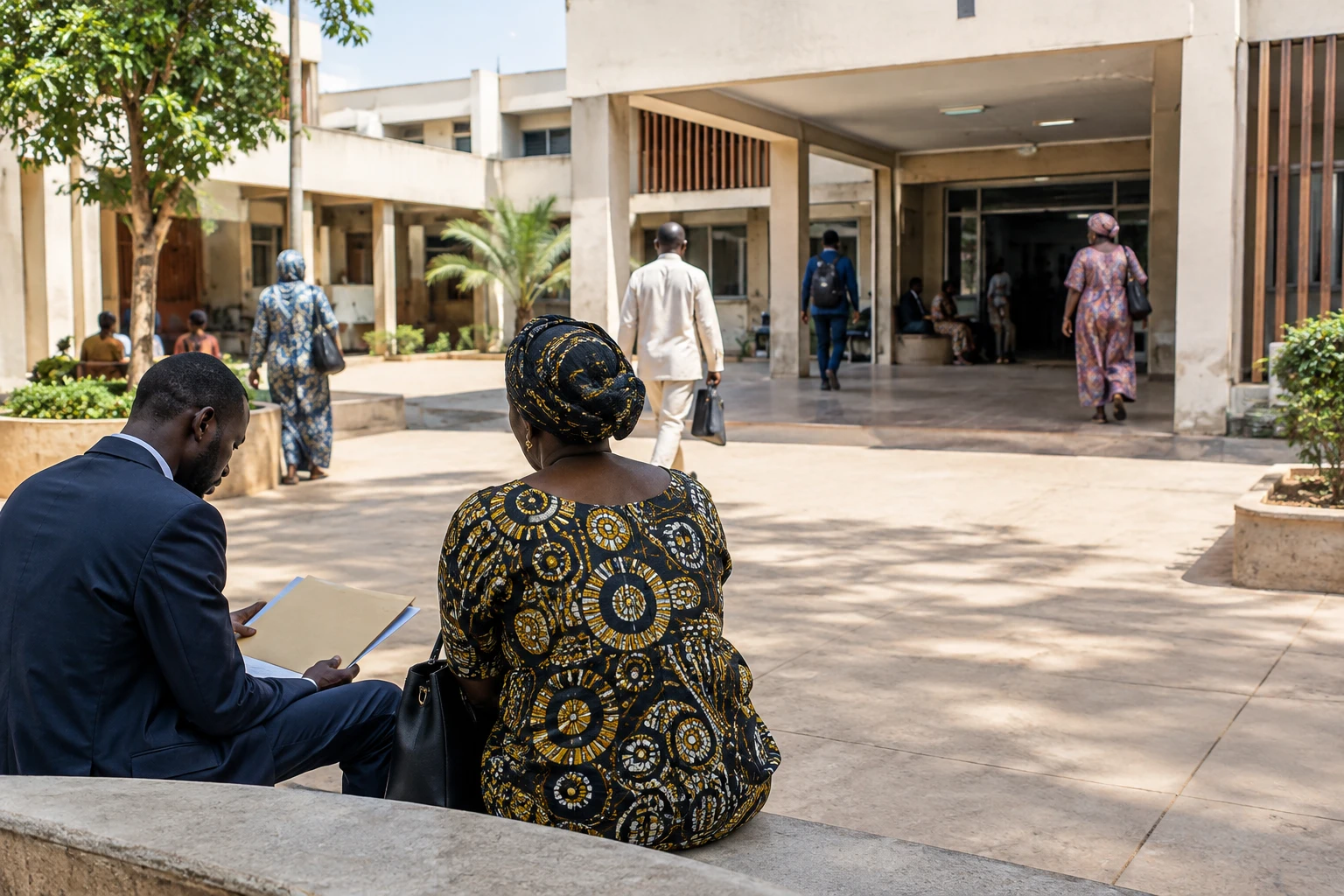
In Kati, near Bamako, an activist says he spent nearly five months without being brought before a judge. His account raises a central question for Mali: what becomes of the right to challenge the authorities when political parties are dissolved and opponents disappear without their detention being acknowledged?
An arrest amid political restrictions
El Bachir Thiam, a member of the Yelema party, says he was abducted on 8 May 2025 in Kati by masked men. He says he was then held at the premises of State Security, Mali’s intelligence service, until his release on 25 September. Amnesty International confirms the dates of his abduction and release on 26 September. The sources consulted do not allow independent verification of the precise conditions of detention he describes.
The case comes amid a period of political tension. In early May 2025, opposition figures had demonstrated in Bamako against the extension of the transition and the suspension of political activities. On 13 May, a decree dissolved political parties and organisations of a political nature. Mali’s official text confirms this decision. The authorities defended a restructuring of the political system, presented as being in line with recommendations from national consultations. UN experts, by contrast, warned that the dissolution infringed political freedoms.
Mali has been governed by transitional authorities since the coups of 2020 and 2021. In July 2025, the authorities adopted a renewable five-year mandate for the transitional president, Assimi Goïta, without a national vote. This decision heightened questions about the timetable for a return to civilian rule. Yelema, led by former prime minister Moussa Mara, was among the parties dissolved.
An account of detention, and allegations to attribute
In his testimony, Thiam says his abductors accused him of not supporting the military regime and of wanting to join Yelema. He reports undergoing only one formal interrogation, on the day of his release. According to him, an agent accused him of receiving money from France to fight his own country. Thiam denies the accusation. No independent evidence consulted confirms that it was formally made against him.
He describes overcrowded cells, poor hygiene, insufficient food and a lack of adequate medical care. He also says he heard and saw a detainee being tortured with electricity, and reports that several fellow detainees died. He believes he witnessed several dozen deaths. This particularly serious toll could not be corroborated by a second independent source. It must therefore remain presented as Thiam’s claim, not as an established toll.
His testimony also refers to Fulani and Tuareg detainees who, he says, were arrested without a clear explanation, sometimes in rural areas. These allegations are sensitive: they concern the risk of ethnic profiling in a country where security and communal tensions are acute. They cannot be generalised on the basis of this account alone. The UN Human Rights Office had, however, received information in 2025 about Thiam’s alleged enforced disappearance and asked the Malian authorities for clarification.
Thiam recounts that, upon his release, agents threatened to kill him if he revealed what he had seen. He says he still suffers from muscle pain and nightmares. These lasting effects, like the reported threats, are part of his testimony. They have not been the subject of a publicly released medical assessment in the sources consulted.
Consequences for families and public debate
A secret detention first deprives relatives of essential information: the place of detention, the detainee’s state of health, the reason for arrest and access to a lawyer. It also makes judicial scrutiny difficult. For activists and political parties, the fear of arrest can curtail meetings and public speech. For families, uncertainty compounds efforts to find a relative and obtain news.
Thiam’s case is not the only one in Mali’s public debate. Amnesty International reports that Alhassane Abba, a political figure abducted on the same day, was released on 5 June without being brought before a judge. The organisation also cites other arrests or enforced disappearances targeting political figures and civil society members. These documented cases do not establish Thiam’s specific allegations about deaths in detention, but they shed light on concerns about legal safeguards and oversight of places of detention.
The Malian authorities did not publicly acknowledge Thiam’s detention while he was missing, according to Amnesty International. This lack of acknowledgement complicates efforts to hold anyone to account. It also affects trust between citizens and institutions, in a context where the justice system and security services are at the heart of political challenges.
A regional issue beyond Mali
Mali’s political crisis is also unfolding in a changing regional landscape. Since 29 January 2025, Mali, Burkina Faso and Niger have no longer been members of ECOWAS, the Economic Community of West African States. The three countries have created the Alliance of Sahel States while maintaining exchanges with their neighbours. The institutional rupture therefore does not erase social ties or shared issues of movement, security and trade.
At continental level, the case brings two priorities into tension: the fight against insecurity and the protection of fundamental freedoms. The Malian authorities invoke political renewal and national sovereignty. Human rights advocates point out that security measures must respect the safeguards provided for by law. Follow-up to the UN’s requests for information, lawyers’ access to detainees and the possibility of independent judicial oversight will be concrete indicators of how the situation develops.
For now, the most serious elements of Thiam’s account — notably the number of deaths he says he witnessed — remain to be verified. Presenting them accurately, without dismissing them or turning them into established facts, is essential. It is also a condition for the questions raised in Bamako to be examined by Malian institutions and independent mechanisms.